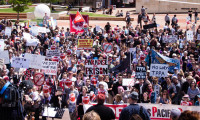
On the 29th of July, a referendum was held in Romania regarding the removal from office of President Traian Basescu. This is the second attempt of the ‘Social-Liberal’ alliance (USL) to get rid of Basescu, and it has spectacularly failed while also seriously damaging Romania’s image abroad. However, what the events of the last two months did was to finally reveal that Romania is not truly a ‘republic’ governed by ‘democratic laws’. Rather, it is governed by a shameless oligarchy of communist heritage, disseminated into all major political parties, which plunders public funds by using a feudal hierarchical system that includes mafia and organized crime.
We have shown a sketch of this pyramid in our previous article. Yet, the modern Romanian nobility, like others before it, must have immunity from prosecution or at least receive a preferential application of the law. After 1990, this was provided by the Romanian justice system, whose judges have for almost two decades failed to condemn more than a few corrupt politicians. The police and other services identified cases of corruption, bribery and fraud, yet the chances of acquittal were directly proportional with the importance of the place in the feudal hierarchy. Thus, the justice system has represented, until recently, the supreme guardian of the Romanian ‘barons’: whenever the police actually did its job well, the murky seas of the justice system could always be navigated at the right cost and with the right influence. Just as the clergy would provide the ultimate legitimacy for feudal nobles devoted to the continued wealth and position of the church.
The events around the 29th of July referendum have shown that this situation is less stable than originally thought. It all started with an event that shook the world of corrupt politicians and their associates: the condemnation, without right of parole, of Adrian Nastase, ex-prime minister, member of the Social-Democrat party and a ‘heavyweight’ in the lucrative business of extracting public funds and using them for personal gains. Even though the High Court of Cassation and Justice only gave him two years, the condemnation of such an individual set a very dangerous precedent. The actions of the High Court, combined with an increasingly potent offensive from the National Anticorruption Directorate (DNA) and the National Agency for Integrity (ANI) represent an outright heresy from the dogma of the justice system, where everyone stole and no one was condemned.
In this context, a full strategic offensive was launched by the ‘Social-Liberal’ alliance (USL) against President Basescu, who, despite a long series of gaffes and poor management of his position, had named the new leadership of the DNA and a number of prosecutors, who were both efficient and apparently impervious to blackmail. The offensive was started by parliamentary defections, which allowed the necessary majority to suspend the president. After the suspension, the prime-minister Ponta illegally appointed officials and dissolved the commission that revealed his PhD thesis was one third copy-pasted. He could not, however, remove the executives from Hidroelectrica and other giant tick-companies that feed on public funds and produce little in return. However, in order to finally get rid of Basescu, a referendum had to be passed with over 50% of registered voters.
An epic ensued, where the USL used every possible means of obtaining popular support. First, they did everything in their power to change the referendum law in order to make its decision valid on a majority ‘yes’ vote, regardless of whether 50% of voters had voted or not. When the Romanian Constitutional Court, backed by the West and reminders of democratic commitments, did not approve this, they started a mass-media bombardment that bordered between the hilarious and the grotesque. They publicly made declarations in which they accused western leaders of interventions in Romania’s internal affairs, forgetting the EU treaty commitments and Romania’s hopeless dependency of western financial aid. In the campaign, it was suspected that the vote will not be decided by the yes/no balance but by the valid (>50%) or invalid (<50%) balance. Thus, the USL even distributed pro-Basescu flyers, just to squeeze out 50% presence no matter what.
The second epic was the attempt to remove citizens from voting lists. Initial removal proposals even included Romanians living abroad, falling just short of simply stating that only pro-USL citizens can vote. Lists were changed, upgraded, or even changed after the referendum, in total disregard for legal and common-sense norms of running a poll. The media offensive reached unimaginable proportions and resembled the frenzied propaganda of the 80’s combined with a cheap south-American telenovela. Basescu was ‘the enemy of the people’, and the source of all evils on this word and perhaps others.
During the referendum, over 300 cases of fraud were observed immediately, and investigations would reveal much more. The referendum was not validated, as only 46% voted, despite a 80% majority ‘yes’ vote (for the dismissal). The KBG school of disinformation entered into action once again: The ‘people’ had voted overwhelmingly against the president but had been defeated by the system. Ion Iliescu, the ancient Bolshevik whose long shadow still lies on Romanian politics, stated that the will of the people and 7 million votes cannot be ignored (!). He also described prosecutors investigating frauds as ‘hordes of a ferocious primitivism’ who abuse the democracy-loving citizens. Comrades Gorbachev and Kryuchkov would have been proud.
As it turned out, many poor people in the countryside had been convinced to vote yes by the local (USL) mayors, and many votes were simply bought on small ‘offerings’ from the local USL party office, such as bags of potatoes or small amounts of free construction material. The level of fraud, however, was immense. The DNA stated that the general secretary of the ruling Social-Democrats, Liviu Drangnea, used at least 10 different methods of fraud, including (very) mobile urns, fake lists, imaginary people and votes from people without voting rights. The full scale of fraud is yet to be revealed but it is certainly huge.
During the summer, the USL has done it all: fraud, bribery, obstruction of justice, breaching of democratic commitments, breaching of citizen’s rights, plagiarism scandals, cheap TV propaganda and even naming an anti-Semite minister while criticising the U.S. and E.U. leaders. This hopefully shows what a severe threat the feudal system faces, making it willing to go to any length to keep the status quo.
The real battle was never about the president. It is about destroying the heresy: those institutions and people that upset the balance and started to make progress in the war against corruption and organized crime.
About the Author