
Whilst almost every sovereign state has, to some degree, embraced the progress of the 21st century, the DPRK (Democratic People’s Republic of Korea), by its own volition, has isolated itself from the rest.
DPRK remains trapped in a bizarre time warp, with military marches and parades from an era that has now passed into the annals of history. Its government propaganda, mass surveillance operations, and imagined perpetual conflict conjures up images of Orwell’s 1984. Whilst this sounds rather amusing from a superficial glance, North Korea’s continued flouting of international rules and norms is a perennial irritation to the regional powers, and to the United States.
The most recent example of this is the imprisoning of three American citizens for alleged crimes. This is by no means the only infraction the regime has committed. In 2010, it sank a South Korean Corvette warship, killing dozens on board. Later that year, it fired barrages of artillery at a South Korean island, taking the lives of two civilians and two soldiers of the South’s Armed forces. In 2009, it kidnapped two American journalists.
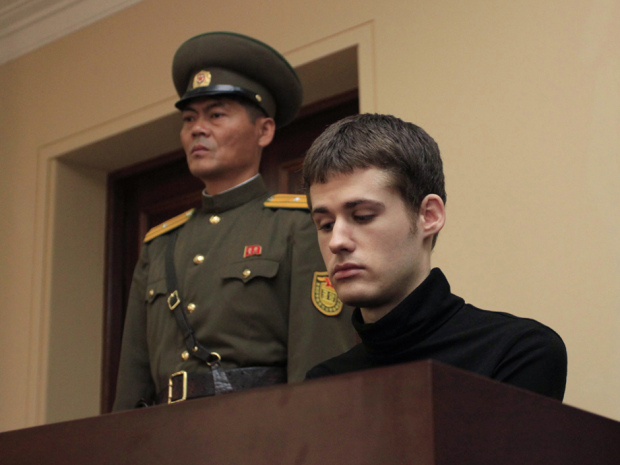
Matthew Miller, a U.S. citizen, sits on the dock at the Supreme Court during his trial in Pyongyang, North Korea. Image Credit: National Post via Associated Press
Provocative behaviour
These instances garnered the attention of the international community and this, it seems, is no different. An article by CNN last month hypothesised that the three men would be used as ‘bargaining chips’ to have the U.N. Sanctions that were imposed, lifted. This type of bartering is not a unique instance: in the past, it has used the threat of its nuclear weapons programme to illicit food aid; In exchange for supplies, it would freeze its atomic ambitions. After all, its isolation has left millions of its people starving and they cannot go forever without food.
Fast-forward back to the present, and the United States must once again confront North Korea’s provocative behaviour. However, U.S. attention, if one judges by news reports has been rather tempered. A google search of ‘Barack Obama’ and ‘detained Americans’ in the news tab, demonstrates this. The current news at the time of writing appears to be focused almost solely on the current Middle East crisis, and the volatile situation in Hong Kong.
Does this mean that the US has abandoned its citizens to meet their fate? No.
On a recent trip to Asia, Glyn Davis, special representative for North Korea policy, was spurned by North Korea on the topic of the American prisoners. Perhaps, then, this is an indicator that the regime will not use the detained men to barter for resources or for negotiations. However this seems unlikely given past crises and other related situations.
North Korean behaviour has always been rather volatile, often hyperbolic, and bizarre. It likely facilitates their propaganda efforts that they are able to bend the Americans, to their whims. Therefore, it is likely that they will end up using the prisoners to their benefit, it is just a question of when, rather than if.
Another question that might arise from this relates to the ethics of using prisoners to get what they want. North Korea’s isolation leaves it with few options; its economy is stagnant, the United Nations enacted stringent sanctions that are further crippling it. Secondly, as a sovereign state, it is acting in accordance with its national laws. The US citizens have purportedly broken them, and are being dealt with accordingly by the North Korean legal parameters. Another argument could well come in the form of a criticism of the United States for having allegedly used detainees as tools for bargaining during the War on Terror.
Pawns for political gain
Contrastingly, North Korea has arguably detained these people on scant evidence, for actions that are, at worst, misdemeanours elsewhere in the world. It is possible that using prisoners as bargaining chips violates international law. Finally, human beings are, according the the UN Declaration of Human Rights, born with inalienable rights. Life, freedom of speech, belief etc. They are not commodities to be bartered with and traded. Treating humans like pawns for a political gain is a violation of these universal principles to which we are all supposedly born.
Nonetheless, from a purely practical standpoint, it is doubtful that this will gain DPRK the affections of its opponents. However, it will again force the United States to confront the North Korean leadership. In essence, it is par for the course again on the Korean peninsula.
All in all, it is quite likely that in the next few months we will witness the North Koreans negotiate with US officials or distinguished statesmen for the release of the men. They will want something in return, as is the norm in these kinds of negotiations. The ethics behind this are up for debate, but, regardless: the DPRK will not be assuaged from using people for personal gain.
About the Author