
Mainland Chinese activists are skirting censorship and risking arrest to publicly declare their support for pro-democracy protesters in Hong Kong.
At least 34 people have been arrested as of October 6, and seven of them are artists from the Songzhuang art centre in Beijing. The arrests began after Hong Kong students debuted a class boycott to demand genuine democratic elections on 22 September.
Peaceful protesters have camped out at a massive sit-in in Hong Kong’s financial district for more than a week, calling on China to scrap its requirement that a largely pro-Beijing nominating committee select the candidates in the city’s next chief executive election. To prevent information on the pro-democracy movement, dubbed Occupy Central, from spreading to mainland China, major social media platforms, including WeChat’s public platform and Sina Weibo, have been under heavy censorship.
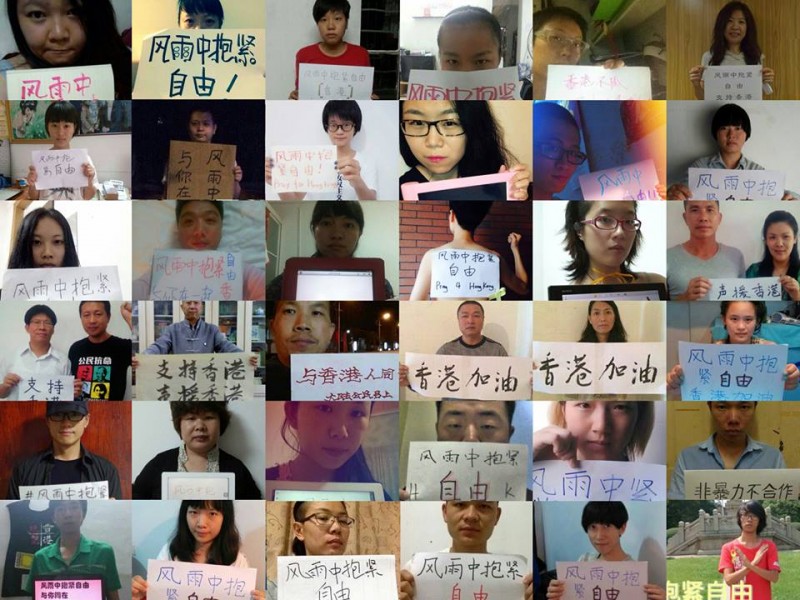
Netizens from mainland China show their support for Hong Kong’s democratic protests by publishing photos with messages of solidarity on social media. Image Credit: Facebook page “Mainland Supporters.”
Wang Peng alerted his friends on Twitter to the arrest of poet Wang Zhang, tweeting a photo of the poet posing in front Taiwan’s national flag and showing his support for Hong Kong’s so-called “umbrella revolution“:
https://twitter.com/wangpeng89/status/517856086993674240
Please pay attention! Poet Wang Zhang was arrested by the authorities at around 11 p.m. on October 1 because of his activism and recent support for Hong Kong. Around 6 or 7 police officers and national security guards raided his apartment at 7 a.m. on October 2. He had been out of contact for more than 24 hours.
Taiwan is a sore spot for the mainland Chinese Communist Party, which does not recognize the democratic island’s independence. Although Hong Kong enjoys a certain amount of autonomy from China, unlike Taiwan it is a special administrative region of China. Mainland authorities claim that the “one country, two systems” principle adopted in Hong Kong should be a model for the future reunification of Taiwan to China. The failure to implement a genuine democratic system in Hong Kong is a warning for Taiwanese against a closer relationship with China.
Why are mainland Chinese taking the risk to show their support for Hong Kong’s democratic struggle? Administrators of “Support Across the Border”, a Facebook page devoted to circulating information about Hong Kong’s Occupy Central in mainland China and delivering supportive messages from China to Hong Kong, explained why:
In a conversation with local Hong Kong citizens, one of the page administrators pointed out the significance of Hong Kong’s democratic development in relation to China:
Mainland Chinese from Twitter also voiced their support for Hong Kong’s pro-democracy protesters. Isaac Mao, a prominent mainland Chinese tech-blogger explained to his friend why Hong Kong needs democracy:
https://twitter.com/isaac/status/518587393008730113
@Andrew_920626 Hong Kong is close to the center of the worldwide supply chain. If we can keep its economic freedom and legal system effective, Hong Kong can be a local hub and a demo for other cities in mainland China. A democratic process is necessary to solve the problems in this society, in particular the disparity between the rich and the poor in this city. Then the young people will have more opportunities for starting new businesses. They will not need to struggle along the old tracks of this society. They will be more energetic.
@guinaigu wished that Hong Kong will be a role model for democracy in China:
@guinaigu @wenyunchao 我是广东的,希望香港的占中能够得到好的结果,我非常支持香港学生占中,香港得到胜利,大陆会民主遍地开花,如果香港这一关失败了,估计华人有排受苦受难,香港加油
— eric (@kyleclean) October 3, 2014
I am from Guangdong. I hope #OccupyCentral will have positive responses. I support the students’ protest. If the protesters in Hong Kong achieve a victory, we will have democracy everywhere in mainland China.
The idea of Hong Kong being a role model for China’s future democratic development is a huge burden for Hong Kong’s pro-democracy movement, explained one of the administrators in the “Support Across the Border” Facebook page, who felt the pressure: