
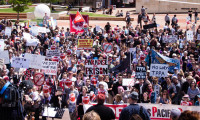
Last Saturday’s ‘March of Millions’, which took place in central Moscow, drew tens of thousands of people to protest against President Vladimir Putin, the latest in a series of protests against the current Russian government this year. The protests have been sparked by the controversy surrounding the State Duma elections last December, caused by allegations of fraud in President Putin’s re-election. Protesters, who have previously been supported by members of the opposition party and prominent critics of Putin, have called for the resignation of the president, early elections and, more recently, the release of activists who were arrested during the rally on May 6th when protesters clashed with police.
Saturday’s rally remained peaceful, monitored by 7,000 police officers and a police helicopter, and opposition leaders claimed a crowd of approximately 100,000 supporters took part. However despite optimism from some among the opposition, many of whom were heard to be shouting cries of “Russia without Putin!” and “We are the power here!”, Police estimates suggest that only 14,000 were present and Russian newspapers have reported that the rally failed to attract many supporters with support for the cause slowly waning.
Prominent critics, including billionaire Mikhail Prokhorov, former Finance Minister Alexei Kudrin and leaders of the liberal Yabloko party, have distanced themselves from the rally, citing the dominant role that groups with extreme views now have in the protests, including nationalists and left-wing radicals. In an article in The Moscow Times, Boris Kagarlitsky suggests that the situation has resulted in a ‘stalemate’: “The confrontation with the authorities will continue, but the opposition has exhausted its political resources. If it repeatedly stages the same type of rallies, it will only lose popularity and influence.”
Amid the other issues faced by Russian citizens, increased gas and electricity prices, problems in the education system and job losses, the protesters cries may now be falling on many deaf ears, especially as there has been little change since the first rally in December. Even attempts by the event’s organisers to encourage support by mentioning the socioeconomic demands of the population have failed to bring in new support as many want concrete promises of change rather than slogans and placards.
Vladimir Milov, politician and opposition figure, has counselled against repeat protests, describing them as “senseless” and emphasising the importance of new focus on the October 14th regional elections. The elections, which will be monitored by web cameras and broadcast live on the internet, are to take place in 73 of the 83 regions and are expected to have a high turnout. They have, however, already attracted criticism since the government’s decision to close the Moscow office of USAID, the US Agency for International Development, which was reportedly funding opposition parties. Alongside this is the suggestion that the government is attempting to make it increasingly harder for opposition candidates to file their nomination papers by insisting they are submitted with signatures from local legislators, allowing serious candidates to be excluded without appearing to ban them.
Putin’s government is evidently trying to hold on to power while at the same time avoiding the riots and demonstrations that followed the last elections; an effort that may prove futile in the long term as, according to a poll by the independent research organisation Levada Centre, more than 70% of Russians do not want to see Putin re-elected in the future.
About the Author



[…] Square demonstrating against Vladimir Putin’s presidential inauguration at an event called “The March of Millions” were involved in clashes with riot police. Despite the fact that the route of the march had been […]
[…] Square demonstrating against Vladimir Putin’s presidential inauguration at an event called “The March of Millions” were involved in clashes with riot police. Despite the fact that the route of the march had been […]