
This is not, as some media outlets have described, “‘the Seinfeld Election,’ an election about nothing”, yet election news continues to reiterate this conception.
Midterm elections are exceptionally important, especially if voters are fed up with the complacent Congressional attitudes that led to the government shut-down that cost taxpayers nearly $2 billion in October 2013. From issues on immigration reform, LGBTI equality, the economy, student debt, climate change, foreign affairs, and the controversies still shadowing ‘Obamacare‘, these elections are pivotal to what unravels in the final years of Obama’s presidency.
The Races to Watch
In the battle for Senate control, there is a toss-up of 7 districts (AK, CO, GA, NH, IA, KS, NC), which could potentially lead to Republican control of the Senate, not only the House of Representatives. The Senate race in the mentioned states will have a national impact, particularly on the issues where Democrats and the GOP diverge and where future policy and policies in place may become at risk.

Iowa and Georgia both have open seats, with no incumbent seeking reelection in either state. Iowa’s seat opened after serial Senator Tom Harkin (Democrat) decided to retire his seat to challengers Bruce Braley (Democrat) and Joni Ernst (Republican). Braley had a substantial lead at the end of February until the race became exceptionally close in June and has stayed between 1-3 points since that time with Ernst holding a slight lead. Ernst’s lead would be one of the toss up races that would go towards giving the GOP Senate control, as well as putting their divergence on the issue of stem cell research at potential risk. Ernst’s personal opinions would give legal rights to fertilized eggs, which in turn would have impacts on abortion rights, stem cell research, as well as the In Vitro Fertilization procedure, amongst other medical research. Braley takes the opposing view, strongly supporting stem cell research and its potential that could help further medical advances. They diverge on other issues from minimum wage (Braley supports a raising the national minimum wage; Ernst opposes the decision on a national level, believing it should be left to respective states), refinancing student loans, gun control and green issues, each leaning towards their party’s agenda preferences.
In Georgia, another state with an open seat is leaning towards another vital GOP win in the battle to gather majority in the Senate. Republican David Perdue has had a lead during much of race since August, currently 2.2 points ahead in the polls, against Democrat Michele Nunn, who has trailed behind Perdue for much of the campaign. Georgia, a typically Republican state, is likely to go towards the GOP, although Nunn has been considered a Democratic hopeful considering the close race between the two thus far. Perdue has a strong commitment towards issues such as the national debt, Fair Tax reform, the U.S. Israel relationship and repealing ‘Obamacare’ . The major issues of divergence are on minimum wage increase (Perdue against, Nunn for), gay marriage (Nunn personally for however should be left to states, Perdue against), government action for green issues (Perdue against, Nunn for), restrictions for abortion (Perdue for, Nunn against), as well as a range of other issues on the national agenda.
Alaska, another toss up, appears to have a GOP lead with Dan Sullivan(R) about 2 points ahead of incumbent Mark Begich(D), according to RealClearPolitics. This appears to trend to Colorado’s race with Democratic incumbent Mark Udall, whose opponent, Republican Cory Gardner, leads by about 2 points in the polls. Although both elections are up in the air until the results of election day and difficult to call even with early voting results.
The GOP has much of the advantage in these four states (IA, GA, AK, CO) to take majority control of the Senate, which requires 51 states to gather majority. The right has four more seats in the Senate that are safe compared to Democrats 38 safe seats; polling would have the Republican’s with ‘likely’ or ‘leaning’ right adding to 47 GOP states versus 45 states with the seven additional ‘likely’ or ‘leaning’ left. To secure a Republican takeover of the Senate, they would need to keep their lead in all four, which are only slightly leaning right.
North Carolina’s incumbent, Democrat Kay Hagan, is also in a close race against Republican Thom Tillis this election. Hagan has followed the Obama and Democrat party’s agenda, which has its unpopular following, although opponent Tillis appears to have a likewise unpopular following as House Speaker. Kansas has the only toss up Independent candidate on the ballot, Greg Orman, running against Republican incumbent Pat Roberts, with Orman keeping a very narrow lead against the incumbent. In the battle to take over the Senate, Orman is still likely towards the right, as Kansas is a typically Republican state. Lastly, New Hampshire incumbent Jeanne Shaheen (D) has just managed to keep a narrow lead over Republican candidate Scott Brown, who lost his Massachusetts Senate seat to Elizabeth Warren in 2012.
The current polling results appears to give the GOP an advantage and likely to takeover the Senate. Democrats have fought hard to maintain seats this campaign season, bringing in former President Bill Clinton and potential 2016 Presidential candidate Hillary Clinton to speak on behalf of Democrat candidates, speaking in New Hampshire in support of Shaheen and Governor Maggie Hassan just two days before Election Day.
The Senate, responsible for creating the laws, has been a hub for dysfunction between the GOP and Democrats throughout President Obama’s terms, with infamous filibusters such as that of Ted Cruz (R-TX), to defund ‘Obamacare.’ The respective parties can understand the importance and necessity to win in these elections, particularly seeing how they will frame the issues for the 2016 Presidential Election.
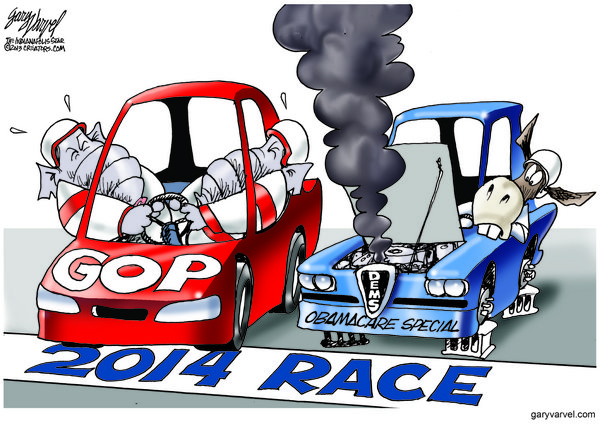
Approval ratings for Congress sat at 15% a couple months ago, in reality there probably should be more states that are toss-ups. A GOP Senate takeover would be a substantial shift and certainly have implications for how the rest of President Obama’s term will unfold. The no-action attitude that has plagued the image of the Congress may finally shift into more progressive attitudes that are willing to reach across the aisle in order to avoid low approval ratings and to boost party image.
The Republican image has been tainted with some severe criticisms. They need the ‘Hunger Games’ attitude to regain control of their public image as well as to swing public opinion towards the right, especially if they hope to find a popular Republican candidate for the 2016 Presidential Elections.
This is not an ‘election about nothing’. These are the Hunger Games elections where only one party will come out ahead. These are the elections to fight for party control and the GOP seem likely to win it this term.





