
What is identity?
Identity is the internalized reality of an individual or a group which constitutes their most intimate self-perception. In a modern secular democracy, it is imperative that the state takes identities into account and follows a policy of comprehensive inclusion. However, in the effort towards nation building, this pressing need is often deliberately ignored, as states attempt to homogenize different lived experiences of citizens or communities.
How is it protected?
The most common misgiving that prompts such homogenization is that if cultural diversities are encouraged, dissident voices will shake the very foundation of national unity. But history has categorically proven this fear unreasonable and unfounded. Whenever and wherever minorities have felt excluded or neglected, or their existence has been threatened by either fiercely assimilationist projects or by state-sponsored purposeful neglect, deprivation has caused them to rise up, often in arms, against state machineries. This has made multiculturalism a deeply felt need to foster development and internal cohesion in socially diverse societies. Liberal democracies, despite having recognized this, have often displayed an overt bias towards the majority culture, thereby promoting a limited and often superficial multiculturalism to keep dissent at bay.
But such has failed to serve its intended purpose. Minority cultural identities have suffered invisibilization, neglect and deprivation as majority cultures have been allowed to establish their hegemonic supremacy, leading to the creation of a rigid hierarchy of religious-cultural identities within a heterogeneous society. Such hierarchical stratification has led to an inflexible system of domination and subordination which has disrupted social peace and equality. Thus, it becomes an obligation on the part of states to effectively dismantle such hierarchical arrangements to open up spaces where equality can only be compromised for equality’s sake. It is primarily with generous help from the state that minority interests can hope to be articulated in the national agenda, following which affirmative actions are taken to render credibility to multiculturalism. The 21st century has made the world more globalized than it ever was, promoting heterogeneity in the most obdurately unvaried of spaces. Thus, multiculturalism is in the very cultural logic of globalization. However, inconsistencies bred within states’ political structures have often rendered ‘multiculturalism’ highly suspect.
Multiculturalism and immigration
The problem of immigration is most closely related with the politics of multiculturalism. Diasporic narratives often reflect identarian crises of immigrants. They bear the baggage of their unique historical specificity, cultural tradition and ways of life which are, more often than not, in contradiction with the majority cultural ethos of the country they have settled in. The difference is manifested in their interaction with the majority. As states pursue assimilationist agendas, such difference is rendered unimportant for purposes of nation building. Deliberate oversight creates more trouble. An immigrant who was not acutely sensitive of her cultural, socio-religious identity in the home country, gains a heightened sensitivity in the face of the threat posed by assimilationst manoeuvring. Hence, immigrants when forcibly required to re-define their identity in a different cultural context find themselves vulnerable.
One needs to understand the nuances of identity construction. An immigrant identity is differently constructed in the home country than it is in the host one. An immigrant has to assert visibly her cultural difference to resist the myth of homogeneity which the host country tries to create. In this regard, the need to pursue a “politics of recognition” along with the “politics of difference” is strongly felt. Difference becomes a subject of recognition. As immigrants or minority identities are subjected to frequent, and often deliberate, misrepresentation, subjugation, ostracization and the indignity of invisibilization, the “politics of recognition” becomes an effective tool to promote multiculturalism. Through the constant affirmation and re-affirmation of cultural plurality, the politics of recognition tries to destabilize the notion of the ideal citizen as Caucasian, upper class, heterosexual male in Western liberal democracies. Mainstreaming of citizen identity is resisted to preclude the possibility of cultural injustices. For this, group or collective visibility of minority identities becomes significant. Communitarian ideology is often privileged over individual rights to pursue identity politics in a heterogeneous cultural context. However, territorial space to different ethnic/racial/religious minorities cannot be adequate ground to believe a state’s identification as multicultural. As long as in the policies of the state, diverse identity interests do not find articulation, the mere presence of intra-state cultural plurality does not imply multiculturalism. It becomes important to examine how a heterogeneous society deals with cultural pluralism and what status is afforded to its minorities and their cultural identity. This opens up the dichotomy of cultural diversity on the one hand and multiculturalism on the other. The latter does not necessarily follow the former. It cannot be stressed enough that the mere presence of a substantial minority does not confirm the utility of multiculturalism when they are dissociated from their cultural identity. Thus, the need for the validation of cultural plurality by the state is the most important in building a multiculturalist state.
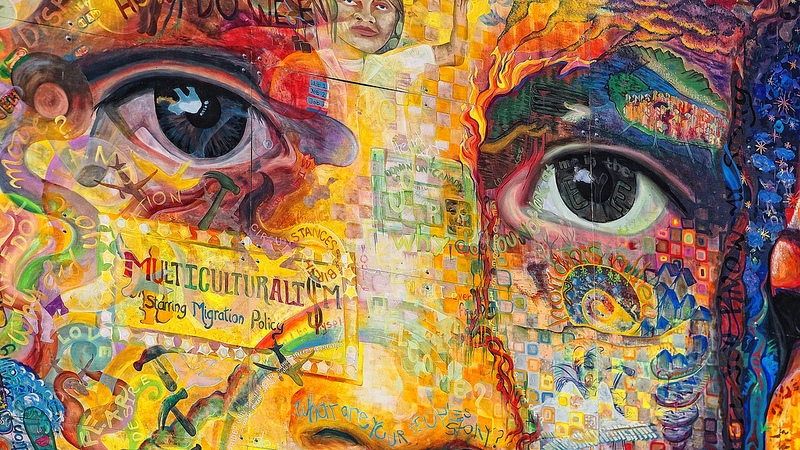
Image Source: Straight.com / Nattawot Juttiwattananon http://www.straight.com/blogra/499376/photo-day-vancouver-multiculturalism
Secularism
For the success of multiculturalism, secularism has been rendered unavoidable. However, identifying the variety of secularism which secures multiculturalism is important. Religion is so deeply enmeshed in the socio-political life of a state that a secular framework which tries to invisibilize all religious identities in the public domain to foster a false sense of unity proves to be catastrophic. On 18th September, 1989, three female students were expelled for refusing to remove their hijab in class at Gabriel Havez Middle School in Creil. In 2004, France passed a law banning religious symbols in schools including the hijab and turban. Sikh students were expelled from state run institutions in France for wearing the turban. This left little scope for multiculturalism in the public life in France. France’s secularism is rather unproblematized. When individuals are not allowed to display their unique cultural or religious identity in the name of secularity, it threatens the existence of multiculturalism.
However, the Indian variety of secularism does not displace multiculturalism from public space. The secularism in the Indian constitution seeks to harmonize all religions into a peaceful co-existence rather than exclude all religious differences from public discourse for the sake of a discomforting uniformity. However, in the recent past when the famous Shah Bano case was being widely debated across India, the Supreme Court of India expressed its regret at the Uniform Civil Code (UCC) remaining a non-justiciable ‘directive principle’ in Art 44 of the Constitution of India. This revealed a homogenizing tendency of the Indian judiciary which so far has been resisted since India being a richly heterogeneous society cannot afford such homologous tendencies. UCC is unwanted.
However, in Pakistan, since the state is mono-religious, assimilationist agendas have often launched violent attacks on minority identities. The French resistance to multiculturalism is different from Pakistan’s resistance of the same. There have been numerous reports of minority Hindus and Christians in Pakistan being forcefully converted to Islam for the sake of an absolute cultural and religious homogenization. This brand of resistance to multiculturalism does not tolerate religious plurality even in private spheres as the French system does. The line between private and public has been obstinately blurred for the sake of preserving the sanctity of one particular religion. This is the most potent threat to multiculturalism, one that, for the sake of a national identity, denies to citizens the liberty of self-definition by imposing on them an identity external to their existence, with the hope that they would somehow be compelled to internalize it.
Challenges facing multiculturalism
Multiculturalism is tolerance. It proposes to provide dignity to all citizens regardless of their different shades of identity.
However, in the acceptance of uncritical multiculturalism, some grave problems arise. Liberals argue that primacy of individual rights over group rights is unacceptable. Since multiculturalism has to be reached through communitarianism, uncritical communitarian ideologies can pose great threat to the idea of justice and human rights. Just because an ideology has been part of the cultural heritage of a community, it may not necessarily be just or acceptable. Communitarian cultural identities have often been found to compromise individual rights, especially women’s rights. Communities are patriarchal units which, in the name of their unique cultural authority, control women’s bodies, their mobility and their right to independently imagine for themselves a future and a present they are comfortable with. The individual cannot be made secondary in a multiculturalist debate. The individual therefore has to be made the center of all discourse and debate, and this is the most common argument coming from the liberals.
However, what constitutes an individual must also be made a subject of scrutiny. Treating the individual in isolation of their socio-cultural moorings is usually a naïve venture which cannot stand up to scholarly inspection.
This creates a paradox. In a world where organized religions, communities, cultures tend to frequently disrupt peace and stability, the aim of any deliberation should revolve around how to subvert dominant identities. It shouldn’t be done for the sake of homogeneity but to create a world where individual destiny is not shaped by the fortune or misfortune brought about by identerian constraints. What identity an individual grows up with is a socially assigned truth. How far it should go in deciding not only an individual’s destiny but also the political structure of a state and that of the international community is one of the greatest debates of our time.
About the Author






ASIA FOR THE ASIANS, AFRICA FOR THE AFRICANS, WHITE COUNTRIES FOR EVERYBODY!
Everybody says there is this RACE problem. Everybody says this RACE problem will be solved when the third world pours into EVERY white country and ONLY into white countries.
The Netherlands and Belgium are just as crowded as Japan or Taiwan, but nobody says Japan or Taiwan will solve this RACE problem by bringing in millions of third worlders and quote assimilating unquote with them.
Everybody says the final solution to this RACE problem is for EVERY white country and ONLY white countries to “assimilate,” i.e., intermarry, with all those non-whites.
What if I said there was this RACE problem and this RACE problem would be solved only if hundreds of millions of non-blacks were brought into EVERY black country and ONLY into black countries?
How long would it take anyone to realize I’m not talking about a RACE problem. I am talking about the final solution to the BLACK problem?
And how long would it take any sane black man to notice this and what kind of psycho black man wouldn’t object to this?
But if I tell that obvious truth about the ongoing program of genocide against my race, the white race, Liberals and respectable conservatives agree that I am a naziwhowantstokillsixmillionjews.
They say they are anti-racist. What they are is anti-white.
Anti-racist is a code word for anti-white.
Share it now. Like it while you’re at it.