
27 year-old Nixiwaka, originally from the Yawanawá (translated to “People of the Wild Boar) tribe in Brazil’s Amazon, now lives in London where he works hand-in-hand with Survival International; their collaborated efforts aim to raise awareness of the rights of Brazilian Indians.
Nixiwaka’s talk at London’s School of Oriental and African Studies (SOAS) reminds us not only of the need to return to basic pleasures and to reconsider our own values but, most importantly, to use our platform and rights to fight for the beliefs of the less privileged:
“We [Yawanawá people] feel happy even though we don’t have money but we feel happy because we have our land, water and our community that gives us a life and our freedom.”
What Nixiwaka’s talk evokes is a self- reflection on why many of us find it so hard to accept the rights of minority groups: does accepting another ethnic group mean more than just tolerating them?
Economic rights over legal protection
His community is located towards the West of Brazil, neighbouring Bolivia and Peru. When the borders dividing the three regions were constructed, many indigenous groups found themselves forcibly pushed to evacuate and to continue their lives elsewhere. Brazil, a fast growing economy, has continued to prioritise development projects and policies over the protection of indigenous peoples. As one of the BRIC countries, economic rights have found themselves ahead of political rights that ensure the legal protection of ethnic groups across the country.
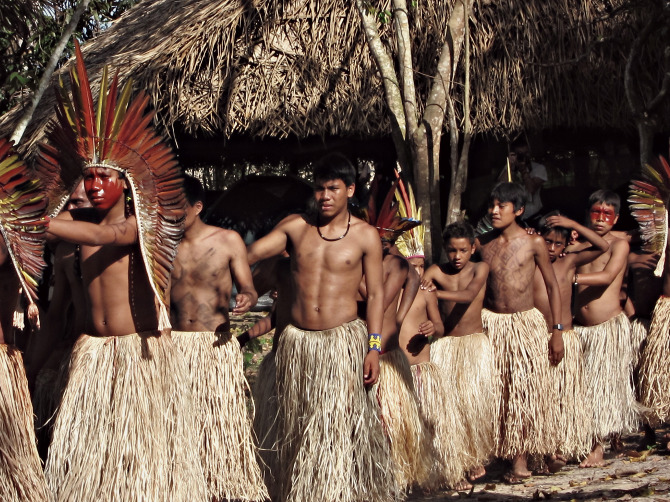
Yawanawá Festival. Image Credit: cargocollective.com
The increase in the number of ethnic groups that communicate in Portuguese, Brazil’s official language, is a common example of globalisation. As a young child, Nixiwaka was brought up learning to speak both Portuguese and the Yawanawá language. Now, with the ability to communicate in Portuguese, the younger generations of some groups have started to migrate to larger cities with the wish to pursue further education and the chance for greater career opportunities. Exposed to the luxury and hedonistic lifestyles in larger cities, some teenagers have decided to either forget their own culture or to cut off contact with their original tribes. Discrimination and inequal treatment between city and rural residents is also a major problem in Brazil, arguably an explanation for why many decide never to return to the Amazon.
Loss of identity
Nixiwaka’s decision to move to London in 2010 was a marking moment for both him and for the Yawanawá people. It confirmed his decision to accept Western culture, whilst preserving his own identity. From a country of over 300 tribes, in total communicating in over 180 languages, losing one’s identity through culture, language, food is most frightening if not increasingly common. Just after his great grandfather made the first contact with outsiders, the Yawanawá people collectively decided to start learning from the outside world. Though the first contact was successful, the second was less stable, killing many from the spread of the common cold.
With this opening mentality, the Yawanawá people now have access to the internet and social media platforms, and are willing to accept western constructs such as motor engines and guns for hunting. Even Shamans are willing to go to cities to get better treatment when natural remedies fail. But the stress of limiting Western culture is still dominant within the community. In fear of the past repeating itself, including the excess consumption of alcohol, drugs and reliance on modern technology, foreign influence is still very much limited within the Yawanawá community.
“Western influence is very strong. If we accept it completely, it can kills us, it can kill our soul and it can kill our culture.”
The Yawanawá people have continued to turn to nature and their inner feelings when they feel a lack of belonging.
Every year from October 25-30, the Yawanawá people open their doors to visitors from across the world. Having won their rights in the 1980s, the Yawanawá are a success story among ethnic minority discussion. But this is not the case for all existing indigenous communities. “Many have lost their culture, but we have not lost ours.” Being granted rights from Brazil’s constitution is often extremely difficult and time-consuming. The Awá people, another ethnic minority in Brazil’s Amazon, were only given their rights this year after 57,377 letters were sent to the Ministry of Justice. The government then sent the military to drive out illegal lodgers inhabiting the Awá peoples land. Many isolated tribes still exist in Brazil, unwilling to make contact with the outsiders. But even those open to foreign contact are not given the equal representation by associations or the Brazilian government.
Living in a metropolitan city like London still poses challenges for Nixiwaka. “A year after moving to London I felt a calling from my people, I knew I had to help them through my presence in England.” Coming to London and learning that people do care about the rights of indigenous peoples was a major shock for Nixiwaka. But the truth is, there are still many people across the world who will continue to disregard the rights of minorities. With the increase in investment into production in Brazil, many companies look to buy up large masses of land for sugar cane or soya plantation. In Brazil like many existing states, large bundles of cash in exchange for land are not rare. The increase in land being sold to external companies has simultaneously led to a rise in ‘homeless communities’. Forced to move elsewhere, photos of tribes living under tents alongside Brazil’s rural roads are a true indicator that indigenous peoples rights will continue to be threatened, as long as Brazil’s voters are more concerned with economic rights over political influence.
Poor media presence
Discussions on ethnic minorities are still ill-represented in the West through media but also among our own communities. Although their problems may seem alien to us, similar issues including the disparity of treatment within migrant communities or the unequal representation of certain ethnic groups even in Britain today are still very common. As said by Nixiwaka:
“Governments will only change if they are pressured by the people.”
The bottom up process of pushing for reforms whether it is for indigenous peoples or for another cause is a lesson that we can all take from Nixiwaka’s talk. Accepting means more than simply tolerating. Accepting another culture requires a degree of open-mindedness and willingness to exchange ideas and values. Survival International, along with Nixiwaka, is an existing example reforms to protect these groups are possible. But the key lies in accepting before protesting.
About the Author





