
Since last summer, El Hierro, in the Canary Islands, is the first island in the world with a project working to make it energy self-sufficient. A hybrid hydro-wind generation system is currently working to provide the island with electricity and water, and to eliminate CO2 emissions.
In the 1980s, a few engineers came up with the idea of making El Hierro an energy ‘clean’ island, by developing a system based on renewable energy that would reduce CO2 emissions. Thirty years later, five wind turbines and a small hydroelectric power installation have begun to make this possible.
The renewable power plant started working during the summer:
“In July, the plant produced around the 8 per cent of the total energy for the island. Currently, we get almost the 40 per cent of the electricity from it. Once the contract will be signed with the expert company Endesa, we expect the productivity to grow a lot more,” said Alpidio Armas, president of El Hierro island council.
At the moment, the traditional heating plant is still working to complete the rest of the 60 percent of electricity that El Hierro needs.
“We want to provide electricity coming from natural resources, but also water. In order to do that, we are using the energy from wind to also make work desalination plants. This way, we are building a closed circle where all the parts work with renewable energy as well as all the resources we provide to our people, like water and electricity,” said Armas.
The project cost 80 million euros and was funded by El Hierro’s regional council, the Spanish national government and the European Union. It will be worth the investment in around 20 years, according to El Hierro’s council. When at full capacity, the plant will be able to produce up to 11 watts, while the whole population of El Hierro, around 10,000 people, uses less than eight watts. Given the depth of the surrounding ocean, this energy cannot be transported anywhere else.
How the plant works
The way the new plant works is very simple: Five wind turbines generate energy which is used to produce electricity and to desalinate water. At the same time, this water is stored in the new and elevated 500,000 cubic metre container and will be released into turbines when the wind is not strong enough to provide the necessary electricity.
Likewise, when wind generation is too high, the energy will be kept in a hydroelectric power installation. In the case of renewable energy not covering all electricity needs, El Hierro will continue to use its plan B; the traditional heating power plant.
Dolf Gielen, Director of IRENA Innovational and Technology Center (IITC), said:
“El Hierro is a very interesting case. The island has excellent wind resources, and it has a volcano. The volcano caldera can be used for a pumped hydro installation. Not every island has this combination. In fact it would apply to just a few islands.”
Either way, such an island could not be self-sufficient with just wind energy because of its geographical condition. As such, it is necesary to make a plan bringing together different kinds of energies. In the case of El Hierro, scientists were able to create a plan eventually to become independent from petrol by tusing heir natural resources like water and wind. But what about in other parts of the world?
Would a project with 100 per cent renewable energy be possible?
Wildpoldsried, a German village, and Samso, an island between Denmark and Sweden, have also been successful in their own projects of being energy self-sufficient. These small towns have their own projects based on sun energy, in the case of Germany, and a mix of water, wind, biomass and sun energy, in the Nordic island.
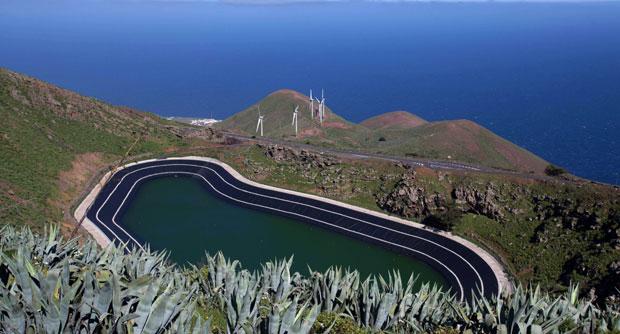
General view of the upper reservoir of the Gorona power station on the Spanish Canary island of El Hierro on March 28, 2014. Image Credit: Lifestyle.inquirer.net
The possibility of developing new projects that use 100 percent renewable energy seems realistic based on these examples. But would it still be possible on a bigger scale? Do we have the solution to reduce CO2 in the main areas where pollution is rife?
Emanuele Taibi, Island Roadmaps Analyst at IRENA Innovation and Technology Center, said: “El Hierro is a Lighthouse in terms of building technical expertise in operating small island systems based on high shares of variable renewable energy.”
Alpidio Armas said that El Hierro’s project “could be also developed in other areas with strong wind and at least 700 metres slope. Under those two conditions, any continental territory could build a renewable plant like ours”.
Scientists said that it is “still not clear what sustainability is for small islands or what is the best approach to achieve it”. However, Juan Gil, chief engineer of the renewable power plant, said “the way both plants work is exportable”.
About the Author





