
The past weeks may have erased in part the legacy of the hard-fought Egyptian revolution of 2011. The decision by the Egyptian judiciary to clear the former president Hosni Mubarak and members of his regime of the deaths of 846 protesters has made clear that the events of January 2011 did not lead to a true revolution. A true and lasting revolution would have signified the overthrow of a government or regime and its replacement with a new system. What happened in Egypt was the ousting of an authoritarian ruler and several of his key supporters. There was no significant reform to the legal and political framework that would continue to restrict the civil liberties of Egyptians.
The court decision was not a review of the evidence but rather a rewriting of the events leading up to the mass demonstrations of January 2011 in order to frame them as a conspiracy. According to the judge, the plot was supposedly orchestrated by the Muslim Brotherhood and the “axis of evil of the United States, Qatar, Turkey, Israel, and Iran.” In essence the verdict blames everyone but the state actors and the institutions that facilitated violence against civilians. The hard truth is that the outcome of the trial was likely set in stone the moment Mubarak’s first conviction was overturned by a higher court in 2013. Since then evidence has been lost and the drawing out of the trial for three years led to a decline in public interest in its outcome.
A fundamental reason that the trial was doomed to acquit Mubarak is due to the unchanging nature of Egypt’s institutions in spite of mass mobilization in 2011. Though Mubarak and several key individuals of the security forces were arrested, the institutions that failed to protect Egyptians, and that contributed to their repression, remained in place. Amnesty International’s 2012 report recommended that Egyptian authorities “conduct full, impartial and independent investigations into all cases of human rights violations taking place in the context of the 25 January revolution” in order to restore the trust of the Egyptian public in their institutions.
This did not occur and now Egypt is stuck in a vicious cycle; without reform to its institutions, political figures who are suspected of crimes against humanity will never face a fair trial and without a fair trial of the institutions themselves, reform is unlikely.
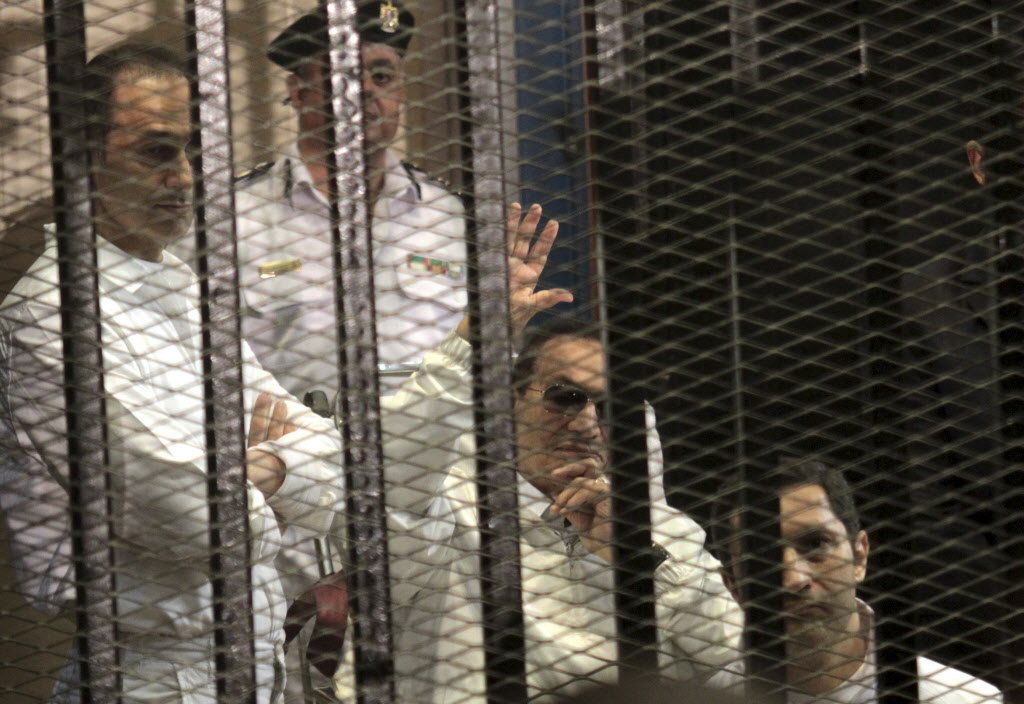
Image Credit: Cleveland / Tarek el Gabbas, Associated Press http://bit.ly/1BPDviP
Both presidents of Egypt following Mubarak’s overthrow, Mohamed Morsi and Abdel Fatah al-Sisi, have made clear the lack of progression of Egypt’s civil liberties. Since Mubarak was ousted journalists have been imprisoned, over 500 Morsi supporters were sentenced to death and a political party (the Muslim Brotherhood) has been banned with most of the its leadership imprisoned. A Human Rights Watch report found that more than 1000 protesters were killed in July and August of 2013 by the firing of tear gas and of live ammunition and “identified more than a dozen of the most senior leaders in the chain of command who should be investigated for their roles in these killings, including Interior Minister Ibrahim, then-Defense Minister and current President Abdel Fattah al-Sisi, and the Special Forces head and commander of the Rab’a operation, Medhat Menshawy.” What then was achieved by the 2011 Revolution if the presidency is occupied by al-Sisi, a former member of Mubarak’s intelligence apparatus?
The absence of a conviction sets a dangerous precedent for human rights in Egypt and worldwide. It sends a message that regimes and individuals can commit crimes without fear of prosecution. In the case of crimes against humanity the main deterrent to committing abuses is the likelihood of prosecution and punishment for perpetrators. The conviction of Congolese rebel leader Thomas Lubanga by the International Criminal Court has been “hailed as a landmark in international justice and a deterrent that [will] resonate around the world.” But with such heavy influence by the military over judicial and political proceedings in Egypt, al-Sisi and security forces will feel that they can act with impunity to repress opposition.
Some say that this is the final step of the total reversal of the 2011 revolution but even before Mubarak’s acquittal the state of Egypt’s democracy was deteriorating. What happened in 2011 would be better defined as a revolt which resulted in the swapping of one authoritarian ruler for two others. In fact, Mubarak allowed a certain degree of free press during his regime and tolerated political opposition from the Muslim Brotherhood. As long as Egyptian security forces remain in a position of political power; as long as there is no civilian oversight of police and military actions and as long as there is no independent judiciary to try perpetrators for their crimes, Egypt will continue to exist in a state which is similar to or even worse than its pre-2011 upheaval. By placing the blame entirely on individuals and overlooking the role of the actual institutions of Egypt in failing to protect civilians and in injuring and killing protesters, the verdict has proven what many already knew to be true.
In order for a true revolution to occur in Egypt, its institutions including in particular the military, the police and the judiciary must undergo major reconstruction.
About the Author





Well researched analyse of a politically complicated country. Good work Eva