
Yesterday, on January 7th 2015, gunmen entered the Paris office of satirical publication Charlie Hebdo, killing 12 people, including police officers, the editor and journalists. The event marks the deadliest terror attack on France since the Algerian War in 1961. The hunt is now on for three suspects, and Paris has been placed on the highest level alert. The rest of France, meanwhile, stand in unity, holding a national day of mourning today.
The magazine had previously published cartoons depicting the prophet Mohammed in 2011, closely followed by a cover on which a cartoonist was illustrated kissing a Muslim man with the title (translated) ‘Love: Stronger than Hate’. These instances represent only a small portion of the divisive material published by Charlie Hebdo. Since this point, the magazine has received various threats and criticisms from every direction; the Muslim community to French politicians and police forces. The cover in question can be seen below.
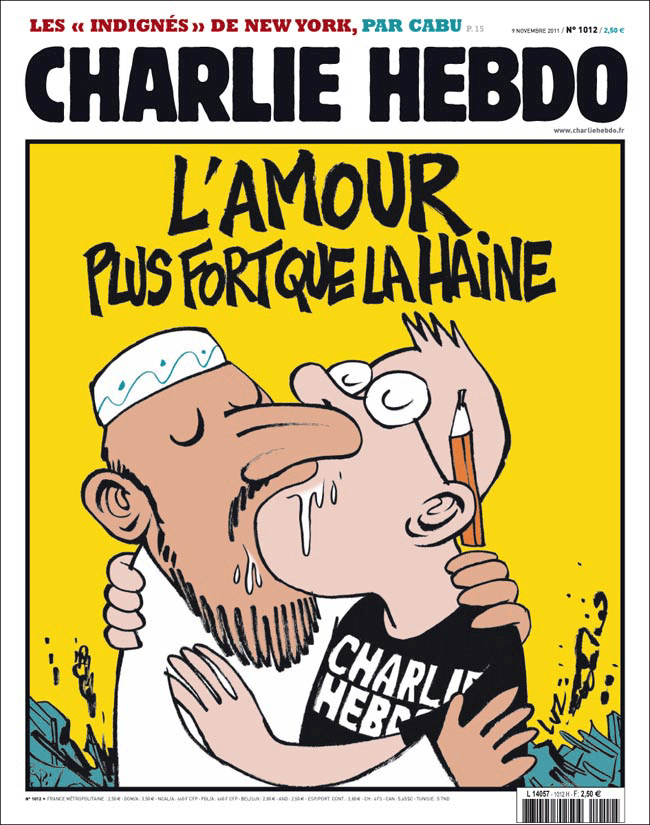
Image Source: http://bit.ly/1zUbCn5
Today and yesterday, the hashtag #JeSuisCharlie has trended on Twitter in a display of solidarity with Charlie Hebdo and those affected by the tragedy, while cartoonists across the world have reacted to the attack by producing a fantastic outpouring of images. Cartoonists Rights Network International issued a statement in response to the crisis, saying ‘CRNI encourages political cartoonists of all stripes and political persuasions all over the world to make their opinions about free speech and this particular attack known. We encourage the world’s press to show their support for free speech by republishing the very cartoons that caused this attack.’
Horrible attack.Cartoonists across the world are uniting against bloodshed and violence. @ibnlive @cnnbrk pic.twitter.com/QtTe9INeU9
— Neelabh (@NeelabhToons) January 7, 2015
The little weapon! #CharlieHebdo #cartoon pic.twitter.com/VFFZD2f8Rz
— Satish Acharya (@satishacharya) January 7, 2015
https://twitter.com/davpope/status/552844593046097920
https://twitter.com/khalidalbaih/status/552851710880653312
The outcome of the attack in terms of human loss is both shocking and tragic, and among many emerging dialogues on the event, there are a number of comments that can and should be made regarding its implications.
– The attack represents a growing international threat to our freedom of expression and freedom of speech.
– Attempts to oppress freedom of speech are not something that happen ‘elsewhere.’ They happen in every country in every part of the world.
– To label the attack and the humourless concept of offence as an ‘Islamic problem’ is, at best, an unhelpful reaction. This is not a case of Islam versus ‘the West’, and this line of reasoning propagates prejudice, ignorance and more broadly, rejects the need to focus on the wider protective mechanisms of free expression and the mechanism of offence.
– ‘Offence’ should rarely, if ever, be cited as legitimate ground for censorship. There is a need to reopen this discussion internationally in the context of journalism and media freedom.
– Humour and parody are salient tools in fair and democratic media practices. Their importance and those who practice these techniques should be recognised and protected.
– As well as being important tools in supporting the freedom of expression, ironically, modern communication systems – including social media – act as enabling devices for those who would legitimate censorship on the grounds of offence. This includes providing a platform for virtual harassment and threat, or organised protest and physical, tangible violence.
– Freedom of expression cannot be neglected or allowed to cede to threats or violence, and is a right that must be actively and positively pursued.
All citizens should have the right to information access, particularly where civil society and personal safety is concerned. This right should be protected, and the persecution of citizen journalists strictly prohibited. However, on a level broader than personal safety, societies across the world simply cannot afford to lose satire and parody as methods of communication and sociopolitical commentary. The reaction of cartoonists, media outlets and politicians across the world has been one of overwhelming strength and solidarity (save for those such as CNN), and stands as a credit to all institutions which uphold and protect the freedom of expression.
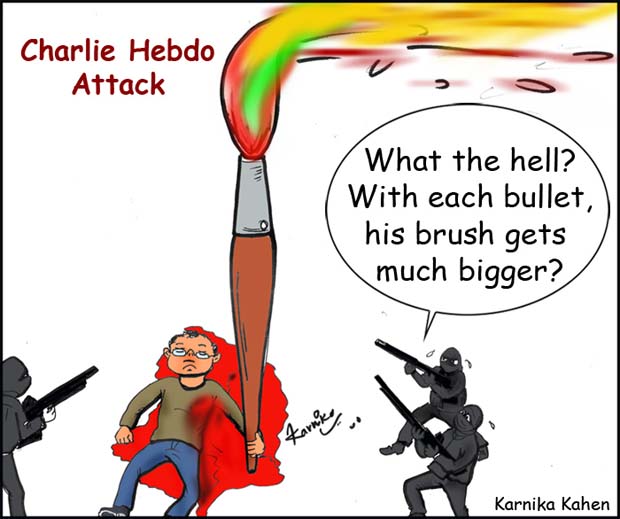
Image Source: http://bit.ly/1tPbE38
About the Author






[…] the wake of the Charlie Hebdo shooting last month, there was a particularly worrying phenomenon building momentum in the West – the […]