
The recent publishing of a report by the Senate Intelligence Committee has caused a storm in Washington, and a flurry of worldwide political and public reactions. In the wake of the revelations that the CIA, under the auspices of the Bush administration, perpetrated acts of torture, has drawn sharp, albeit hypocritical criticism from China, Iran, and North Korea. In direct contrast to this, several American politicians have criticised the report as missing out key information, wrongly painting the CIA as having been complicit in serious wrongdoing; former Vice-President Dick Cheney is a key case in point. Moreover, CIA officials themselves have stated that the report is flawed. This is an important point and it needs to be given its due. To simply ignore it because of these revelations is short-sighted at best. Nonetheless, the details of the report cannot be ignored either.
The report raises a number of questions about the CIA’s enhanced interrogation techniques – namely, did it work? In other words, did the use of torture provide worthwhile information? Secondly, who was targeted under this programme, and what were their nationalities? Thirdly, did the use of these techniques have consequences, such as increases in militant recruitment, and political fallout? Finally, to what extent did the president and congress know about what was going on? In order the answer these questions, we begin with perhaps the most important one; did it work?
If it is effective, then the use of these techniques in extreme circumstances is perhaps justified. If on the other hand, it does not provide accurate information, then it is simply pointless to use them. If its much touted efficacy is non existent, then the rationale of the programme is undermined; the central justification is in fact illusory. In direct contrast to this, the intelligence agencies have claimed that the methods used in interrogation provided essential information in preventing terrorist attacks, and more notably, assistance in tracking down Osama Bin-Laden.
The report however throws these arguments into doubt, cataloging over a dozen instances of the use of enhanced interrogation techniques being called into question. A case in point is the claim by the CIA that using these methods led to the thwarting of a dirty bomb plot, and the capture of Jose Padilla. The report seemingly throws doubt on this.
“… a review of CIA operational cables and other CIA records found that the use of the CIA’s enhanced interrogation techniques played no role in the identification of “Jose Padilla” or the thwarting of the Dirty Bomb or Tall Buildings plotting CIA records indicate that: (1) there was significant intelligence in CIA databases acquired prior to—and independently of—the CIA’s Detention and Interrogation Program to fully identify Jose Padilla as a terrorist threat and to disrupt any terrorist plotting associated with him.”
So it appears that in this case alone, not only did the techniques not provide any worthwhile intelligence, but that the information that was instrumental in the arrest of Jose Padilla was found before these procedures had even been implemented. This is a far cry from what is touted as: “one of the eight most frequently cited examples provided by the CIA as evidence for the effectiveness.” However, as previously stated, this is just one example. What about the other cases cited in the report?
One that is perhaps closer to home, especially for those who are in the UK, is that the use of these methods acquired information that thwarted attacks on Canary Wharf and Heathrow Airport in London. Successful attacks on these two locations would be disastrous for the United Kingdom; Heathrow Airport is the second busiest in the world for international passenger traffic, and Canary Wharf is a major financial centre. Destruction and/or disruption of these transport and capital centres could well have severe economic implications, as investors would be cautious about investing in ventures or travelling to places where safety cannot be guaranteed. Naturally, the most severe cost would be human life, as hundreds of thousands of people flood through these locations on a daily basis. It is horrifying to contemplate how many people would die if such a plot was successful, and it is indeed for similar reasons that the CIA justifies the use of enhanced interrogation techniques to counter this, notably saving lives. This justification though, like the capture of Jose Padilla, is, according to the report, a facade;
“A review of records indicates that the Heathrow Airport and Canary Wharf plotting had not progressed beyond the initial planning stages when the operation was fully disrupted with the detentions of Ramzi bin al- Shibh, KSM, Ammar-al-Baluchi, and Khallad bin Attash. None of these individuals were captured as a result of reporting obtained during or after the use of the CIA’s enhanced interrogation techniques against CIA detainees.”
A second instance like this might also be passed off as another outlier. After all, two ineffective cases compared to over a dozen successes would by any measure deem the use of torture as an unfortunate but useful method to obtain information. However, this is not what the summary of the report found. On the contrary “The Committee found the CIA’s representations to be inaccurate and unsupported by CIA records.” So all in all, and based upon this report, the methods don’t appear to have worked.
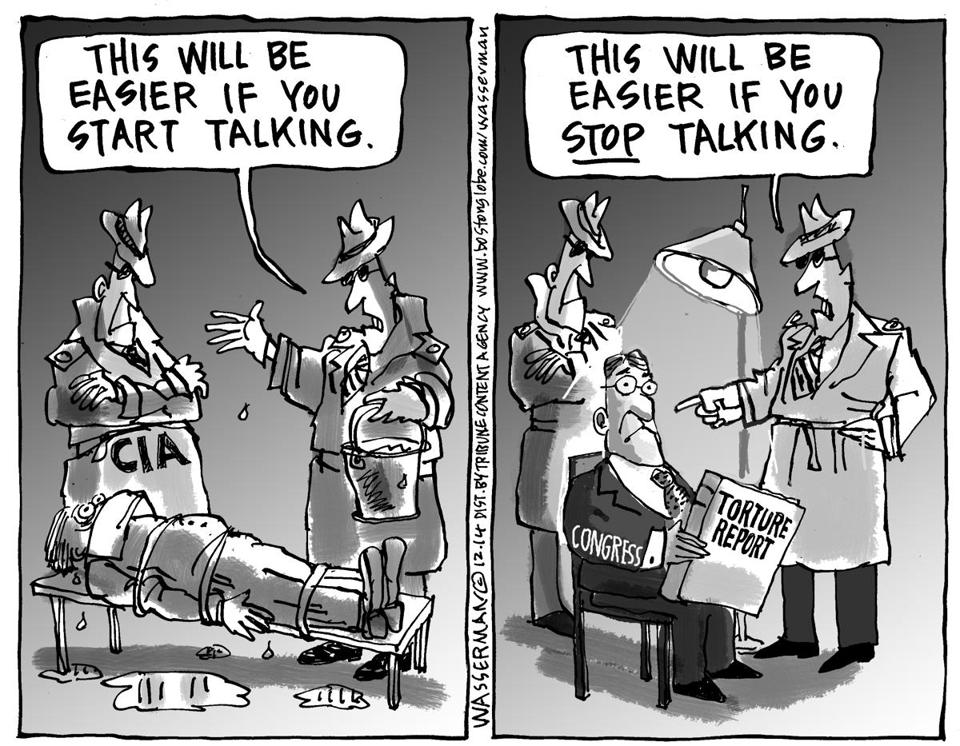
Image Source: http://bit.ly/1ylWL8l
Irrespective of the efficacy or lack thereof of torture, a second query that this report addresses is who was subjected to these techniques in the course of the CIA’s counter-terrorism operations, and their nationality. The report notes that the interrogation of two specific individuals was allegedly instrumental in the the capture of individuals and thwarting of plots, and another two likewise provided crucial information. These men were Abu Zubaydah, Abd al-Rahim al_Nashiri, Ramzi Bin Al-Shibh, and Khalid Sheik Mohammed.
Abu Zubaydah, captured in Pakistan and then subsequently rendered to a CIA Black Site elsewhere (the report does not state where as significant amounts of information has been censored), is an alleged former al-Qaeda operative, who remains indefinitely detained in Guantanamo Bay. He was born in Saudi Arabia, however, he regards him self as a ‘stateless Palestinian’. The report however, does not explicitly state his nationality, though infers it by noting his apparent denied application to join an al-Qaeda training camp that comprised of many Saudis.
Abd al-Rahim al-Nashiri was detained in the United Arab Emirates in Early Autumn 2002, and believed by the CIA to have been instrumental in the bombing of the US Naval vessel, the USS Cole. He too was rendered to a CIA detention site. Like Abu Zubaydah, al-Nashiri’s nationality is Saudi Arabian. The report does not mention this either, although it does provide hints, a reference for those who need more information is provided in the footnotes. That al-Nashiri is Saudi is particularly interesting and shows signs of a developing pattern about those interrogated.
Ramzi Bin Al-Shibh was captured around the same time as al-Nashiri, and like Zubaydah was found in Pakistan. He too received the same hospitality from the CIA as the others, rendition to a undisclosed CIA detention centre. He has been charged with the with the deaths of almost 3000 people in the September 11 attacks, and is currently interred in Guantanamo Bay. Like the others, his nationality does not appear to be explicitly mentioned, but a simple Google search reveals that he is a Yemeni citizen.
Khalid Sheik Mohammed was captured in his native Pakistan (again his nationality is not mentioned) by Pakistani officials. He was briefly held in the country and interrogated by both the CIA and Pakistani authorities. He was then, like the others, renditioned outside of Pakistan and then interrogated with the use of the enhanced techniques that were used extensively on the other detainees.
There seems to be, as previously mentioned, a commonality between these four cases. Indeed, there are two. The first is perhaps more obvious; all of these suspects came from the Middle East; Pakistan, Saudi Arabia, and Yemen are all situated in that region. The second commonality is perhaps less so. While the aforementioned countries are located in the Middle East, none of them were invaded by coalition troops in 2002 and 2003. Instead, they were from countries that were, for all intends and purposes, allied to the US, and, in the case of Yemen and Pakistan, were where clandestine operations were conducted and continue to be to this day; as those who are aware of the targeted killing programme will know. This is of course coincidental, but it is interesting nonetheless that the main suspects come from states that are US allies rather than its enemies. (For a complete list of detainees, see page 458 of the report.)
With the nationalities of the prisoners established, a third and highly important question that relates to the purported effectiveness is whether the use of such methods was in fact detrimental to the US and its allies. The report concluded that the methods:
“created tensions with U.S. partners and allies, leading to formal demarches to the United States, and damaging and complicating bilateral intelligence relationships […] “caused immeasurable damage to the United States’ public standing, as well as to the United States’ longstanding global leadership on human rights in general and the prevention of torture in particular.”
So in a political sense, the US, according to the above, came off rather badly. A bastion of democracy and freedom, the ‘Empire of Liberty’ as Thomas Jefferson termed democracy promotion, was seen to be a sham. And indeed, this poisoned international relations between the US and the rest of the world – relations that did not noticeably heal until Barack Obama was elected president.
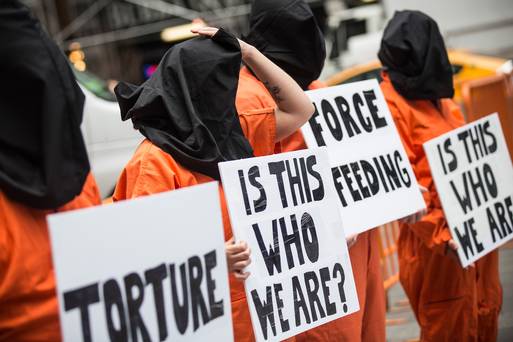
Image Source: http://bit.ly/1INYmoD
However, there is no mention of repercussions of a more deadly nature. That is, did the use of enhanced interrogation techniques result in attacks against America and her allies? There seems to be no direct evidence of this, nonetheless, the presence of Guantanamo Bay prison is said to act as a ‘recruitment tool’ for al-Qaeda. In addition, US officials have argued that the prison is a threat the national security, risking the lives of Americans. While this is not attributed directly to torture, the procedures used in the questioning of Khalid Sheik Mohammed et al were employed in Guantanamo, as such, it is not a step too far to assume that radicalisation is in part a result of their use. After all, it was not only the four men mentioned previously who were interrogated in such a way.
The final question that is asked here, is to what extend did Congress and the White House have knowledge of what was going on? For if these groups knew a lot, then it is arguable that they are culpable in either standing by and letting it happen, or actively supporting it. Fortunately however, the situation was much more complicated than that. What is certainly true is that the Executive and legislative branches knew about it, but lacked significant knowledge of what was going on. However, it was at the same time, limited in its scope. Concurrently, the CIA went out of its way to circumvent congressional investigation, or tried to avoid the eyes of congress but was found to have deceived the investigators as the report makes clear:
The CIA did not brief the leadership of the Senate Select Committee on Intelligence on the CIA’s enhanced interrogation techniques until September 2002, after the techniques had been approved and used….The CIA restricted access to information about the program from members of the Committee beyond the chairman and vice chairman until September 6, 2006, the day the president publicly acknowledged the program…. Prior to September 6, 2006, the CIA provided inaccurate information to the leadership of the Committee. Briefings to the full Committee beginning on September 6, 2006, also contained numerous inaccuracies….The CIA misrepresented the views of members of Congress on a number of occasions. After multiple senators had been critical of the program and written letters expressing concerns to CIA Director Michael Hayden, Director Hayden nonetheless told a meeting of foreign ambassadors to the United States that every Committee member was “fully briefed,” and that “[t]his is not CIA’s program. This is not the President’s program. This is America’s program.” The CIA also provided inaccurate information describing the views of U.S. senators about the program to the Department of Justice.
In essence, it seems that the CIA was effectively acting of its own accord, trying its utmost to avoid accountability for actions committed by its agents, and the concerns of elected members of congress who were disconcerted by its arguably carte-blanche attitude. Unfortunately, this attitude did not stop at legislatures. It appears to have gone all the way up to the White House. The report notes that like the attitude they took with congress, the CIA deceived senior White House officials and National Security Council officials. Ever more damning, the President himself, George Bush, was not informed of the use of the procedures before April 2006, by which time all but one of the people who would face the interrogation techniques had already endured it. Additionally, neither he nor Vice President Dick Cheney were told of the locations of various CIA detention centres, bar one country. The country in question has been censored in the report.
Taking these factors into account, it seems unwise to harshly criticise the Bush Administration and congress for what happened. Though it is true that they knew what was going on to some degree, the extent of this knowledge appears to have been very limited. Rather, the CIA effectively acted rouge, ignoring calls for investigation, deceiving the legislature and the presidency, and refusing the elucidate what was truly going on until the procedures had already been enacted on the suspects.
Overall, the report seems to make a lot of things clear. Firstly, enhanced interrogation techniques do not actually work as purported. Secondly, the main targets were almost exclusively Middle Eastern men. Thirdly, the procedures damaged US relations with its allies, in a time when America needed friends. Finally, the CIA deceived both congress and the presidency, acting in near complete autonomy and unaccountability, trying to avoid being taken to task for their actions. In closing, it seems a sorry state of affairs for the Agency, and serves as a reminder that greater checks and balances are needed when dealing with them, if such actions want to be avoided in future.
Addendum; a More Sceptical Eye
This article has attempted to examine the Senate Intelligence Committees report on torture, and answer a number of questions that its release poses. However, as always, there a limitations to providing a definitive answers and this is due to a number of factors, the first of which becomes clear when one reads the report. Despite being declassified, it remains heavily censored. Innocuous information does not see the censor’s pen, and it is likely that the blacked out text would provide a yet deeper insight into the activities of the CIA during the War on Terror, and perhaps answer questions to greater effect. A second factor is the authorship of the report. The Senate Intelligence committee who authored the report were comprised of democrat senators. It is quite possible that information was omitted by them, given that they were the opposition party in the legislature when these procedures where ongoing, and have again become the opposition party, with the recent federal elections. The Republicans and CIA officials who state that there are errors with the report need to be taken seriously, and refusing to hear their opinions and arguments against this report may well blind us to seeing only one point of view. The report is a damning indictment of the CIA, but is not, and should not be the final voice in this long and arduous saga.
N.B. Most of the information from this article has come from the report, which can be found as a free download on CNN’s website: http://edition.cnn.com/interactive/2014/12/politics/torture-report/
About the Author





