
North Korea is an Orwellian nightmare, straight out of the Cold War: a dictatorship with the world’s largest active army per capita and the fourth largest active overall, a nuclear arsenal, more than one million people suffering malnourishment every day, and a history of belligerence. The international community has accorded North Korea this image, making its threats and every action on the international stage a feast for the media. Yet beyond the size of its military force, the media often overlooks North Korea’s outdated military technology, the presence of worker-peasants in the military, the lack of technology and access to the internet, and its faltering ties with its closest ally, China. The Hermit Kingdom has long been a source of media fear, most recently because of its dubious claims that its nuclear weapons could hit the United States’ West coast.
North Korea’s strategy of dealing with the U.S. and maintaining global relevance is by taking radical actions that garner worldwide attention: the development of nuclear weapons, rocket tests, the purported recent hacking of Sony, and the kidnapping of Americans, Japanese, and South Koreans. The U.S., in response, is easily provoked: the mainstream media is driven into fear; Congressmen and Senators respond with boisterous speeches and calls to action, and the President is forced to make North Korea a major focus of his foreign policy. All of this clamour takes place against a nation that hardly poses a strategic or military threat to any nation: North Korea knows that any conventional or nuclear attack against the U.S. would mean an end to the regime and the nation as they know it. Kim Jong-un and his predecessors have long known that their provocations mustn’t cross a line, and that any military action against an economic, military, and technological behemoth like the U.S would end in annihilation.
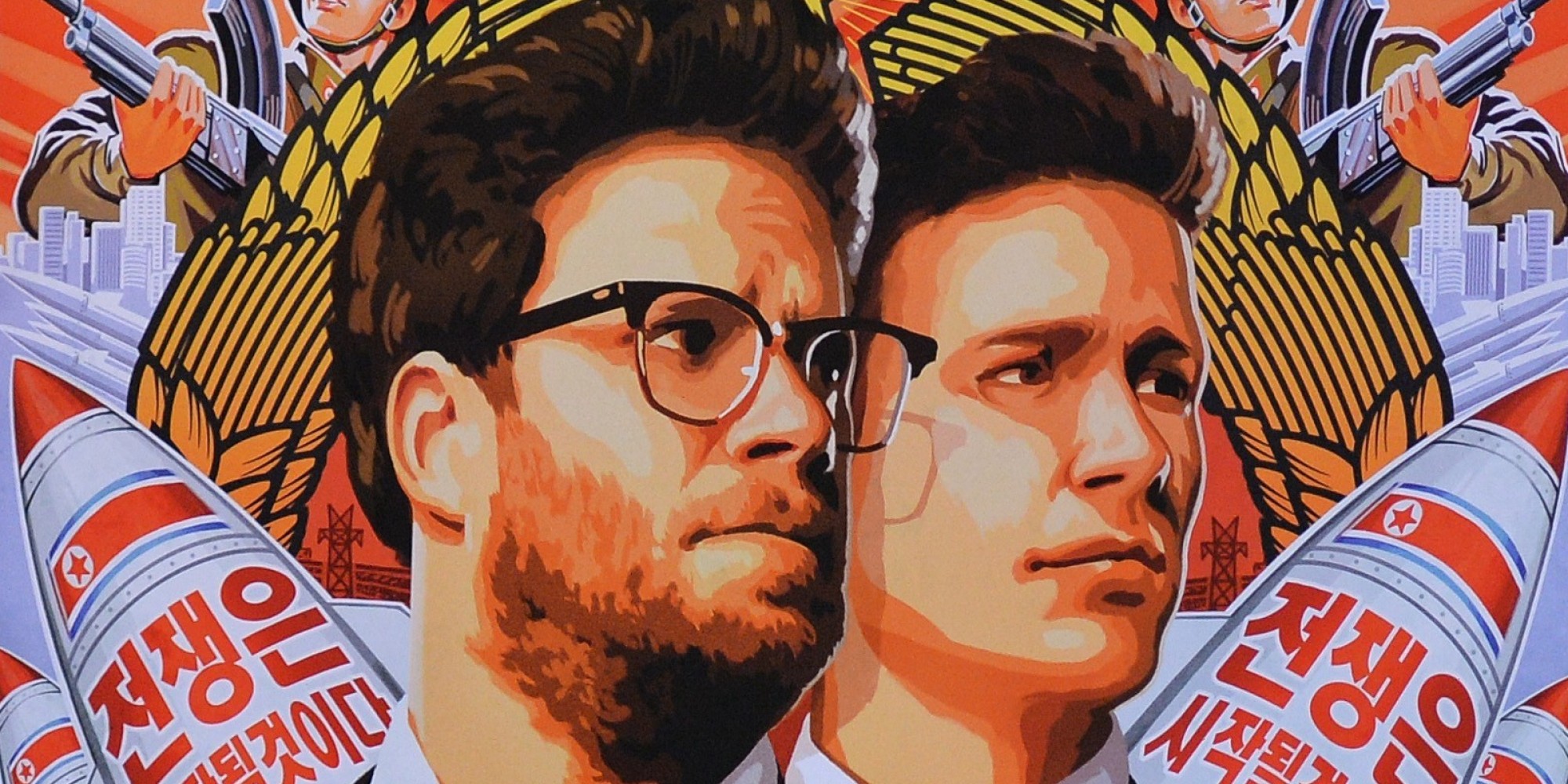
Promotional poster for The Interview. Image Source: http://huff.to/1AILLQH
Take for example North Korea’s nuclear arsenal; the nation is purported to have between two and nine nuclear warheads, and delivery systems that have a laughable success rate given the multiple failures of its rocket launches. Were Kim Jong Un to decide that a nuclear attack would be necessary, the U.S. would immediately retaliate. In addition, any conventional army attacks would at best be a shambles: the North Korean military still uses computers that are reminiscent of the 1990s, and is equipped with Soviet tanks. Compare this to the U.S., which invests more in its military than the next nine nations combined, and has the strongest conventional military in the world. While any war waged between North and South Korea would be costly both in human lives and economically, it would hardly be fatal to South Korea, Japan, or the U.S., though certainly starving the Korean People’s Army and ending any true credibility for the Kim Jong-un. In strategic terms, such a war would be a devastating idea for Kim Jong-un.
In short, North Korea is a paper tiger. Its foreign policy makes it credible only so long as the U.S. pays attention to its boisterous claims and its attempts to bring about doomed negotiations. In fact, such threats and issues and the U.S. response ultimately bolster the image of Kim Jong-un through North Korean state-run media. Although it is true that the humanitarian crisis in the region is absolutely condemnable, any form of aid or political capital offered to the nation will inevitably empower its ruling dictatorship and prolong the life of the regime by feeding its people and its media, while it maintains its iron grip and starvation of the North Korean people – without achieving much for international actors or the U.S.
While it is true that the Sony hackings are a potential violation of international law, the amount of furore over the issue and the threats that followed simply made the nation look more dangerous to the international community and made it an issue that Americans and the media held accountable to its political leaders. The reactionary policy of Sony in withdrawing The Interview, in itself a mediocre film from theatres, exacerbated the image of North Korea as a threat and increased its relevance to people’s daily lives. And while The Interview and other such satires have the noble goal of mocking an absurd, odd looking, strangely-styled man who has an obsession with large pieces of cheese and lube, such satires make North Korea and Kim Jong-un a media presence.
If America and the West truly want to deal with North Korea, it must be done through starving the nation of the publicity it so badly needs to remain relevant. Ultimately, that is as much a burden on political leaders as it is on citizens. Those who are cowed by North Korea’s empty threats and occasional actions must learn of the logical unfeasibility and implausibility of a truly lethal North Korean attack. Those who fuel the pittance of North Korea’s economy by travelling there, or eating in its mediocre Pyongyang chain of restaurants, do the disservice of encouraging a regime that, as all other isolationist, totalitarian, communist dictatorships, is slated by history and reason to fail. In the short term, it is true that ignoring the humanitarian crisis in North Korea – the presence of concentration camps, the lack of basic amenities, education, food, and the lack of media and thought freedom – is condemnable, and a failure of the international community. But any action in the short term simply prolongs the longevity of the regime in the long term, which ultimately means the continued violation of human rights. If we truly want the humanitarian crisis to be solved, we must ignore the empty threats of a nation which feeds on publicity to maintain its existence, and focus on more relevant and threatening issues. The country is a joke, and its threats should be confined to just that.
Other Sources
Hackett, James T. The Military Balance 2012. London: Routledge for the International Institute for Strategic Studies, 2012.
About the Author





