
“The vicious cycle of austerity is over,” declared Syriza leader Alexis Tsipras on the day of his party’s election win. After six years of austerity, recession, mass unemployment and falling living standards, the Greek people have voted for Syriza to renegotiate the terms of Greece’s €240 billion bailout, imposed by the so-called ‘troika’ of the European Union, International Monetary Fund and the European Central Bank.
Much has already been written about Syriza’s demands and their likely impact on the rest of the Eurozone, not least whether the troika will actually agree to demands. Angela Merkel, the German chancellor, has already ruled out further cancellations to Greece’s national debt, which is more than 175% of GDP.
But with the Greek government unlikely to back down, how will this confrontation play out with public opposition to German-led austerity policies hardening across Europe? International Political Forum casts our eye at upcoming elections across the continent:
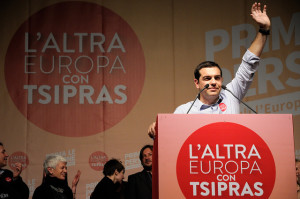
Syria leader Alexis Tsipras. Image Credit: lorenzog/Flickr
Spain
On Saturday, tens of thousands of people took to the streets in Madrid in support of anti-austerity party Podemos (We Can). Led by university lecturer Pablo Iglesias Turrión, their pro-social justice and anti-corruption message is winning over a populace disenchanted with years of economic malaise and high unemployment with the party winning 1.2 million votes at the 2014 European Elections. General elections are scheduled for the end of 2015 and with the two main parties emboiled in corruption scandals, it’s not wholly inconcievable that Spain will start 2016 with a government led by Pablo Iglesias.
At the rally, Igelsias heralded Syriza’s election win but cautioned against those assuming it will automatically lead to a Podemos triumph. He said:
“In Greece they did more in six days than many governments have done in many years. We support our brothers but nobody did their homework for them and nobody will do our homework for us.”
Yet the Spanish economy has recently emerged from its six-year recession, expanding at its fastest pace since 2007, although unemployment is at 23.7 percent. With Podemos currently polling around 30 percent, it may take more than one euphoric rally for the end of austerity in Spain.
Britain
While voters in Greece and Spain have turned to the left, the British electorate have gone in the opposite direction with the United Kingdom Independence Party (UKIP) winning the 2014 European Elections with 27.5 percent of the vote. Aligning their long-standing Euroscepticism with anti-immigrant rhetoric, UKIP are currently polling around 20 percent, have gained two MP defections from the primary member of the governing coalition, the Conservative party, and look set to greatly increase the 3.1 percent of the vote they received in 2010 (though they still may not gain more than a handful of seats thanks to Britain’s antiquated first-past-the-post election system). If the economic situation in the Eurozone worsens, thereby pushing Europe up the political priority list, UKIP could well be the main beneficiary.
But recently, Britain has also seen a ‘green surge’ with the left-wing Green party gaining 13,000 members in one week. The Greens, who want to nationalise the railways, abolish the monarchy, and provide every citizen with an income of £71 a week, reject austerity with leader Natalie Bennett saying in a statement: “we have to focus on the reason for our current difficulties, the near-collapse of our fraud-ridden, reckless, over-large financial sector.”
| UK Political Parties Membership |
|---|
| Labour – 189,531 |
| Conservatives – 174,000 |
| Scottish National Party – 92,187 |
| Green Party – 50,172 |
| Liberal Democrats – 43,000 |
| UKIP – 41,966 |
With the seeming attractiveness of anti-austerity policies to the electorate, Labour MPs are now urging leader Ed Miliband to adopt a Syriza-like platform to negate the Green threat. If public opposition to austerity continues to grow, we could see an election between a Conservative party led by David Cameron promising further cuts to public spending and a Labour party promising to increase it.
Ireland
With a general election in 2016 and memories of bank bailouts and the shame of going to the International Monetary Fund (IMF) and the European Central Bank (ECB) to stop the country going bankrupt still fresh in Irish minds, victory for Syriza threatens to allow opponents of Irish PM Enda Kenny’s coalition government to paint it as subservient to Brussels and Berlin.
Sinn Fein president Gerry Adams congratulated Tsipras by phone on his victory, and his party, as well as a mixed group of Independents with long-standing links to Syriza, will be hoping to capitalise on Syriza’s victory. Yet recent polls have shown a rise in support for Kenny’s Fine Gael party and his Labour coalition parties with a fall in support for Sinn Fein too. With the economic situation in Ireland starting to improve with unemployment falling to around 10 percent, Adams’ statement that Syriza’s victory “opens up the real prospect of democratic change not just for the people of Greece, but for citizens right across the EU” may be wishful thinking.
France
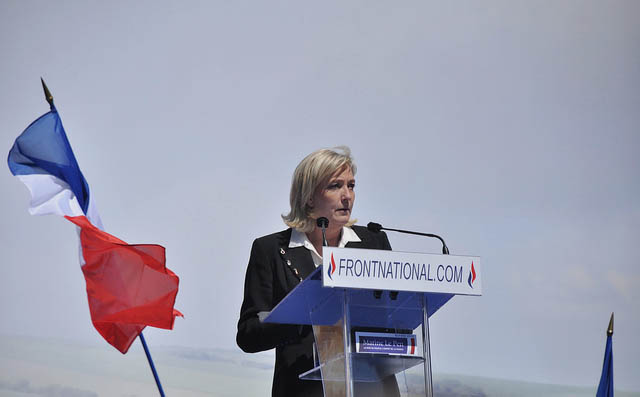
FN Leader Marine Le Pen. Image Credit: Blandine Le Cain/flickr
Demonstrating that resistance to austerity spreads across the political spectrum, we go now from the far-left Syriza to France’s far-right Front National (FN). FN Leader Marine Le Pen has somewhat succeeded in detoxifying the party’s reputation for xenophobia and, well, racism that surrounded it during her father’s leadership – Le Pen senior’s greatest hits include denying the holocaust and criticising the French national football team for being too black.
The FN won the first round of a crucial by-election on Monday and look set to maintain their position into the second round. “It’s very serious. Marine le Pen is on the doorstep of power,” one former minister from the centre-right party Union Pour un Movement Populaire (UMP) minister was quoted by Libération as saying.
With their wholesale rejection of both austerity and the EU hierarchy, any perceived weakness and concessions in the EU’s dealing with Greece could both embolden the FN and threaten the stability of the Eurozone further.
Portugal
Elections in Portugal are scheduled for Autumn 2015. The reaction in Portugal to Syriza’s win has been low-key with the governing right-wing Social Democratic party releasing a statement saying the result represents “another positive step in the long and difficult journey taken by Greeks and their institutions in their efforts to find financial stability as well as economic and social prosperity.” Their coalition partners, People’s party, also released a statement emphasising several key differences between Portugal and Greece, perhaps in an effort to shore up their position and dismiss analysts who have attempted to draw comparisons between the two countries.
But the anti-austerity party Left Bloc, which holds eight seats in the Portuguese parliament, has been celebrating the Greek election result. Left Bloc MEP Marisa Matias told a Syriza rally in Greece last week that “the elections are Greek, they concern the sovereignty of the Greek people, but also that of the Portuguese, Spaniards and Europeans. We were with you yesterday, we are with you today and we will be with you tomorrow. A victory for Syriza is a victory for all of Europe.”
Italy
Though elections aren’t likely to occur in Italy until sometime around 2018, Italy, like Spain, also has an insurgent anti-austerity political grouping – the Five Star movement, led by comedian and blogger Beppe Grillo. If Syriza are successful in gaining concessions from the troika, Five Star’s demands for an end to austerity in Italy will undoubtedly be strengthened. The Italian government will likely have to start pressing for an easing of austerity lest they be swept from office by an anti-austerity tidal wave of public opinion. Five Star, which rejects the traditional political paradigm of left-right and considers itself a “movement” rather than a party, may find itself having to put its ambitious program into action.
About the Author





[…] Originally published on the International Political Forum, for whom I am the Elections Director http://archive.the-ipf.com/how-will-the-greek-election-result-affect-the-rest-of-europe/ […]