
From Copacabana to Salvador da Bahia, Brazil is a country known for its cultural richness and is a growing international player in the economic field yet still lacks political and social coherence. I used my time in Rio de Janeiro and Sao Paulo to discuss politics, social and economic challenges facing the young generation. The following reflections mirror the thoughts of young ‘Cariocas’ (‘Cariocas’ is the name given to people living in Rio de Janeiro) and ‘Paulistas’ (‘Paulistas‘ is the name given to people living in Sao Paulo) that want to see their country prosper and live to its full potential.
Dilma’s first government was successful, but at what cost?
President Dilma Rouseff , a few months after her re-election has still to face big challenges. Her socialist reforms followed the footsteps of Luiz Inácio Lula da Silva, the ex-President from the Partido dos Trabalhador (Worker’s Party). For the past three mandates similar reforms have fought to eradicate the extreme poverty in Brasil (particularly in the North). Her strong socialist measures helped maintain a low unemployment rate last year, however inflation and taxes had increased. Recent statistics suggest that Brazil’s economy is in recession. As the graph below indicates, the country’s GDP has practically stagnated in spite of Brazil having one of the highest taxation rates in the world.
| GDP Growth | |
| 2010 | 7,5% |
| 2011 | 2,7% |
| 2012 | 1% |
| 2013 | 2,3% |
| 2014 | 0,1% – 0,2% (est.) |
Dilma’s government earlier blamed the economic stagnation on the international financial crises. Surprisingly, the mundial crises managed to affect Brazil the most since it presented the lowest general growing rates in the whole Latin America. Brazil’s gains in the late 90’s was not applied wisely by the subsequent governments in the 2000’s. This means that little was done to sustain the prosperity that Brazil enjoyed under Cardoso’s government. In the big cities of Rio and Sao Paulo many believe that social reforms carried out in 2000’s by various governments came at the cost of Brazil’s economic development. Brazil’s current status as a founding member of the ‘BRICS’ obligates it to meet certain economic standards. Dilma’s government will have to be ready to undertake tougher measures to restore Brazil’s macroeconomic imbalances.
What main issues are the Brazilian youth facing today?
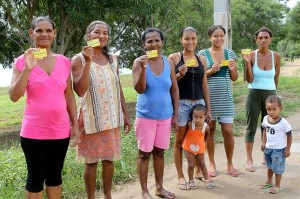
Image Source: http://bit.ly/1D83vF9
Starting in 2002, when President Lula da Silva came into power, his socialist government launched ‘Bolsa Familia’ (a social security program that provides financial support to low-income families) aimed at reducing the income gap. This was an extremely successful program and indeed reduced Brazil’s extreme poverty, especially in rural areas.
Nevertheless, today many Brazilians in metropolitan cities point out that the Bolsa Familia led the people in the north to conform to social support so much so that they believed ‘procreation is now a form of sustenance’, according to a taxi driver in Sao Paulo who wishes to stay anonymous. Some Cariocas and Paulistas go as far as suggesting a division between the north and south on account of their vast economic and cultural differences. These are only the tip of the iceberg though. Education and Health Care have not received enough support for years!
What are (or should be) the main issues on the agenda of the re-elected President Dilma?
Over and above Brazil’s various economic challenges, education is still a sector in much need of development. On average Brazilians attend school for 8 years, meaning that most of the population does not reach high school. Statistically speaking, Brazil’s population is educated i.e., they know how to read and write. However the literacy rate – the ability to understand what is written or read – takes a downturn. Many people who complete eight years of primary education (known as ‘Primeiro Grau’) do not know how to write correctly, apart from local slang. The high dependency on attending classes over academic evaluation poses another problem to Brazil’s educational sector. Further, public schools across the country have a bad reputation. Private education in Brazil on the other hand, requires a family to be financially stable. As a Paulista described to me, “A good education is private. An even better education is a luxury”. An uneducated population jeopardizes the growth of a country’s middle-class, which then creates an income gap. Interestingly though, instead of making focused, thoughtful distributional investments, the government seems to be concentrating on only one end of the spectrum.
Public hospitals in Brazil are poorly equipped and do not have the best assistance. Public discontent in such cases may well be described as revolting for a population that pays one of the highest tax rates in the world and does not receive either good public education or health assistance.
So how is Partido dos Trabalhadores still in power?
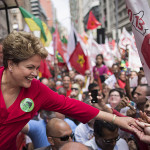
Image Source: http://bit.ly/1JHUrQb
Dilma’s main supporters are in the North of the country where her socialist policies have been welcomed. In Bahia she won 70.16% of the votes while in Sao Paulo she lost to her opponent Aecio who won 64,31% of the votes. Overall, Rousseff won the elections with a meagre 3% margin over her opponent, Aecio Neves from the PSDB party. Does this mean the Brazilians are starting to shift their support?
Brazil’s Future: a new Venezuela or Argentina?
Will Brazil eventually replicate Venezuela – a country focused on social policies that diminish the income gap but at the cost of the country’s march towards growth and development – or Argentina – with high levels of inflation and lack of transparency?
Brazil must pay more attention to other areas such as education and justice. Dilma Rousseff has probably one last chance to invest in Brazil’s economic potential to avoid further inflation and recession. At same time she needs to consider future generations while improving the country’s educational system. After all, they are the future voters and governors of Brazil. A more educated society is one that is more aware of opportunities and can drive Brazil to realising its full potential.
It is perhaps time to consider giving more autonomy to Brazil’s states to focus their resources in areas they see fit. In doing so, poorer areas in the north could use their resources to encourage more social participation from those receiving social benefits while the southern areas could focus more on educational reforms and better patrolmen in order to address the high crime rate. Now that the carnival is over, it is time to go back to policy making and changing the route that Brazil is taking…
About the Author





