
The Co-founder of the Libyan Youth Movement spoke at an event organised by the International Political Forum on 27 February 2015. This article includes reflections of the discussion that was held on the day about LYM’s role in the Libyan Uprising, as well as what the future holds for Libya.
Listening to the Libyan Youth Movement (Shabab Libya) speak about their role in the 2011 uprising and present day Libya provoked thoughts on the reality of uprisings and revolutions.
The movement was key in sharing the stories of Libya to the rest of the world from sources on the inside – a particularly important role during times where it was extremely dangerous for journalists to gain access.
The founders, Omar Amer and Ayat Mneina touched upon the problems Libya is facing today and were very open and honest about the harsh reality that the fall of Gaddafi, though a huge achievement, has not solved the hardships faced by the Libyan people.
The words of Gene Sharp’s work looking at the transition from dictatorship to democracy ring true:
“A complete governmental void could open the way to chaos or a new dictatorship.”
Sharp’s work also warns of how the very nature of an uprising can determine it’s future. An uprising with violence can often lead to more violence. Where dictatorships have been eradicated, there is often economical hardship. Where there is growth or wealth there may be exclusivity over who is entitled to it. After turbulence people are either more encouraged or more unlikely to share with one another. The latter, the protective, may not serve a newly governed country well.
An issue that may have been foreseen, simply by looking back at how history has played out before, is that the unity held in animosity of a dictator disintegrates once that dictator has fallen. The shared value and goal has been dealt with and new goals are created. These new goals are less likely to be shared. When trying to replace the system with a new ideology there will be mixed views and conflict. This is especially if the primary focus for such a long period of time has solely been to lose the previous government and it has not been thought about before.
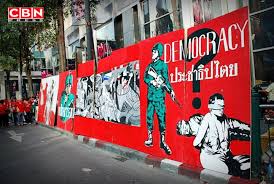
An anti-military dictatorship mural in Thailand. Image Source: http://bit.ly/1GxJIoQ
It certainly seems to be the case in Libya today. The Libyan Youth Movement explained the divide in thought succinctly – it’s very much between the young and old. Libya has been left to be governed by it’s “wiser” elders – the ones who lived under Gaddafi. They now feel like they should be compensated. The youth in Libya, who were largely responsible for the uprising, have little say, or have voiced little opposition for the ruling, which is not currently functioning well. Each day Libya is faced with a new “crisis”. Some young Libyans have joined militias out of sheer frustration and anger. There are now fears that ISIS (Islamic State of Iraq and Syria) has found it’s way to Libya and are looking to recruit.
Ultimately if there is no responsible plan set out before an uprising takes place, it can take a long time for a country to find its feet. The new democrats need to ask, will there be a functioning interim government? And for how long will that be in place? What parts of the old government need to be abolished and what needs to remain?
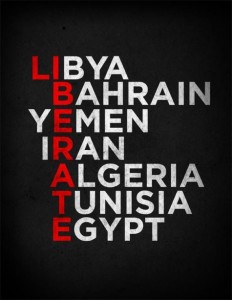
Image Source: http://bit.ly/1GxJIoQ
When describing the events of 2011, the Libyan Youth Movement mention how they were operating in a reactionary way to the energy felt by those on the ground in Libya. People took to the streets in protest. Gaddafi’s forces attempted to take them down and the uprising was sparked. It is difficult to plan something that is not expected, something many Libyans once thought may never happen.
Based on the hardship faced now, an audience member asks whether or not the Libyan Youth Movement would play the same role again. Amer answers: “To get rid of Gaddafi, yes – over and over.”
Gaddafi caused much pain to Libyans and the uprising gave many hope. The Libyan Youth Movement refer to the events in 2011 as an “uprising” as they say it has not truly fulfilled a revolution.
They speak about the future of Libya. They say those with the optimism that led the uprising are the ones who will need to help democracy find a way through.
Revolution and uprising are so often glorified and suggested as instantaneous liberation. It’s not that simple but it will find a way. Let’s hope it finds a way for Libya’s people soon.
About the Author





