
In a fifteen-minute long speech delivered on Tuesday evening, President Juan Manuel Santos announced that Colombia’s Armed Forces shall stop their bombing operations against the Revolutionary Armed Forces of Colombia (FARC) for the next month.
Since August 2012, the central government and the guerrilla group have been negotiating a peace agreement to put an end to Colombia’s fifty-year-old internal conflict. On December 20 last year, the FARC had implemented a unilateral and indefinite ceasefire: the truce, as of today, still holds, and the guerrillas’ ceasefire has led to a significant reduction in the levels of violence across the country. By declaring a month-long halt to the offensive against the guerrilla not only does Santos’ administration respond to the FARC’s unilateral truce: the deal is a major step forward towards the de-escalation and final overcoming of Colombia’s internal conflict.
This January, Santos had already instructed the government’s delegation in Havana to begin discussing with the FARC’s counterpart a definitive ceasefire that would involve both Armed Forces and the guerrilla. The rationale behind Santos’ claim was simple: a bilateral truce could serve as the necessary step towards the end of the conflict – one of the last two items of the six-point agenda the delegations are yet to discuss in Havana.
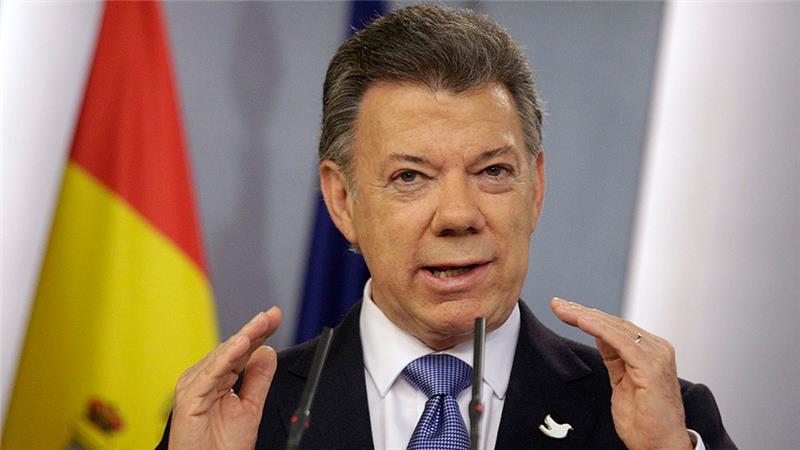
President Juan Manuel Santos. Image Source: http://bit.ly/1HCGFcF
But Tuesday’s announcement should not be conflated with the sort of ceasefire Santos had spoken about only two months ago. This is because what Santos outlined is not a definitive agreement, nor a ceasefire in any simplistic sense. Should the FARC threaten the Colombian people in any way – or, more generally, wage any threat against the country’s stability – Santos has made clear the halt to the Army’s offensives shall be immediately lifted.
Seen from this angle, and contrary to the rampant criticism voiced by former President Uribe’s opposition party Centro Democratico, Santos’ decision is not tantamount to a sudden giving up of the State’s monopoly of violence to the benefits of the guerrillas. The duty of the Armed Forces is to protect the Colombian people – and this is a prerogative which the ceasefire does not undermine. Nor does the deal entail the withdrawal or reconfiguration of the Armed Forces’ presence in the territory.
Temporary solution
In this sense, the President’s deal is neither a bilateral ceasefire of the kind Colombia had witnessed during the peace process undertaken by former President Belisario Betancur (1982-1986), nor a system of territorial concessions akin to those granted to the guerrilla during the negotiations carried out under Pastrana’s administration (1998-2002). It is a temporary solution – a trial, so to speak – that now places the responsibility for what comes next on the FARC’s shoulders.
By implementing a unilateral ceasefire and making it dependent on the government’s avoiding any attack against the guerrillas, the FARC had effectively made Santos’ administration co-responsible for a possible breakdown of the truce, and the consequent crisis the peace talks would have suffered. By calling for a temporary halt to the hostilities of the Armed forces, Santos has now shifted the burden back. Whether or not the current status-quo shall be undermined is not something that concerns the government alone, but the guerrillas too. For a breakdown of Santos’ deal on the part of the FARC would result in a tremendous loss of the political capital the group has acquired in over two years of negotiations. In this light, the President’s announcement formalises what has already been a virtual bilateral ceasefire, with each side all too aware of the risks the deterioration of the truce would bring about to dare disrupt the equilibrium.
Stalemate
The virtual stalemate has led to a drop in the levels of violence associated with the armed conflict unseen since the early 1980s. Civilian deaths have also decreased dramatically during the FARC-led ceasefire. But the intermittent clashes with the Armed Forces and the attacks to the country’s infrastructure by the hands of the guerrilla have not led to a parallel strengthening of people’s perceptions of security.
Convincing the public of the government’s strategies will most likely be one of Santos’ most difficult challenges. If the final peace agreement is to be put to a referendum – as the President has reiterated at length – then it is imperative for Santos to make sure any decision his government shall take will be justified before the eyes of the Colombian people and the many victims the conflict has left. Appealing to the “supreme good of Peace”, as the president has done for the last third of his speech, can only work up to a point.
Quite another task will be fostering the support of the Armed Forces. Santos has already involved the Army more directly in the negotiation process through the establishment of a sub-commission in which military and guerrilla leaders have already begun discussing recommendations for the end of the conflict. Giving the Army an active role in the negotiations is not just a way to legitimise the latter: it will also help the government to make sure a powerful source of dissent is co-opted and tamed down.
Disenfranchised parties
Whether or not Santos will prove capable of securing the public and Army’s backing, the last great challenge will be to ensure the peace process will enjoy the input of those sections of the political spectrum that have so far been disenfranchised by the talks. In other words, it will require Santos to involve – to the extent possible – Uribe’s party and its affiliates in the negotiating process.
In his speech, the President announced the establishment of an Advisory Board that will be joined by the likes of former presidential candidates Antanas Mockus and Clara Lopez, former M-19 member and senator Vera Grabe, and indigenous leader Ati Quigua, amongst others. The invitation has also been extended to the former Centro Democratico presidential candidate Oscan Ivan Zuluaga.
Whether the opposition will reply by supporting or criticising Santos’ efforts, no peace can be premised upon the exclusion of a political party which has proved capable of giving a voice to the fears of a great fraction of the Colombian electorate. The President’s decision to halt the Army’s bombing against FARC targets is a major breakthrough towards the de-escalation of Colombia’s armed conflict. But its benefits will only be reaped if Santos will turn the negotiations into a process that will involve the Colombian people in its totality. However critical, the input of the opposition is necessary for the peace to be a legitimate and durable one. Somewhat paradoxically, establishing a dialogue with Uribe’s ranks may be for Santos harder than reaching a deal in Cuba. Nonetheless, the prospects of Colombia’s negotiations depend on both.
About the Author





