
After surviving a rebellious scare that threatened the existence of the Nationhood of Mali in 2012, the country is back on the track to finding lasting peace; a peace which is not owed to French Military intervention that saved the face of the Malian government in the wake of a looming capitulation to advancing Islamist Militants of the Ansar Dine and MUJAO movements.
The vast arid North of Mali (an area the size of France) is covered by the Sahara desert and is populated by the Tuaregs (a nomadic people who live in Mali, Algeria, Libya, Burkina Faso, Mauritania and Niger). Seen as light-skinned (though they are called the ‘blue people’) they complain of marginalisation in their respective countries of residence. As such, the Tuaregs have fought several rebellious wars against the governments of Niger, Algeria and Mali.
As a colonial creation, the Malian state is an agglomeration of several black African and light-skinned African (Tuareg and Arab) tribes. With the government domiciled in Bamako and dominated by Black African tribes, the Tuaregs who occupy the Northern half of Mali crave for an independent state of ‘Azawad’ that will unify them with their kin from Niger, Mauritania and Algeria; hence their rebellious agitation since Mali’s independence in 1960.
The North of Mali which is part of the Sahara desert is also home to several armed gangs and extremist Islamist Militant groups whose networks extends throughout the Sahara covering Niger, Mali, Algeria, Mauritania and Libya under the umbrella of ‘Al Queda in the Islamic Maghreb’ (AQIM).
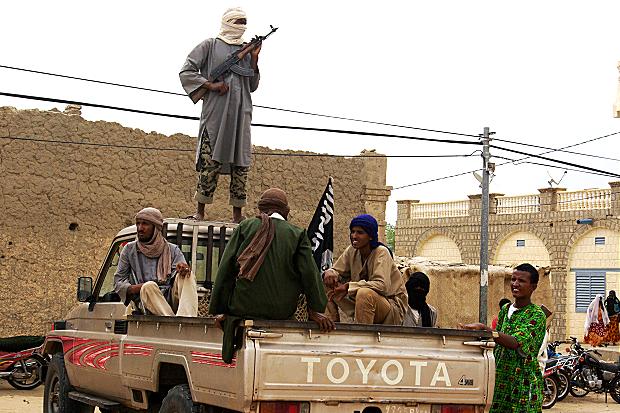
Mali militants. Image Source: http://thetim.es/1MDP9RJ
Ceasing the initiative of the political instability that rocked Mali following the deposition of President Ahmadu Toure in a military coup 2012, the Tuaregs added more impetus to their long running rag-tag rebellion and captured the Northern provinces of Kidal, Gao and Timbuktu. Following the ensuing collapse of government control in Northern Mali, the ubiquitous Islamic Militants under the umbrella of the Ansar Dine and MUJAO movements joined the cause of the Tuareg rebels and expelling government authority from Northern Mali. After achieving their aim, the Islamic militants wrested authority from the Tuareg rebels declaring and implementing Sharia law in their areas of control and began pushing further South towards Bamako to overthrow the Malian government.
Sensing a dangerous path to disintegration of coporate authority in Mali, the French government and troops from ECOWAS countries launched a counter offensive to crush the advance of the Islamist Militants. Tuareg rebels under the umbrella of the National Movement for the Liberation of Azawad (MNLA) also fought on the side of the government.
After a successful military operation which cast off the Islamist Militants of the Ansar Dine and MUJAO movements, the underlining issue of the initial Tuareg rebellion was again brought to bear. It was feared that this might trigger a wider Tuareg rebellion in neighbouring countries of Mauritania, Niger, Libya and Algeria as the Tuareg sought a unification of their kith and kin in a Tuareg republic of Azawad.
Demands for autonomy and greater inclusion/representation in the central government are placatory offers the Malian government can offer the Tuaregs to quench their appetite for secession. It is hoped that the Malian government will accede to grant the Tuaregs autonomous rule following the latest truce, for Mali to be restored to the path of lasting peace.
About the Author





