
A little before the anniversary of 16th December 2012, I was summoned to the principal’s office in college. My nerves melted into relief when I saw a fax addressed to me from the British filmmaker Leslee Udwin. She had tracked me down after my “trouble-making” at Parliament Street, and wanted to interview me about my small role in the December protests. I was over the moon. Here was someone from the other side of the world who wanted to know my story, who was drawn by the palpable rage of Indian people which had re-ignited the gender justice movement in a big way. Here was a chance to tie my personal narrative to the larger reality of rape culture, impunity and police brutality. And yet, the finished project released in February this year was much narrower than I had hoped.
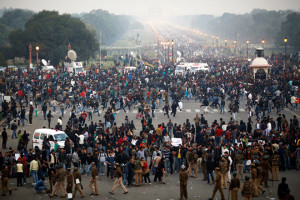
An image from December 16, 2012 protests on Parliament Street, New Delhi, India. Image Source: http://bit.ly/1GZ8vPA
It has its merits of course – gritty footage of police violence on unarmed protestors coupled with the gruesome details of the original incident shook people out of their stupor and reminded civil society that rape as social and communal control is by no means a thing of the past. However, many within the social movement circles remained unimpressed as it brought nothing new to the conversation.
Granted, Udwin has creative control over her film, and is free to set her own agenda, but we cannot ignore the issue of when it was released – while the main accused, Mukesh Singh, is still under trial. While many have held Udwin responsible for this breach of law, we’re forgetting that it was Indian authorities who granted her access to the prisons and also shirked their responsibility in reviewing footage (as Udwin mentions in an interview). But the breach of law isn’t as unsettling as its implications. Civil society’s response to rape, which was earlier passive and indifferent, has taken a bloodier turn, the effects of which are visible in Dimapur, Nagaland. Here, an incident of vigilante justice resulting in the lynching of an alleged rapist (later identified as the consensual sex partner of the woman in question), has split the discussion into two camps – one condemning it and one egging it on. It was something women’s rights activists had warned of three years ago when demands for capital punishment were fresh and peaking.
During the hour-long interview process, I was intent on raising this and other concerns, and on not letting my voice as a young middle class woman overshadow the multiplicity of resisting voices in India, from all classes, castes, religions and sexual orientations, each of which experience gender based violence in separate ways.
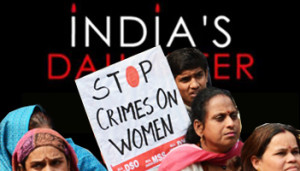
Image Source: http://bit.ly/1FC0yl8
Udwin was polite, encouraging, and shared with us her vision of a film that seemed broad enough to accommodate the spirit of dissent. But then I got down to watching it. I wondered where the analysis of the likes of Tarun Tejpal and R K Pachauri was in India’s Daughter. Why were men of a certain class background like Mukesh Singh, or his defence lawyer M. L. Sharma being singled out as demons in Indian society, when men in positions of authority across institutions have been sustaining rape culture both before and after 2012? Why had the harassment faced by young female employees of a mammoth organization like Greenpeace in India only merited a watery apology notice? An analysis of the policies and lax legal framework would have been useful when negotiating the practicable solutions to sexual violence, but the film doesn’t concern itself with that. Whether or not the document had featured misogynists from various classes, the rejection of an Indian student’s application to a German institute because of the “rape problem in india” was inevitable. And if the country has developed such a reputation, it isn’t without reason. But race politics has produced an uncomfortable double standard. One wonders why German exchange students aren’t being denied on account of the nation’s anti-Islam movement, or why American students weren’t being hauled up for the equally alarming race problem in Ferguson, Missouri and other cities.
The campaign organization Jhatkaa has catalogued the troubling misogyny, lest we forget, of authority figures in India, both male and female. It’s called the Victim Blaming Wall of Shame, and the extracts had no mention in the documentary, even though they fit perfectly well. The primary target audience of India’s Daughter, people of the West, is not likely to be aware of these toxic sentiments, and receives at best only a portion of the real picture. Another issue with the film is that while exposing a sickness in India, its agenda isn’t to turn the lens on rape culture in Western societies.
It seemed strange to me that names like Soni Sori, Manorama Thangjam and Mathura were not welcome in the documentary, even though they were principle cases in the fight for gender justice. Nirbhaya was being treated like an isolated incident once more, even after many of us within the women’s movements had clamoured for recognition of rape as a recurring phenomenon rather than a rarity.
The absent figure of Jyoti Singh too was a cause for some concern, presented as a good, virtuous Indian girl. What would the documentary have looked like if the focus had been a “sexually loose” woman or sex worker? Would there have been a tacit suggestion that some women over others surely deserve to be raped? As a rape survivor herself, I would have expected Udwin to present a more nuanced picture, and, as many women’s movement activists have already said, to have done a little more research on Indian feminist politics. In fact, voices from within women’s organizations aren’t developed enough to exhibit the essence of the women’s movement in India.
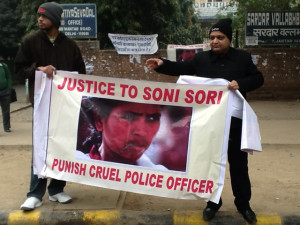
Image Source: http://bit.ly/1MOORHK
Today, civil society has called on the Bar Council of India to remove the main accused’s defence lawyers because of the horrendous comments they made in the documentary. Yet, to use Udwin’s own analogy, weeding out two apples when the whole barrel is rotten, doesn’t eliminate the hurdles to justice. Today, in Nagaland, we witness the bodily violation of a Muslim man who has transgressed conventional sexual relations without seeing it as the corollary of using rape as a tool to control women. The mentality that fuels both these acts ought to be recognized as two sides of the same coin. Today, a global campaign allows Meryl Streep to point at an alien culture as the source of uncivilized behaviour, when there are rotten apples in her own barrel. Today you have to be somebody’s daughter to think of justice.
To conclude, India’s Daughter, well intentioned as it was, could not address the vast and interconnected issues that are constantly being raised by the Indian women’s movements. If its objective is to keep the debate going, it does well. But if its objective is to educate and spark change, it is ill-equipped and inadequate.
About the Author





