
This month sees the UK release of The Salt of the Earth, the production from film-maker Wim Wenders (Buena Vista Social Club) that documents the life of Brazilian photojournalist Sebastião Salgado.
Originally released in French last autumn, winning awards at the Cannes Film Festival and nominated for an Academy Award, the Franco-Brazilian biography gives an account of the great expanse of work by the man considered by many to be one of the most important photographers of the 21st Century.
Teaming up with Salgado’s son Juliano, a fellow writer and director, Wenders delivers a powerful visual homage to the artist who initially captivated him with pictures taken at the Serra Pelada gold mine in Brazil, some of his most famous images. The collaboration between the two directors, each initially setting out to create their own separate films about the same man, maps the journey taken by Salgado that lead him from his studies in ecology, his work at the World Bank and social activism, to his time at Magnum Photos and his life-encompassing projects that made him the world-renowned photographer he is today.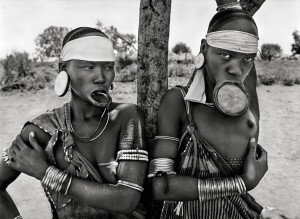
Sebastião Salgado was one of the photographers who personally inspired me to pick up my camera; his striking black and white images from every continent of the globe expertly capture the faces of humanity and represent some of the least visible people and lives on our planet. This is a man who claims to shirk colour in his photographs because he feels it is a lie that detracts away from the people in his images and their stories*, so important in all of his pictures, and I was keen to find out more about his work and his story as told by Wenders.
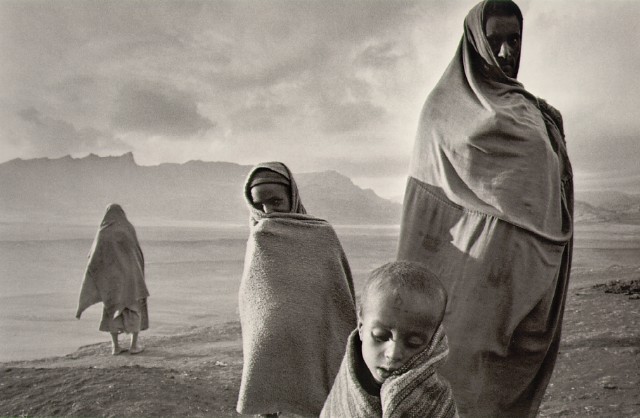
Refugees in the Korem camp, Ethiopia, 1984. Image Source: http://bit.ly/1DNrRu6
Beginning with the photographs taken in the mines, the film discusses the idea of light and dark, important in all of Salgado’s photographs, before returning to explain how he discovered the camera, photographing anything and everything before finding his vocation. A large section of the film is composed of a slide show of photographs taken from each of Salgado’s vast projects; Workers, Migrations, Africa… each collection focusing on aspects of humanity and part of his collective work that our director-narrator describes as his depiction of the human condition. Due to the nature of Salgado’s projects, which document famine, war and life as a refugee, some of the images are upsetting and towards the end of the film, as the photographer’s face is projected over his own pictures, he gives a powerful monologue about the destruction caused to himself by his work, both physically and mentally.
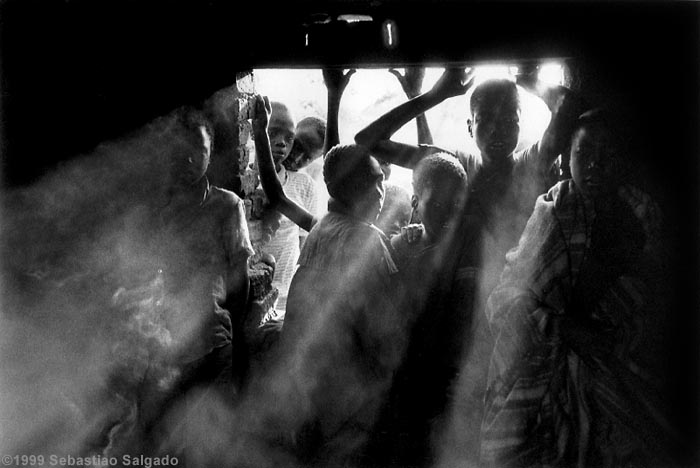
Southern Sudan. 1993. Image Source: http://bit.ly/1CZQyzQ
Yet in a sudden change of tone, both the film and Salgado’s life veer off in another direction and in his latest project to date, Genesis, he begins to contemplate the regions of earth still unspoiled by man and the cathartic effect this has had on his life is evident. With his wife he returns to the farm where he was born, now barren and desolate and begins the creation of the Instituto Terra nature reserve, and the restoration of the Atlantic Forest in Brazil, and with it the restoration of himself.
The film is a beautiful introduction for anyone new to the work of Sebastião Salgado, and for others it gives a greater context to some of his photography, revealing the story behind the subjects in his pictures. At times images used in the documentary are harrowing, showing as they do some of the worst natural and man-made disasters in recent history, but the film is lifted by its ending which would seem almost clichéd if not for being true. While Salgado’s story might appeal to those with an interest in photography, I would recommend anyone take the time to watch this film because as Wenders states during the film, Salgado is much more than a photographer.
Reference: Sebastiao Salgado – The Unfiltered Lens by Bryan Appleyard [for The Sunday Times]
About the Author





