
2010’s election was known as the “internet election”, with more use of online polling and digital campaigns than ever before. However I think it’s safe to say that internet usage, particularly social media, has become even more widespread in the last five years and will continue to grow exponentially as an integral part of everyone’s lives.
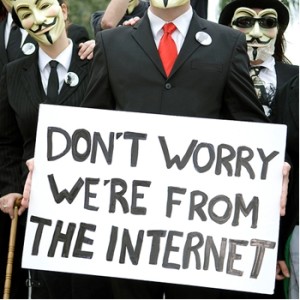
Image Source: http://bit.ly/1H2QNwK
In terms of the development and discussion of ideas, anonymity is a big factor in why the internet is so popular, and it can be much easier to express things online. This anonymity and ability to avoid direct confrontation in person has undoubtedly been dangerous in terms of the rise of online bullying, abuse and harassment – but on the plus side, internet anonymity and the “protective screen” means that while you may be uncomfortable airing your controversial, non-traditional or unpopular views at the dinner table, at a party or even in a class, you have a platform on the internet with which to do this. With regards to taking in ideas, whilst in the past you would need access to a library and a lot of spare time in order to access the same volume of information, the internet’s existence transforms this issue for anyone who has access to a computer or smartphone.
In addition to people unofficially discussing ideas and thereby being more likely to be drawn towards politics, what also makes the power of the internet, – particularly social media – so important is the ability it gives political parties to run election campaigns basically free of charge. Whilst a billboard is only visible to a small number of people, and therefore needs to be replicated many times to be seen by a large amount of people, a Facebook page or Twitter feed can be viewed by millions in minutes.
This pool of ideas and exposure is what is going to be the biggest challenge to what has traditionally been the biggest factor in winning election campaigns: money. Money is the thing that the smaller parties don’t have as much of, and this is where they have been at a disadvantage.
This is how much each main UK party received in 2014 via donations:
Conservatives: £28,950,917
Labour: £18,523,701
Liberal Democrats: £8,096,689
Scottish National Party: £3,772,594
UKIP: £3,500,570
Green Party: £648,660
Plaid Cymru: £184,584
What’s interesting is that the sources of these donations affect and are affected by party politics in the first place. Labour, for example, has 194,269 official members, whilst the Conservative party has 134,000 – but donations to the latter outnumber donations received by Labour by over £10 million. Similarly, the Green Party has more members than Ukip, but somehow Ukip received over five times the amount of donations.
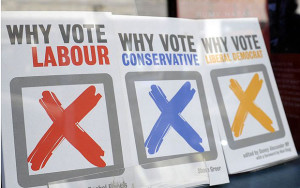
Image Source: http://bit.ly/1CTRPVW
Inevitably, this means that this money is coming from certain sources, which could tell us about to whom the richer parties are appealing in the first place: 50% of the Conservatives’ donations received since 2010 have been from individuals donating over £50,000 each, and 22% were from companies – these figures are only 5% and 2% for Labour, respectively. It is a similar situation for Ukip and the Greens, though on a smaller scale.
A lack of finances appears to be categorically debilitating to parties like Labour and the Greens who are actually very popular, because they do not appeal to wealthier donors to the same degree.
While this may seem irrelevant to a discussion on politics in social media, having money (in the form of land) used to be one of the things that guaranteed you a right to vote. Laws may have changed, but due to our economic system, money is still what largely controls election campaigns. It may not ultimately decide who people vote for, but traditionally, the more money you spent on an election campaign in the pre-internet age, the more likely it was that this would help tip the odds in your favour when it came to Election Day.
In terms of people discussing ideas and political parties getting their ideas out, the use of the internet could consequently mean that we are moving towards a situation whereby ideas, instead of money, are fuelling the dialogue and winning election campaigns.
So why is this all relevant? Surely the richer parties also have access to the internet and social media?
Well, it all comes down to the youth vote. 70% of young people surveyed by The Mirror don’t know which political party they’ll be voting for, if they vote at all. In 2010, the voter turnout for young people was low compared to other age groups, with only 51.8% of people aged 18-24 voting compared to 74% of those who were over 65 years old, and a general voter turnout of 65.1%. There is a general consensus that young people are too disengaged with the idea of voting.
What’s fascinating is that according to a poll by Ipsos Mori, a third of 18-24 year-olds think social media will influence their vote. While the majority of those surveyed also believed things like Facebook and Twitter were making politics more divisive and superficial, young people were revealed to be far more positive than those aged 55 and over about the idea that social media platforms help to break down barriers between voters and politicians and political parties.

Image Source: http://bit.ly/1HnkfxY
But why is young people’s use of social media so crucial in helping political parties with less money (in proportion to their size)?
It’s no secret that young people have traditionally tended to sympathise with “progressive” ideals and less with traditional or conservative ones, and research tells us that young people actually support the Labour Party and the Green Party (if we are to discount the Scottish National Party from this figure, as it only has candidates in Scotland) much more than other parties, in proportion to overall party size.
Now obviously the Labour Party and the Green Party are working against each other just like any other party, but there is definitely something to be said for the fact that if Labour and the Green Party were to tap into the young electorate to a greater extent – the young electorate that already seems to have faith in them – they would certainly perform better in the May 2015 election. And as we’ve discovered, social media and the internet have increasing potential for helping to achieve this.
About the Author





