
Tuition fees have become a key battleground in the election campaign. What are the parties promising? Who has the best deal for students?
From violent protests on the streets of London to Nick Clegg’s infamous “I’m sorry”, an overhaul in student funding has been one of the most significant changes over five years of coalition government. In spite of this, by the end of the next parliament students may once again have faced a near-total overhaul of the funding system.
While the introduction of £9,000 fees may have done little to bolster the Liberal Democrats’ student vote, the party has remained steadfast in its commitment to the policy. In a recent address to the NUS national conference Clegg described it as “the fairest deal we could get for students and graduates of the future”.
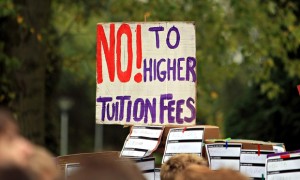
Image Source: http://bit.ly/1bj6kMh
It is well known, however, that Labour sees this deal as not being fair enough. Ed Miliband continues to stand steadfastly by his plan to cut tuition fees from £9,000 to £6,000. Labour say that allowing young people to start their working lives with £44,000 worth of debt is simply unacceptable.
Meanwhile the Conservatives maintain that no changes are needed to their current policy, although the party is pledging to bring in a system of postgraduate loans – a commitment conspicuously absent from the Lib Dem manifesto following their pledge to never again make a promise they cannot deliver.
All of this posturing leaves students with a significant amount of debate as to what brand of government would benefit them the most. For its part, the Institute for Fiscal Studies said immediately after Ed Miliband’s announcement that reducing fees to £6,000 would primarily benefit mid- to high-earning graduates, as the total amount they need to repay would fall.
So, if you want to leave university with less debt, vote Labour. If you want to pay less money back, vote Conservative. Got it?
But of course there are more than two parties to choose from on May 7th and those on the fringes, on both the left and the right, may be hoping to draw the student vote by offering something different to ‘lots of debt’ and ‘a bit less debt’. The Green Party have said that they will abolish tuition fees and write off existing student debts. This will only take place at the cost of rises in taxation elsewhere.
Although the Greens have flattered to deceive throughout the campaign, there remains a hope that the party will be able to sabotage the Lib Dem vote. This is particularly key in seats with substantial student populations. Bristol West, for example, is a major Green target seat as the party seeks to overhaul the incumbent Stephen Williams. Although such seats are only a minority of the total in parliament, any small party will attest to the significance a single MP when coalition discussion begin on May 8th.

Image Source: http://bit.ly/1GzVASD
On the right, UKIP have also set out their stall to attract students by promising to waive tuition fees for students studying science, technology, engineering mathematics and medicine. Although a large swing from students to UKIP is unlikely, removal of fees for some groups may attract a handful of young people who would otherwise not have viewed UKIP as a party representing their interests.
But while tuition fees are the main barometer by which the student vote is judged, there are significant issues elsewhere that often go unnoticed. Labour has also pledged to boost the maintenance grant, meaning that those at university will find themselves with more cash in their pockets.
The Greens have said that they would look to extend free public transport to students, a policy costing up to £4bn a year. Alongside this, they have also pledged to introduce £2bn worth of grants a year as well as using its citizen’s income to boost students’ finances. That all sounds well and good, but Natalie Bennett’s inability to explain the costs of the later recently means it may just be too good to be true.
As a result, students must ask themselves which policies are actually trustworthy? The Lib Dems have proved that removing tuition fees is a great PR ploy, but it is far trickier to pass through government.
So while some parties offer students the world, it may be the case that those who promise little are best placed to deliver it.
About the Author





