
Turkish policy is “to pretend that it is waging a war against IS, while at the same time following up on another goal, which is to destroy the PKK“.
– Kerem Oktem, Professor, Centre for Southeast European Studies, University of Graz.
Amidst the throes of neighbours enmeshed in the aftermath of the Arab Spring, Turkey has remained an island of stability in an otherwise volatile Middle East. Despite its secular pro-Western stance and its membership of the North Atlantic Treaty Organization (NATO), Turkey’s neutrality and stability has been called to question following the current Syrian conflict.
As an ex-empire controller which held sway over the Middle East under its Ottoman heritage, and despite seeming indifference to its neighbours’ conflicts, Turkey’s intervention in these conflicts was always a question of a matter of time. After initial fence sitting, the Turkish military has recently been called to action following a suicide bomb attack by the Islamic State (IS) on the town of Suruc close to the Turkish-Syrian border, which killed about 32 people on 20th July.
This aroused a new twist. Turkish-Kurdish PKK rebels blamed the Turkish government for alleged collaboration with the ISIS in the Suruc attack and took a break from an existing cease fire to kill two Turkish policemen. They accused the policemen of facilitating the Suruc boming. As such, an initially reluctant Turkey was forced to call upon the USA to make use of its Southern Incirlik airbase as a launch pad for airstrikes against ISIS, while also pursuing its interests against perceived enemies of the Turkish State.
Posing a threat to regional and global stability, ISIS have caused a coalition of regional and Western powers to launch airstrikes to contain the movement in Syria and Iraq. However, until now Turkey has chosen to stand aloof in the fight against ISIS, despite it being on the receiving end of refugee inflows from neighbouring Syria and Iraq. This apparent indifference has caused suspicions in some quarters of the world over the Turkish government’s real intentions regarding ISIS, especially as it now serves as a transit for foreigners seeking to join ISIS in Iraq and Syria.
On the domestic front, Turkey has been trying to curtail the insurgent activities of the Kurdistan Workers Party (PKK) since 1974; who have been agitating for independence of Kurdish areas from Turkey, alongside recent anti-government protests against perceived poor economic and political policies by the governing Justice and Development Party (AKP). Of all Turkish domestic troubles, the Kurdish question generates an unending regional resonance which sends jitters down the spines of the Ankara government.
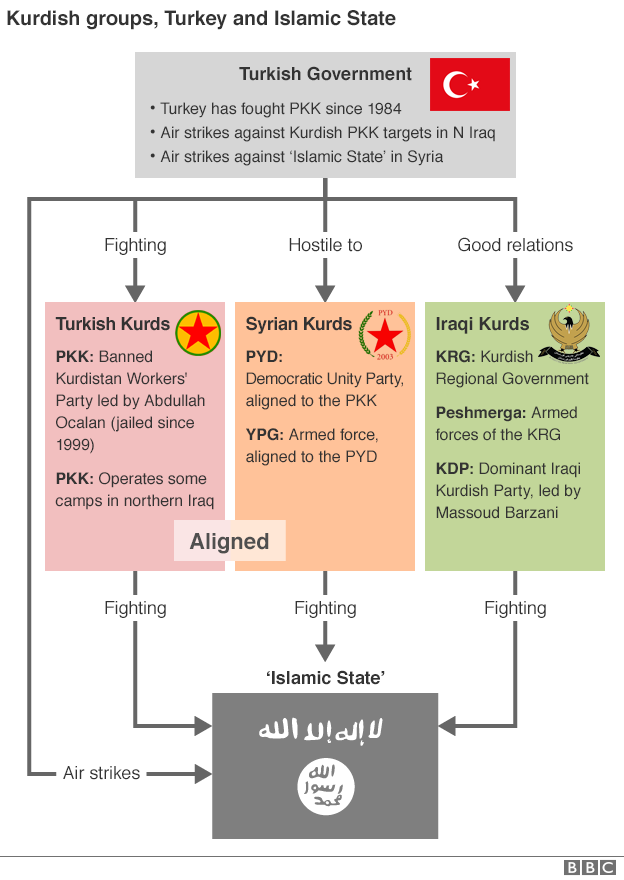 United by ethnicity and language, the Kurds are spread across Turkey, Syria, Iraq and Iran, and they comprise about one fifth the population of Turkey. Failing to get a state of their own following the Treaty of Sevres after World War one, the Kurds of Turkey entrusted their future on the Turkish state that emerged following the Treaty of Lausanne in 1923, which guaranteed the rights of minorities within Turkish borders. With the inability of the Kemalists to provide a sustainable democratic solution to the rights of minority peoples within Turkish borders, the Kurds became the latest group on the receiving end after bitter ordeals of the Armenians, Assyrians and Greeks in the face of Turkish Nationalism which ultimately had exterminated their historic presence in what is known as modern Turkey today. The Kurds in Turkey had their identity repressed as they were to be referred to as Turks. The Kurdish language was banned even as a means of learning in Kurdish areas and was not granted official recognition by the Turkish government. This inflamed Kurdish rebellion against the Turkish government, initially calling for secession and recently greater autonomy and recognition of Kurdish rights in Turkey.
Recognizing the spread of the Kurds across its neighbours, Turkey keeps a close watch on the activities of Kurdish separatism across its borders more so as the PKK has found safe haven and unity of mutual kinship amongst its brethren in arms in Syria and Iraq. Turkey has sought guarantees of non-secession from the autonomous Kurdish government of Northern Iraq and pledges to curtail the activities of the PKK in return for mutual friendship and non Turkish aggression against these groups.
Nevertheless, the Turkish government is concerned to the heights following the increased militarization of Kurdish groups across its borders who are actually seeking to consolidate the fight against IS. The Peshmerga of Iraq and the Kurdish Peoples Protection Unit (YPG) of Syria have both proved potent fighting machines curtailing the spread of ISIS, aided by coalition airstrikes lead by the USA. Thus, the PKK which has been on a long term cease fire with the Turkish government has sought opportunity to aid their kinsmen in arms against ISIS much to the chagrin of the Turkish government. As such, Turkey has sought to restrain the flow of Kurds across its borders to Syria and Iraq.
The recent standoff between the YPG and IS in Kobane in which the YPG was able to hold ground and ward off ISIS advance under the watchful eyes of an unconcerned Turkey, who, fearing an intervention could indirectly bolster the PKK, called to question the tendencies and sympathies of Turkey; seeing a common enemy in ISIS within inches at its borders. This tendency began anti-Turkish inflammation amongst the Kurds which gradually simmered into a fresh PKK insurrection against Turkey.
Though Turkey has followed up the latest ISIS attack on Suruc with joining airstrikes against IS targets in Syria, there are also underlining fears that Turkish airstrikes against the PKK who have joined their brethren in the fight against ISIS in Syria and Iraq, might in the end sabotage the anti IS efforts.
Turkey occupies a strategic and indispensable bridge between the West and the Middle East; therefore, its concerns cannot be ignored by Western powers. Thus, the PKK (which Turkey has made to be seen as an outlaw and terrorist group in the eyes of the West) might just be sacrificial pawns in the latest fight against the IS.
However, with the seeming unabated military power of the ISIS and the potency of Kurdish groups in its curtailment, diversionary airstrikes against PKK positions already embedded with the Syrian YPG and Iraqi Peshmerga might prove disastrous on the long run.
Seeing the complexities of the diversionary trend of anti PKK airstrikes by Turkey, it will be in regional and global interests for a united effort against ISIS devoid of diversionary aims, whilst Turkey settles Kurdish differences at the negotiation table. Not even the creation of an IS free safe zone in Northern Syria patrolled by ‘moderate Syrian rebels’ will help the cause for peace in troubled Syria. Rather, a renewed and increased Turkish involvement in tandem with regional and global powers will do to help the Syrian cause.
Now that Turkey has deemed it fit to intervene in the conflict situation within its region, it must be done for a common good rather than for selfish aims.
About the Author





