
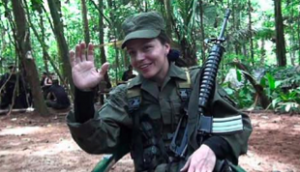
Name: Tanja Nijmeijer
Pseudonym: Eillen
Nickname: Alexandra
Date of Birth: 3 February 1978
Place of Birth: Denekamp, The Netherlands Nationality: Dutch
Occupation: Guerillera
Tanja Nijmeijer joins the peace talks with the Colombian government on behalf of the left-wing guerrilla movement the Revolutionary Armed Forces of Colombia (FARC). After the start of negotiations in Oslo, Norway, the second round of negotiations will most likely take place in Cuba in November 2012. Selected for her linguistic skills and foreign background, she will be the PR-lady of the left-wing guerrilla movement. However, some legal issues have to be resolved in order for her to be present; there are warrants for her arrest on the basis of kidnapping and terrorism.
The FARC wants social justice and land reform to establish long-term peace. According to a FARC press-release of 19 October 2012, 70% of the Colombian population lives in poverty, making it the third most unequal country in the world. However, the FARC is also known as a ‘narcoterrorism’-group. Besides drug trafficking, the FARC generates income through the kidnapping of politicians, landowners and foreign business men. The United Nations consider the FARC to be a terrorist organisation.
Although she has blood on her hands, the young Guerillera is deliberately put forward as the ‘sympathetic’ face of the FARC. “She speaks her languages. She is a good-looking, even a bit naïve, but a tough young lady. Which is obviously nonsense because she is wanted for bomb attacks and the kidnapping of amongst others Betancourt and three Americans”, said the Dutch NOS-correspondent Marjon van Royen in a recent radio-debate. In one of Tanja’s diaries that accidently became public, she indicates that she took part in a bomb attack, killing a child. Tanja is now being put forward as the spokeswoman of the FARC in the battle for peace, creating an international media-hype.
An internship brought the Dutch Tanja to Colombia in 1998. As an English-teacher to kids from elite-families she discovered the social inequalities in the country and developed a strong interest in socialism. Back in her home-country, the Netherlands, she joined the International Socialists. However, this was not enough. She became a political activist shortly after. In 2002, Tanja decided to return to Colombia to join the Marxist-Leninist guerrilla movement the FARC.
Dutch and Colombian governments’ long-time thought that Tanja was held by the FARC against her will. Despite her families’ efforts to get her out of the jungle, she has confirmed several times that it was her own deliberate decision to join the Guerilla-mouvement and that she does not wish to be liberated. On the contrary, in a recent interview with the Colombian journalist Jorge Enrique Botero, she said “If the Army and the Government of Colombia still believe and say that I have been kidnapped then let them come here to “free” me. We’ll receive them with AK47, bazookas, mines, mortars, everything.”
“Being kidnapped is like dying”, said Colombian John Pinchao (39) in an interview I held with him in 2010. The former police officer had been captured by the FARC during an attack on the town Mitú where he was stationed. John’s life turned upside down. Alongside Ingrid Betancourt, Clara Rojas and the three Americans mentioned before, John was held in captivity for almost nine years. The only communication with the outside world was the Colombian radio, through which messages from family members were communicated. It was his family that gave him the power to keep going and hoping for freedom. But freedom was never close by, negotiations with the government failed over and over again and an incredibly strong security system made an escape impossible, according to John.
However, the FARC believes that keeping prisoners busy will prevent them from thinking of escaping and so they provided books; classical books with universal and Russian literature, but also books from Colombian writers. One of the books John read was a novel about a plane crash in the jungle. It describes how the survivors managed to find their way out of the difficult situation. After a long way through the enormous jungle, they found a little village that led them to freedom. John used this story plus the information he obtained from his fellow prisoners to plan his escape from the FARC. Using the river as his guide, he made his way through the jungle until an indigenous group found him and brought him to safety. A year-long preparation was needed for his 17-day journey to freedom. In his book “Mi Fuga Hacia La Libertad”, John Pinchao describes his life as a FARC-captive and his miraculous escape.
The sharp contrast between a young western woman, self-proclaimed fighter for social justice, and the consequences for the young police officer, traumatised for life by the Guerrilla-organisation, is striking. Some believe in the romantic image of a rebellious, courageous, young woman who is proud to take her goals to another level. Others think Tanja is naïve, brainwashed and one of the most dangerous women of our times.
Image: VIDEOSTILL WERELDOMROEP/ANP
About the Author






Hey zus, supergoed! Enige aanmerking: je zou een footnote kunnen plaatsen bij de titel van het boek om de Engelse vertaling te geven voor de lezers die geen Spaans spreken. Voor de rest: helemaal top!