
Let me start off with my stance; I am pro-Israel. I also happen to be pro-Palestine. These juxtaposing labels placed on the cheerleaders of either side of the conflict are neither helpful nor constructive; there should be a two-state solution where both populations live side by side in democratically elected cooperating governments.
The recent successful bid at the United Nations in December 2012 which upgraded the Palestinian quest for a state to “non-observer status” is not going to create a two-state solution based on mutually agreed solutions. As US State Department Spokesperson Mark Toner states; the path to peace “doesn’t go through New York”. We have to remember that Mahmoud Abbas, the leader of Fatah in the West Bank, has no control over those living in the Gaza; does his bid count for those living under Hamas’s occupation? Firstly, an avoidance of negotiations on the behalf of Abbas, means that any potential moves towards tangible solutions have been missed, thus continuing the tit for tat conflict. Secondly Abbas forgot all about the suicide bombers, the rockets thrown indiscriminately at Israeli citizens and anti-Israel and anti-Jewish propaganda espoused by the more extremist Palestinian groups, in his speech to the United Nations. He only mentioned “Israeli aggression”, “Israeli bombs” and asserted there was “no need” for Operation Pillar of Defence. Clearly Abbas forgot about Hamas breaking the ceasefire with rockets escalating from November 13th 2012, days before Israel assassinated Al-Jabari and began their Operation. One must not forget Abbas’ thesis in which he claims that the holocaust was a “fantastic lie” and a “myth”, can Israel really trust this man to promote peace between the two nations in any future bilateral deal?
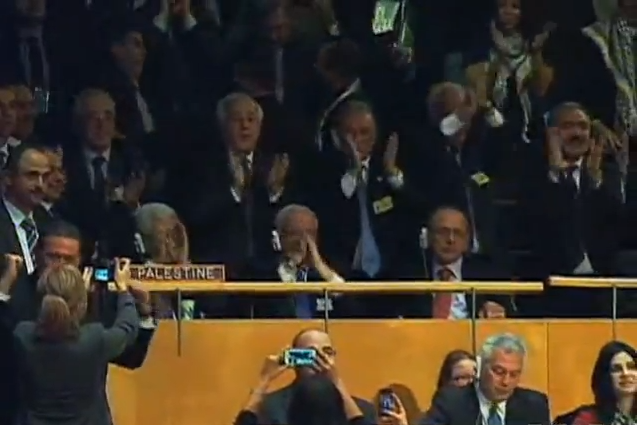
UN delegates applaud after United Nations General Assembly resolution 67/19 is passed. Photo: Wikimedia Commons.
The concept of two states is tentative, as William Hague suggested in his speech to parliament at the end of 2012; the time for it is coming to an end. The only way forward is a Palestinian State and a Jewish State side by side with land swaps along the Green Line to ensure the half a million Jews living in the West Bank in settlements do not have to flee their homes. Furthermore the push for two-states has to include two multi-ethnic and multi-religious populations; Abbas’ previous assertion that no Jew can reside in a future Palestine must be challenged. I don’t believe settlements should be dismantled, I think future construction should be put on hold until a solution comes to fruition. East Jerusalem’s status is something that I believe will be the major stumbling block in any future deal; as a bilateral agreement between Palestine and Israel, not with the United Nations. As a child I remember stories from those living in Israel who were unable to reach their holiest site; the Kotel, the Western Wall, the last remnant of The Second Temple, whilst under Jordanian Occupation. The narrative by them of the 1967 Six Day War was one of a tremendous feat upon re-claiming something so spiritual to millions around the world. East Jerusalem as the capital of a Palestinian state will only create more animosity on behalf of those wanting to pray at their holiest site.
Netanyahu’s reaction to the change in status of Palestine is an attempt to show to hard-liners he’s not going to be a push over in the run up to the hotly contested elections, especially with the new Habayat HaYahudiya, The Jewish Home party under religious Zionist Naftali Bennett, fresh on the scene and widely anticipated to come third in the elections. Netanyahu’s claim to £120 million in unpaid Palestinian taxes is also an attempt at a sign of strength. The endeavour to start building in the strategic E1 zone by East Jerusalem is a step in the wrong direction; Netanyahu is indeed throwing his toys out of the pram. I do not believe Britain and France’s recalling of the Israeli Ambassadors for a dressing down after more settlement building was announced by Netanyahu was a wise move; how many other states do they let continuously break the rules without so much as a slap on the wrist?
Perhaps in terms of internal Palestinian political relations the game has changed. Last week in the Gaza Strip, the first Fatah rally was held since the Hamas coup of 2007, to celebrate 48 years since the first attack by Fatah on Israel. Over 200,000 people attended, with Fatah putting the number at over half a million. However the protest was cancelled half way through with Fatah claiming logistical problems, although reports have now emerged of over 50 people being injured and 1 person dying after supporters of Mohammed Dahlan, whom Abbas accused in 2011 of murdering Yasser Arafat, stormed the stage. This potentially new relaxation in the tension between Hamas and Fatah signals a turning point for Palestine; if both factions can exist in relative peace, perhaps a more democratic Palestine can emerge.
A further step since the Palestinian Bid at the UN, which Abbas has labelled Palestine’s “birth certificate”, comes with the official change in name from the Palestinian Authority to the ‘State of Palestine’. This is a re-affirmation of Palestine’s upgraded status, and the State of Palestine has ordered its diplomatic representatives to start acting like representatives of a fully-fledged state, not just a pseudo-state with observer status.
With Palestine’s new standing, the game has changed. Perhaps now we can move on the path to two-states. With the establishment of a fully-qualified Palestinian state, those who support Israel will truly be able to separate those human rights activists who call for an end to Israeli Occupation, from those who wish to seek the total destruction of Israel who hide behind a mask of Human Rights; the real anti-Semites who I believe to be in a much smaller number than many might think.
About the Author





