
Gaza will crack, creating 500,000-750,000 new refugees in Sinai as well as dispersion of Palestinian leadership and Egypt will be forced into crisis containment status.
The Gaza Strip is one of the largest recipients of international funds in the world; the lion’s share of the incoming aid comes from the European Union and the United States. According to estimates made by the World Bank, the Palestinian Authority received $525 million of international aid in the first half of 2010, $1.4 billion in 2009 and $1.8 billion in 2008. Foreign aid is the ‘main driver’ of economic growth in the Palestinian territories especially for the Gaza Strip. In 2012, Qatari Prince Hamad bin Khalifa al-Thani announced an aid package of $450 for the purpose of reconstruction in the Gaza Strip.
According to a report conducted by the US Congressional Research Service, the purpose of US aid to Gaza is as follows:
•Combating, neutralizing, and preventing terrorism against Israel from the Islamist group Hamas and other militant organizations.
•Creating a virtuous cycle of stability and prosperity in the West Bank that inclines Palestinians—including those in the Hamas-controlled Gaza Strip— towards peaceful coexistence with Israel and prepares them for self-governance.
•Meeting humanitarian needs and preventing further destabilization, particularly in the Gaza Strip. [3]
Qatar and the EU share these interests and make funds available to The United Nations Relief and Works Agency for Palestine Refugees in the Near East (UNRWA), to support the governmental budget of the Palestinian Authority, to sponsor direct projects through international mechanism and to NGOs and INGOs.
Beyond this, there is also a large flow of unmonitored and unreported funds coming into Gaza for Hamas and other groups. This money is used to pay salaries, run schools and build mosques, to conduct charitable activities and often to support armed operations. It is almost impossible to know exactly how much unmonitored money is coming in, how exactly it’s being used or where it’s coming from.
It is clear that Palestinians, particularly those living in Gaza are dependent on foreign aid to survive; Gaza conducts no production activities and has no natural resources to extract or trade.
So the question arises, what would happen if EU and US interests change and they decide to change the rules of the game? What if US and EU aid stopped flooding into Gaza? There are a number of possible outcomes:
1. Fatah and Hamas, the Palestinian leadership, become paralyzed as they lack the mechanisms and the financial resources to respond to such a large crisis and to deal with its implications, so a new leadership possibly consisting of refugees might take charge.
2. Under pressure of a possible Israeli attack, 500-750,000 Gazan refugees would forcefully displace to the Sinai to escape violence and dire living conditions, which could become inevitable due to the lack of space and the current overcrowding (population of1.6 million in 2012, est. 2.1 million in 2020)
3. This will lead to the need for numerous refugee camps across the Sinai desert and so will increase the UN’s role in southern Egypt
4. The Egyptian government might then be forced into crisis containment status, as it will be obliged to direct many of its resources towards helping Palestinian refugees in the newly established Sinai camps, weakening the Egyptian government.
5. The Sinai strategic security position will be under risk and vulnerable to possible Israeli military action. Tensions will arise over the possibility of Salafi Jihadist groups using Sinai as a base for armed attacks against Israel. Potential kidnappings of Israeli citizens might create an intolerable situation leading to an attack and a possible re-occupation of the Sinai by the IDF.
6. Israel might undertake an aggressive attack on Gaza’s military and cause massive destruction of Hamas’ military and civil infrastructure, creating a humanitarian crisis and making the Gaza Strip completely uninhabitable
7. Scarcity of basic resources like food and clean water might cause the start of an internal armed conflict
8. As a containment policy, the international community will work on buying more time to ensure that Gazans have been fully displaced from the Gaza Strip to Sinai. International conferences and aid convoys will be held to create a feeling of urgent response.
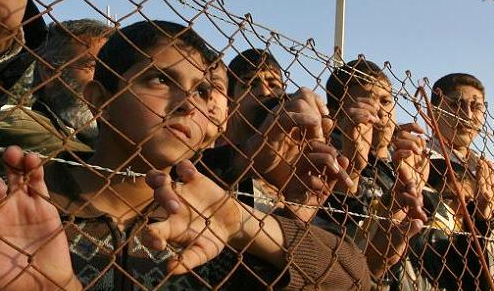
Photo Credit: Illuminating9_11/Flikr
It is possible that this crisis could well occur in the next 10-15 years, but signs of its imminence are already noticeable.
A recent UNRWA situation report on Gaza, entitled Gaza in 2020: A Liveable Place? shared the same concerns with regards to the Palestinians ability to survive the possibilities listed above, although it does not look thoroughly at the possibility of a mass refugee exodus into Sinai.
The Palestinian leadership must work with their regional support base to counter possible crises, despite the current instability in the Middle East due to the changing political, social and economic climates. A Palestinian Crisis Management Group should be established with experts who are capable of planning and implementing strategies. Youth-led committees should also be established and trained on decentralized management, crisis response, and mass-migration. Academic research and strategic planning activities should also be considered to investigate possible options and response plans. These steps should not to be considered as alternatives to already established governmental organs, but rather as complementary capabilities the civil society can make use of if or when the central government cannot respond effectively to potential crisis.
In terms of decentralization, it is of utmost imperative for both Hamas and Fatah to adopt strategies that will limit the bureaucracy and the heavily centralized style of political establishments that they operate.
 It becomes inevitable in times of crisis or conflict that the leadership cannot entirely fulfill its role of economic, political, military, social and religious decision making; recent events in Israel and Palestine have confirmed this. The wars that brought Gaza and Israel to direct confrontation pushed Hamas to use all of their resources in their military efforts, disregarding the fields of economic and social responsibility.
If decentralized policies are adopted, and youth-led committees are established, the duties and responsibilities of the leadership will be far less demanding, allowing Hamas and Fatah to focus on political and military management, while more competent and resourceful committees can take the lead in managing other issues. Such reforms will enhance the abilities of the central government, and of the population as a whole, to deal with crisis, resource shortage or aid termination more effectively. It will create a social awareness among Palestinians that matters of management are not an exclusive right of closed elites, but are the common responsibility of all.
About the Author






Poor people !
[…] What will happen if aid stops flooding to Gaza? […]