
“Valentine day. Do you know what is it ? Saint valentine had loved a young girl and had sex with her before married (ZINA) And that’s why UK government had hanged him on that day 14 february and since then the non believer used to celebrate that day. But the most sad & shameful thing is that today peoples began to celebrate that illegal sex day. WE ARE MUSLIMS AND WE WiLL NEVER CELEBRATE THIS DAY AGAIN. Inshallaha….. – Shahnawaz sonu”
This is a recent comment posted on the Facebook page of the Kashmiri girl band Pragaash which has been making headlines in the Indian and international news circuits of late. This comment, which is strongly in favour of religious ethics pronounced by the Sharia or Islamic law–comes after a fatwa issued against the band by a Mufti in Kashmir. However, the factual accuracy of the statement is both botched and very questionable. But more importantly, it is on Facebook. Of late, the band has ironically been caught between a swarm of opinions from the ‘Indian state’, Facebook comments, and the acts of self proclaimed religious leaders in Kashmir. Ideally speaking, it has come to epitomise the classic counter-cultural status of many Kashmiri youth since it appeared in the news.
This story started after their performance in Srinagar last December–at an event called ‘Battle of the Bands’ where they competed against other rock bands from Kashmir. It continued after they won the best performance award at the event and they have continued to gain popularity since then. It made a beeline into media stories when Grand Mufti Bashiruddin Ahmed issued a fatwa against the band classifying them as ‘straying from the rightful path’. This was supported by an ambiguous reference to the Sharia’s impositions on their behaviour. Later, a pronounced condemnation by the Chief minister of the state Omar Abdullah, was issued against the Fatwa and other hate comments including rape threats on Facebook. These comments resulted in three arrests by the Kashmiri Police who are also in the process of tracking down 26 posts out of the 900 which they found offensive.
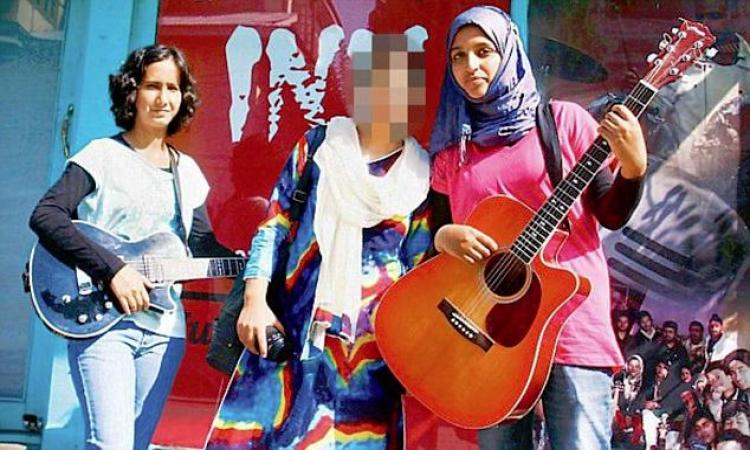
Pragaash. Image via Asian Tribune.
However, the members of the band, who are all 10th class students expressed a different opinion. Vocalist-guitarist Noma Nazir, drummer Farah Deeba and guitarist Aneeka Khalid, announced last Tuesday that they were in agreement with the Mufti’s fatwa and were unaware that music was considered ‘Haraam’ or un-Islamic. In a telephone interview to the BBC, the band expressed a compulsion to discontinue their participation in any further performances.
Interestingly, this development took place amidst claims by historians that the sharia court of Kashmir in fact, could not be traced as having had a chief justice in its legacy. This implies that the Mufti’s authority is questionable. In a recent comment, the custodian of the Indian National trust for Art and Cultural Heritage said, ‘He has no mandate to issue fatwas and no one takes him seriously’. The Chief Minister Omar Abdullah has also pointed out how this move opposes the fact that there have never been any fatwas issued against rapper MC Kash, who has become an extremely popular youth icon in Srinagar. He also felt that the singer issued ‘veiled threats’ in his songs.
http://www.youtube.com/watch?v=It0feof-hxI&feature=player_embedded
This issue might be a classic case of a publicised opportunity for a lot of different organisations to clear the ground for their respective agendas. This continues to be a common feature in most issues at the epicentre of recent protests in India. However, the questions it brings to the forefront are: Is this is an issue of the oppression of Islamic law and its typified anti-woman stance? or self contradictory state authorities identifying innuendos in pop cultural manifestations? From a more casual perspective, it simply seems like a swarm of opinionated individuals on either side of the term ‘agency’. Then, it is worthwhile to think whether ‘victims’ in such cases are only being defined by the law? And has ‘free expression’ given rise to strong politically consequential activities or are these just publicised opinions? This has also sparked another debate over a sensationalist coverage by the media, which Kashmiri politicians like Mehbooba Mufti endorse.
http://www.youtube.com/watch?v=9OjSUB-2NJM&feature=player_embedded
Its not surprising that these reports come at a time when ‘Pussy Riot’, a band being called a feminist punk rock collective are doing the rounds for their imprisonment based on conviction of ‘hooliganism’ by the Russian government. The three members of ‘Pussy Riot’ who had been convicted last August, appealed against the conviction in the European Court of Human Rights last Wednesday. This unfolds, even as the three other members of Pussy Riot continue to be in hiding proclaiming anonymity as a predetermined feature of the band.
http://www.youtube.com/watch?v=6UzE_8yEzyU&feature=player_embedded
There is an evident parallel to note between both the groups in their appeal to anonymity and their allignment with religious icons. Both have also had a spate of supporters and critics who have used cyberspace to make comments and form groups on the basis of their own agendas. Humanisation, victimisation, and largely a stream of polarised agendas find their way into the Habermasian utopia of the public sphere. Then, it is interesting to think that how the cyberspace, with its counter-cultural beginnings is being represented in the light of all these reports? What are the implications for the much touted ‘space of the discontented’? Are democratic futures really shifting to Web 2.0? But moreover, It is important to answer a question to ourselves – How much responsibility does an individual carry in the absence of conventional authority?
While forces like Talibanisation and a massive spate of online supporters continue to post their ‘likes’ or launch petitions in support of their freedom of expression, why is is that young voices in Kashmir remain silent? One of the members of Pragaash has said that they discontinued their involvement with the band because they had no support in Kashmir itself. However, the Chief Minister of the state reserves a different opinion of them. In another story from the real world, Pussy riot continues to be imprisoned, being displayed openly to the media in their cage everyday. This disconnect between virtual reality and the real world seems to pronounce a shortsightedness in the definition of expression itself. A disorientation with reference to the reality of social institutions and codes. However, if a strongly unified charter for establishing alternative spaces is not discovered soon — it might also pronounce a death of creativity or the right to celebrate the organicity of certain human skills.
This article was written by Ananya Dasgupta, and originally appeared on the Urban Times.
About the Author





