
“He that hath knowledge spareth his words” (Proverbs 17:27)
He that hath knowledge spareth his words indeed, a proverb which in light of the recent shock announcement of Pope Benedict XVI’s unorthodox resignation seems more than apt in attempting to fathom the unsettled waters of the Vatican’s mindset. Naturally the question on every inquisitive person’s lips, Catholic or otherwise, is: “who is going to succeed Pope Benedict?”; a succession which would see the election of the 266th Bishop of Rome and rise of a new leader on the world’s political stage. Unsurprisingly the relative few who make up the Vatican’s inner circle seem up to date with their bible studies and are following well the suggestions of the Book of Proverbs by giving away little, if anything, on the subject of who they feel is most likely to fill the soon to be vacated papal office.
As frustrating as it is to those not bedecked in the red and white of a cardinal’s robes, emblems of the men who shall form the voting conclave to decide the next Papa, the lack of opinion expressed by the papal electors does not necessarily point to politician-esque evasiveness. There is a genuine sense of mystery surrounding the possible successor to the current Pontiff where, as was the case in the papal conclave following the death of Pope John Paul II in 2005, no candidate stands out as the obvious choice for the next in line to the legacy of St. Peter, the Apostle.
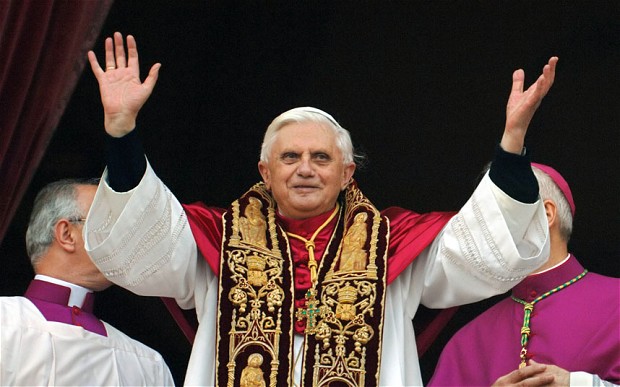
Pope Benedict XVI greeting the crowd from the central balcony of St. Peter’s Basilica. Photo: AP
Who then are the primary actors in the running for the bishopric of the Roman Diocese?
Foremost within the contenders for the papacy stands the 68-year-old Canadian Cardinal Marc Ouellet, former Archbishop of Quebec City and Prefect of the Congregation for Bishops. Favoured by Benedict and selected by the departing Pope for the position of President of the Pontifical Commission for Latin America, Cardinal Ouellet’s traditionalist views concerning abortion and ‘insider status’ within the Vatican marks him out as a ‘safe option’ to choose by the 118 cardinals of voting age. A candidacy marred by little except the increasingly secularised orientation of Quebec City and the considerable strength of the Catholic community in South America.
Alongside Cardinal Oullet and leading the South American charge for the elusive papal crown, is fellow Cardinal Odilo Scherer. Relatively young at the tender age of 63 and the current Archbishop of Rome’s largest diocese, Sao Paulo, Cardinal Scherer holds a strong populist South American following which, considering the continent boasts 1.2 billion members of the Catholic Church , places significant pressure on the unprecedented election of South America’s first Pontiff.
In a similar position to Cardinal Scherer, Argentine Cardinal Leonardo Sandri lays claim also to the South American conclave bloc of 19 votes whilst also reaching out culturally across the Atlantic via his Italian heritage. Though with a smaller popular following, Cardinal Sandri, at the more mature age of 69 and with seven years experience as 3rd in command as Vatican Chief of staff between 2000-2007, may be able to sway his more conservative compatriot voters to support the greater ‘experienced’ South American option.
Closer to the Vatican’s home and arguably Italy’s best papal contender, Cardinal Angelo Scola is considered by many to be the most likely next Bishop of Rome. Aside from his high-profile position as Archbishop of Milan, Cardinal Scola’s expertise in bioethics and Muslim-Christian relations portrays him as the candidate in tune with the 21st century, despite his 71 years. Furthermore, with mounting concerns over the deflating popularity of Catholicism in Europe, the conclave may well continue its previous form and elect a European candidate in a bid to revive Catholicism’s fortunes at home.
Second favourite to sway the considerable European bloc of 62 papal electors, Austrian Cardinal Schoenborn is the strongest non-Italian candidate to challenge from within Europe. A former student of Pope Benedict’s and Archbishop of Vienna, Cardinal Scoenborn’s pastoral touch and prominence as a potential candidate at the last conclave in 2005 places him directly in contention to be considered once more. That is assuming of course that the cardinal’s contentious suggestion to re-examine the issue of priestly celibacy in 2010 does not return to plague him like the ghost of Hamlet’s father at a critical moment in the next couple of weeks.
Finally, but by no means the least likely to fill Benedict’s infamously red papal shoes stands the quietly spoken Ghanaian Cardinal Peter Turkson, the leading candidate from Africa. Fluent in nine languages and a powerful advocate for world financial reform, at 64 the popular President of the Pontificial Council for Justice and Peace makes a strong case for the position of Patriarch of the Western Church. However, his contentious criticisms of Islam at a recent Vatican Synod and controversial stance on Uganda’s homophobic legislation will probably cause a headache for his supporting fellow cardinals come the papal conclave in early March, the first to meet with a Pope still breathing since 1415.
More to follow…
About the Author






A good article. The Pope’s resignation is a very bad news for Berlusconi whose campaign was suddenly eclipsed in the medias. Everyone will be waiting now for the white smoke out of the Sistine Chapel.
I think you need to correct the number of Catholics in South America. It’s not 1.2B, the article you reference says S.A. has 42% of the WORLD’s 1.2B Catholics
Quite right Liam, apologies the sentence was meant to read “42.% of the world’s 1.2 B Catholics” – Incidentally, who do you feel is going to become the next pope? Any of the candidates mentioned in the article or someone else?