
There is a crop of African authors entering the world’s literary scene. Like never before, African written fiction is being acknowledged and praised by booklovers, writers and publishers worldwide. The list of novels and novelists, though not nearly as comprehensive as it should be, is growing. Perhaps my own recent encounters with African fiction are testament to the gradual but inevitable interest of the world in African storytellers and the influence that these writers could have over the next generation of African thinkers. I’m a privileged young African woman with a western education and a fondness for reading. My world has been defined by writers such as England’s Austen, Orwell and Shakespeare and America’s Fitzgerald, Steinbeck and Miller. The list is long and until recently consisted only of authors with skin as white as milk. Whilst this is in itself not problematic, what is are the crises of many middle class Africans living in Africa and the diaspora in identifying their own personal heritage due to a lack of material to educate and inspire ideas on modern African identity. Like me, this faction of people has grown up reading the story of others finding it bares only a partial resemblance to their own.
Enough has been written on the western perspective of Africa. These works are fair in standard, sometimes challenging Africans own perspectives of life on their continent but are understandably, communicating a white ideological view of black life and culture. Joseph Conrad’s The Heart of Darkness is a widely acclaimed piece of literature on Africa yet Achebe, declares the views of Conrad as racist. In my own experience, no one is more apt at expressing African sentimentality than the African.
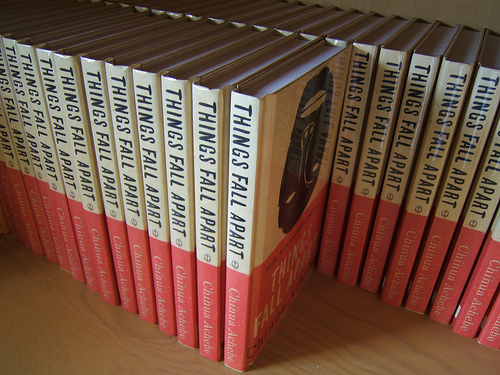
Nigerian born Chinua Achebe is probably the most recognised African writer alive and one of the pioneers of African fiction written in English. No surprise that in post-independence Africa, this choice of medium was viewed by some as deference to an old and oppressive system. African nationalism during the 50s and 60s was of considerable importance. In supporting a culture of nationalism, arts and culture was expected to return to pre-colonial traditions and that would for many mean writing in African languages. As an English speaker I am inclined to feel slighted at the suggestion that people like me would be deprived of the genius of writers such as Achebe, Adichie and Soyinka. Furthermore, the western world with all its ideas on Africa, as inspired by writers such as Conrad, would too be denied a chance at a novel perspective on the African situation.
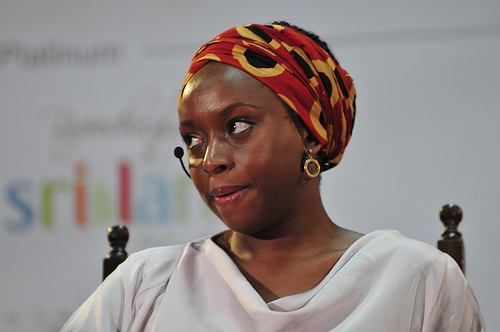
Nigerian Author Chimamanda Ngozi Adichie (Image: bbcworldservice / Flickr)
My dad introduced me to Chimamanda Ngozi Adichie. I read The Thing around Your Neck, a book of short stories that propelled me into unfamiliar reading territory. I had never chosen to read novels by Africans, having been discouraged by those obligatory African works read in classrooms. I had never read the stories of my race, my class, my continent in a way that I would have told them. I have since gone on to read every single one of her published works as well as to delve into this fresh, young crop of people writing ‘African English’. As a black African woman with a story that is forever being directed by the written word, I do not believe there are greater heroines than Adichie and no story could interest me quite like the African one. Imagine my surprise at meeting young women with faces that match my own in books that I not just enjoyed but loved. Imagine my enjoyment at recognising anecdotes of my very own life and the lives of people I knew. Imagine recognising my frustrations in the author’s voice but also that same unreserved affection that comes with learning to forgive a place that has hurt as many people as it has taken care of. Imagine this because it was not until recently that the world of books became about our stories as well as those of others.
It was during a croaky Skype call that my mom mentioned Chibundu Onuzo. This young Nigerian author published The Spider King’s Daughter at the age of 21. It occurs to me in such moments that the emergence of Onuzo marks a time when Africans can write about Africa and share stories with a world that is interested. A marked opportunity for my dreams of writing to be realised is the message of women like Adichie and Onuzo. An opportunity for young Africans to rethink the African identity in a way that respects our history and our futures.
Jane Austen gave my life comedy, Alcott showered it with romance, Orwell created a politician but Achebe came along to give all of that life, love and learning context. The world must celebrate the skill and creativity of upcoming African writers but for me, the greatest triumph of African fiction by African authors is what it gives to the African.
This article was written by Linda Liwewe and originally appeared on the Urban Times.
About the Author





