
It was revealed earlier this week that Chelsea and England midfielder Frank Lampard has signed a deal with publishers Little Brown, and is set to write a series of children’s books. The midfielder breaks the stereotypical, and arguably harsh, public image of the uneducated footballer with the fact he holds a law degree, and is set to centre his stories around a boy (Frankie), his dog (Max) and his football loving friends. The tales were originally told by Lampard to his children at bed-time, but the star evidently wants to share his stories in what will be five separate book releases, the first of which will be in June this year. The benefits for Lampard himself are evident, as this will provide another string to his bow in terms of revenue streams, and further raise his profile as an icon for young people.
However commentators on the subject aren’t all behind the footballer’s foray into the world of children’s literature. Writing on the Guardian website, Emine Saner said:
While some children’s books written by famous people are occasionally well-received – Stephen Hawking’s and David Walliams’s books spring to mind – most seem forgettable; none, for instance, have been nominated for the Carnegie award, which recognises good children’s literature.
Saner also points out that Lampard is not the first footballer to make such a venture: fellow England star Theo Walcott produced four books for children, which were all short-lived in the memory.

Photo Credit: paulbence/Flickr
Despite Saner’s criticism, it seems that if Lampard, who clearly has some academic clout, takes story writing as seriously as he has taken his stellar football career, the stories should be a success. ‘Success’ in this case refers to the quality of the writing , and ultimately the sales that the books will generate; nevertheless there is another area in which these books may well succeed, and that is raising the literacy rates of young boys, and in turn furthering their future education.
There have been a number of studies and articles over the past few years that have suggested there is good reason to be worried about the literacy rate of young boys (11 and under) in the UK. In 2010 The Guardian revealed that around 10% of boys were at a level lower then they should be when it comes to reading, producing with it a condemning map of the country highlighting the scores acquired by pupils in each area. Two years later in the summer of 2012 the BBC released news that the gap between the reading ability of boys and girls was actually widening, and there was no official strategy to deal with the issue. The difference in attitude between genders at a young age also appears to affect the results at GCSE level with 14% more girls receiving an A-C Grade in English then their male counterparts.
Someone who has attempted to explain why these statistics are the way they are is Robert Lipsyte of the New York Times. He makes two important points, firstly that boys need: “the kind of reading that will prick their dormant empathy, involve them with fictional characters and lead them into deeper engagement with their own lives.” And secondly: “Boys don’t have enough positive male role models for literacy.”
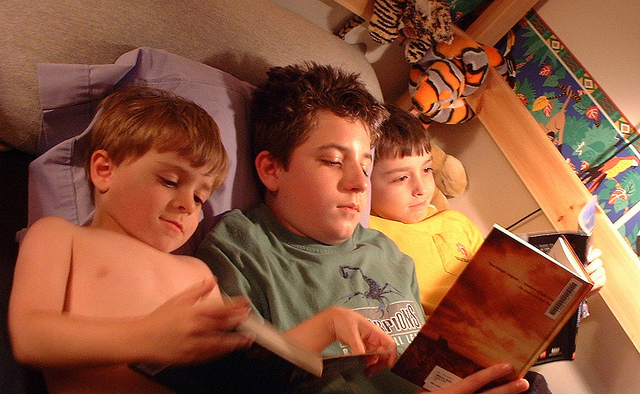
Photo Credit: kbowenwriter/Flickr
It seems clear that Frank Lampard meets both the criteria set out. Firstly his novels are on a subject that will attract a large number of young boys given the nation’s love for the sport of football, and secondly he is somebody who is already a role model to a lot of these young boys, and so his transition to a literary role model should be instantaneous. Lampard has the potential here to reverse young boys’ aversion to reading, and if successful could prove to be the spark that ignites a positive cycle.
If young lads suddenly deem it acceptable, or even “cool,” to read this may inspire an entire generation of boys to start reading. This interest would raise the literacy rate, and higher demand may also result in more male oriented literature being produced, as it would sell more. After all publishers do so for profit, not to raise literacy rates: if there is a demand for literature they will print, if not they won’t. This positive cycle could even improve the average level attained at GCSE in English for boys, and close the gap between the genders.
Whilst it appears that a large number of celebrities have tried, and failed, to enter the literary world, Frank Lampard has a real opportunity to produce some high quality children’s literature. If he does so this may prove to be a real turning point in the battle to get young boys reading. Who better to inspire them then the man on the posters in their bedrooms?
This article was written by Callum Henderson and originally appeared on the Urban Times.
About the Author