
On the 18th November 2012 the International court of Justice in The Hague made a decision concerning a major demand: Nicaragua established a claim over 330.000 square miles of land and sea, space that was previously considered Colombian territory.
This judicial process finally came to an end after 10 years with a controversial decision. Colombia will keep possession and sovereignty over the islands of San Andres and Providencia, but it will lose control over 68.000 miles of sea. What was the matter here? At this place there is an important Biosphere preserved by UNESCO as well as a zone that is believed to hold an abundance of petroleum.
Immediately after this decision was announced, the Colombian government condemned it and it remains unimplemented. Managua menaced Colombia with using its granted rights over the sea and a war seemed imminent. Fortunately, both sides agreed that violence is not a valid solution, but the application of the ruling remains undefined.
For Latin America, this case represents the first time the Colombian government has directly attempted to break international law and this event sets a precedent for future territorial conflicts. The International Court of Justice (ICJ) has a further five demands about disputes in the subcontinent but its legitimacy and the force of its decisions will be under fire if this statement is not fully applied. What does this show?
There are two perspectives that come to my mind: one internal for each of the participant countries and one external. Both of them make this event a pick that shows a deeper problem in Latin America, especially in South America. Internally for Colombia, the decision showed the government’s understanding politics to be focused only on what happened at the continental center of the country, with their interest about the sea emerging only when territorial possessions are under risk.
Furthermore, Colombia understands itself as a country of Andean area roots and not of Caribbean character – and its foreign policy responds to the issues of pressing policy inside the country further the existence of a coherent and articulated policy in the long term.
Inside Colombia a deep feeling of indignation increased in the population, and the citizens did not hesitate in taking any action in order to not apply the decision of the court. Unevenly, a population unaware and disconnected from the foreign policy of the country focused on the events of the international politics of the region. Most Colombians lacked a clear knowledge about the frontiers of their country in the Caribbean Sea, including the majority of the members of the parliament. Nineteenth-century patriotism returned to the spotlight and called to the population to press the government to face the situation. The government tried to free itself from blame by saying the resolution will not be adopted and started to search any possible way to not apply the verdict.
For Nicaragua, the decision implied a similar process but in the opposite way: nationalism and internal political interests and policies motivated the call for intervention of the ICJ, and by the same means, Nicaragua’s foreign policy responds to the needs of the internal politics of the moment. None of the participants recognize that the way they administered and prioritized their respective foreign policies and political identities could affect the map of the continent.
Externally, the decision of the ICJ made evident the lack of response from international actors in the region, especially countries that have borders with Colombia and/or Nicaragua. Other countries on the continent, failed to make any official responses to the differences between the two states nor over the decision by the Colombian government to reject the decision, even if fishing ships of Honduras or the petroleum companies operating in Costa Rica could be affected.
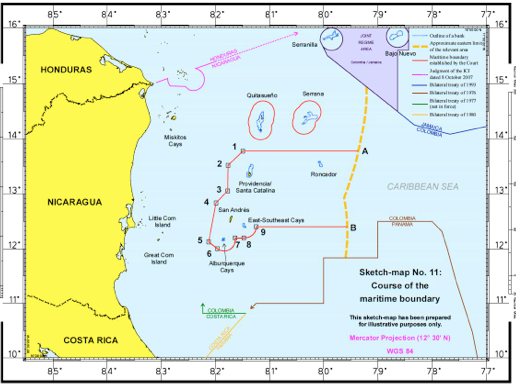
Before the decision. Image: Retailchile/blogspot
This scenario reflects the lack of an articulated frame of action in the foreign policy of countries in the region; something that could be very dangerous for their interests, actions and identities. Such absence exposes the inexistence of serious and clear agendas and actions in the international system, an attitude framed inside the politics of small power states (with exceptions in Brazil and Mexico).
The confirmation of the roles of international actors responds to the relation between them and, if the actors do not recognize the importance and impact of their actions and the actions of others, probably could not change their position in the international sphere.
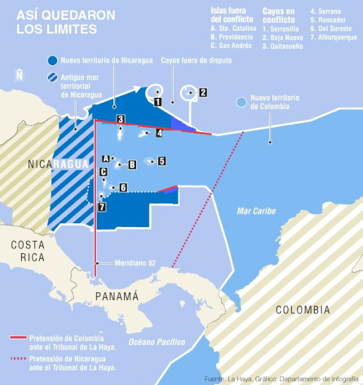
Latin America is now changing its economic and social position in the world and the different countries here must assume a new attitude responsible of their actions internationally – articulated with their internal politics (not dependent of, just articulated to) and focused in the establishment of a new active role that respond to the current events and could constitute the region in a new global leader, not a group of small or medium power states. The different changes that Latin America faces today must be accompanied by a change in the way foreign policy works.
Latin America can develop a new role and each state must act in this sense. Historically, one of the tasks for the strengthening and consolidation of States have been the conformation of a clear foreign policy that represents and defends their interest and ideas in front of other states. If Latin American states do not make this articulation, they will not be successful in taking an important global role. The controversy generated around the decision of ICJ and the diffused and disarticulated reactions inside the countries on it just reflects a failure for Latin American States to integrate themselves clearly and consequently in the dynamics of the international system. At this stage, national and regional interests join and need to be put forward.
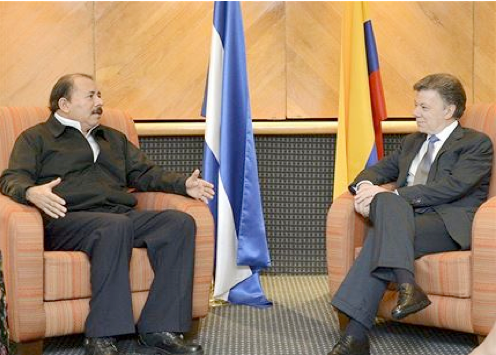
Ortega and Santos arguing about the verdict. Image: Noticias latam.
About the Author





