
Over the past two weeks, Israel’s image has been smeared because of the use of social media, both by international activists and by one of its very own soldiers. Joining the viral craze of The Harlem Shake, and the exponentially growing Instagram application, online activity is proving that it’s not just Facebook that can affect governments.
Israeli Soldier’s Instagram
The emergence of a photograph that Soldier Mor Ostrovski, who currently serves in the Israeli army posted on Instagram serves as a reminder of the power that social media has on public opinion. The Israeli government is no stranger to using social media to attempt polishing its image, with several government officials having accounts in multiple languages to reach out to the public. However, it seems that the puppet masters are losing control of their puppets; the photograph depicts a crosshair pointing to the back of a presumably Palestinian child’s head. The photograph is nothing but a reminder of the cruel cycle of barbarity that the military occupation breeds. As distasteful and shocking as it is, it’s not the first time that the IDF has had to deal with a dent to its PR campaign. Images of Mohamed Al-Durrah being repeatedly shot as his father attempted to shield him still resonate in my mind, despite being eight years old when I saw them. However, it’s one of the few times that Israel’s very own has posted something so publicly.
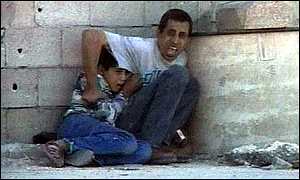
Mohamed Al-Durrah
Harlem Shakes for Palestine
At the opposite end of the world, just a few hours away from Private Mor Ostrovski’s hometown of Tampa, Florida, a group of activists in Brooklyn, New York shook their messages of resistance to the viral theme of Harlem Shake. Traditionally, the Harlem Shake features people dancing frantically to DJ Baauer’s song Harlem Shake. The activist group Existence is Resistance jumped on this craze to communicate the plights of Palestinians to the world.
The placards held by the dancers in the activists’ video show solidarity with hunger strikers. The video also calls for justice, basic human rights such as an integrated road system and a system that allows one to see their family freely.
Israel’s Double Edged Sword Against Anonymity
One notable discrepancy between the video and the photographs posted is the anonymity of the producers; while the Instagram account of Mor Ostrovski was public at the time he posted dozens of photos documenting his life in the military and resentment towards Arabs was public (and continued to be public until it was taken down on the 19th of February), the activists in the video shield their faces with the all-too traditional symbol of resistance: the kuffiyeh.
Whether wearing the kuffiyeh was intentional to hide their identities, or if it was symbolic to emphasise the lifestyle of resistance lead by the activists, it doesn’t change Israel’s notoriety in monitoring online activity. The Israeli government has a history of monitoring online activity, and using the information found online for just about everything, including its decision as to whether or not to allow tourists into the country. Thus, it’s somewhat convenient that a blind-eye is turned when their very own soldiers act “against the IDF’s spirit and values”, as described in a statement to YNet. The few activists who are in fact allowed into the country admit to wiping their digital footprint, deleting their Twitter accounts, changing their names of Facebook, and replacing their names with a pseudonym on their own personal blogs. Thus, it is clear that on-line presence is monitored, so why hadn’t the IDF spotted this activity from within?
Making the Military Cool again
The IDF has tried many tactics to encourage young people to serve for periods longer than what the conscription law requires, letting its soldiers post photographs of themselves smoking cannabis and ‘enjoying’ military life may be just another tactic.
For many, serving in the military is a box they need to tick on university applications. The IDF has gone to many lengths to entice people to join the military. In July 2007, the Israeli Consulate partnered with Maxim Magazine in the United States to print borderline pornographic images of former female military officers. It described the idea as a “creative solution” to their image problem. A job that entails playing with guns, rifles, and smoking illegal substances while getting paid in a country with soaring youth unemployment rates would certainly look more appealing than playing cards to pass time as one waits for a call-back from a job interview.
Social media is a thin rope and the users must tread lightly. In this case, turning a blind eye has backfired on the IDF, but that’s merely because the photographs were exposed. The fact of the matter is that these photographs depict the reality that Palestinians face every day, and the very thought of wanting to end them on-the-ground keeps activists from getting on-the ground, making them resort to social media to fight the system. However, online awareness is just one step in the ladder to have a free and just Palestine.
About the Author






Great article! It’s time people start to see for themselves the cruel torture, that many palestinians endure in their own country in the hands of the victimizing Israeli occupation.