
In the mind of a number of pundits, including a large number of Egyptians, the election of President Morsi as a representative of the Muslim Brotherhood (MB) should have initiated a drastic change in Egyptian foreign policy towards Hamas and the Gaza strip. This was based on the assumption that there is an organic link between the MB in Egypt and its Palestinian off-shoot, Hamas in the Gaza Strip. There is a commonly held belief that Hamas is nothing more than an extension of the MB, and that it has a subordinate relationship to the new regime in Cairo. Coincidentally, the same argument was used by the Mubarak regime in a number of meetings between high level Egyptian officials and their American counterparts. In those meetings the MB and Hamas were portrayed as part of an Iranian plot to destabilize the region. Egypt was cast as the bulwark against those radical forces and an anchor of stability. During the late Mubarak era, this hostility reached a new level with the blockade of the Gaza strip during operation Cast Lead and the continuation of this blockade until the fall of the Mubarak regime. Opposition to this policy later became one of the major themes of the Egyptian Revolution, where Mubarak was portrayed by the protestors in Tahrir Square as a Western stooge and an ally of Israel.
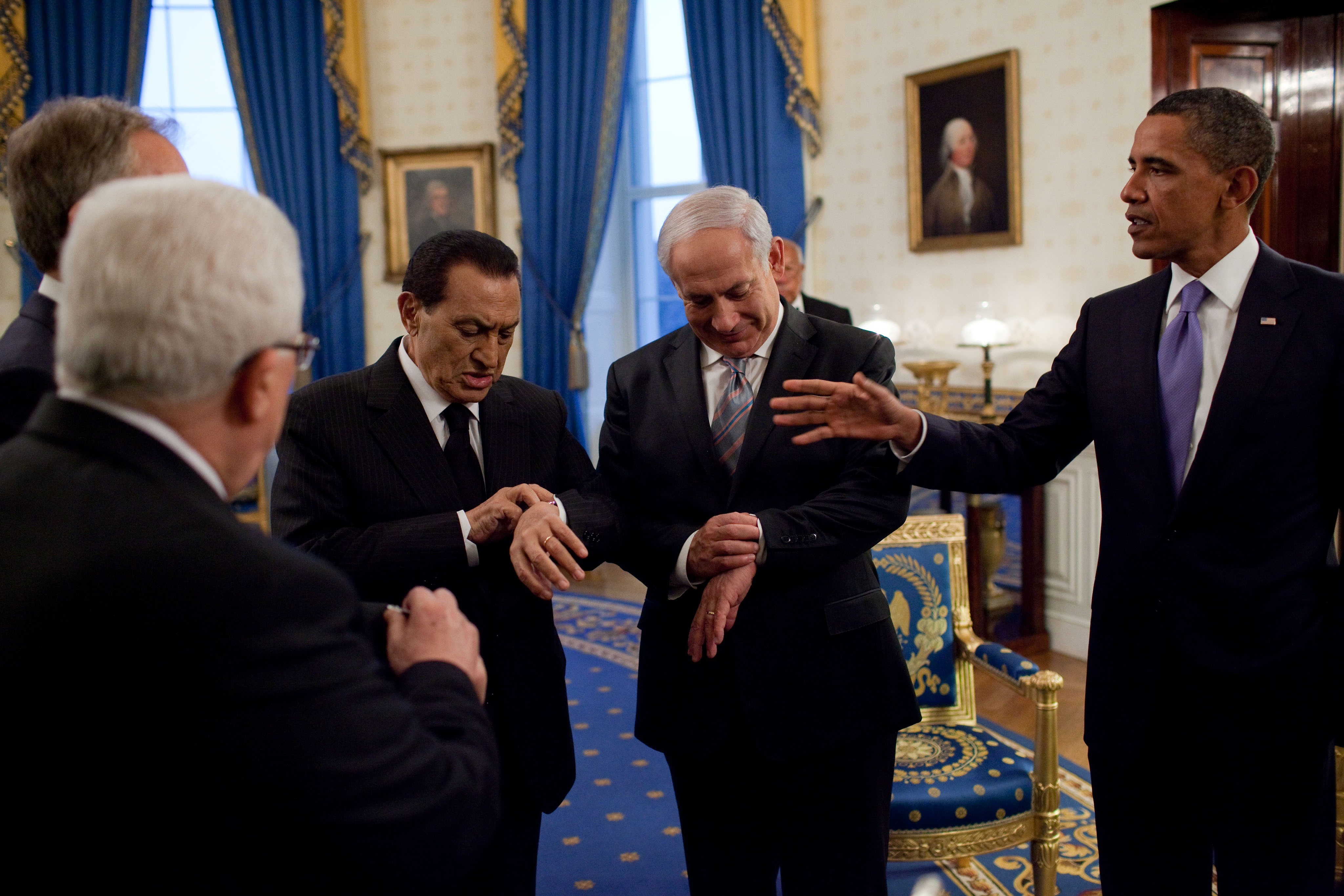
“Mubarak was portrayed by the protestors in Tahrir Square as a Western stooge and ally of Israel.” Image: Pete Souza/White House via Wikimedia Commons
Egypt’s value proposition to the United States and Israel is its ability to co-opt and neutralize radical forces operating in the region. After the Camp David Accords, Egypt took up this mantle and was able to serve the American goal of preserving the regional status quo. This was achieved through co-opting radical forces which threatened the regional order built by the United States. In exchange for this role, Egypt received lavish aid and loans from the United States and other international bodies. Most important of which is the 1.3$ billions of annual military aid, which helped to reinforce the role of the Egyptian Military as an autonomous power center heavily penetrating the state. The Egyptian Military became instrumental in directing foreign policy particularly in relation to Hamas and the Gaza strip, especially after the advent of the War on Terror, where the role of the General Intelligence Agency under Omar Suleiman became more apparent. The General Intelligence Agency remains vital in formulating Egyptian foreign policy.
The election of President Morsi has had little impact on Egyptian foreign policy towards Hamas and the Gaza Strip. Although there was an easing of the blockade imposed on the strip and there were attempts to brand Morsi as the protector of the Palestinians, the major tenants of the policy remain the same. This was made clear in the role played by the Egyptians in the latest Israeli operation in the Gaza strip – a role that was praised by both the Israelis and the Americans. Egypt continued to play its traditional role of coopting Hamas and performing a number of public relations stunts – the visit of the Egyptian Prime Minister to the Gaza strip and the withdrawal of the Egyptian ambassador to Israel – with no real support to the Palestinians. There was no real pressure exerted by the Egyptians on the Israelis. The end result of the Egyptian efforts was an agreement that stipulated that Hamas would not launch rockets into Southern Israel, while Israel would ease the blockade but not lift it. The blockade of the strip continues and the suffering of the Palestinians living in the strip has not been eased.
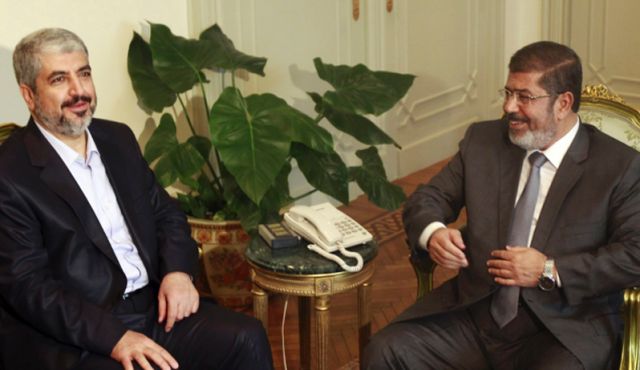
Egypt’s President Mohamed Mursi (R) meets with Hamas leader Khaled Meshal at the presidential palace in Cairo
President Morsi has inherited a foreign policy apparatus that he seems reluctant to change. This includes Egyptian dependence on the United States which Morsi seems to be unwilling to remedy. Egypt is currently facing a deep economic crisis with the foreign currency reserves depleting rapidly. Morsi’s proposed solution to the problem seems to be a 4.8 $ billions loan from the IMF, a first of a number of loans that he hopes to obtain, perpetuating Egyptian dependence on the United States (without American support obtaining this loan would be almost impossible). Morsi seems to be unwilling to pursue radical economic remedies that might upset the current domestic status quo. The most important of which would be the taxation of the vast Military Business Empire or imposing government supervision on those projects. On the other hand, the Egyptian military remains highly dependent on American patronage in terms of aid and weaponry, a situation which has not changed since the fall of Mubarak, causing the Military to remain a guardian of the regional status quo.
The situation is also reinforced by the unstable domestic Egyptian political scene. President Morsi has been focused on power consolidation using force, alienating a large segment of the population and political forces alike. This has narrowed his base of support significantly. Conversely, the popularity of the Military is on the rise as a large number of Egyptians view it as the only viable alternative to the current political turmoil. This has caused Morsi to be dependent on the support of the United States as it is the only force capable of curtailing the appetite of the Egyptian Military for intervention. Naturally one of the pre-requisites of American support is the preservation of the traditional Egyptian role in the region as a status quo power, coopting radical forces and maintaining regional stability. Thus, one should not expect any major shifts in Egyptian foreign policy towards Hamas, unless there are major changes in the Egyptian domestic scene.
About the Author





