
“Revolution” is a dirty word in China; but it shouldn’t be. In fact, the Chinese are rather well versed in it. Everyone is aware of the events at Tiananmen Square in 1989, but less well known are China’s other revolutions. At the turn of the twentieth-century its people rose up against foreign intruders in the Boxer Rebellion; in 1912 they ousted the last Emperor and in the 1920s they protested against traditionalism under the New Culture Movement. The Chinese, it would seem, are no strangers to revolution.
The confirmation of Xi Jinping as president in March has, for some, given renewed hope to China’s latest generation of revolutionaries. They are right to be optimistic, too: last year Mr Jinping openly talked of a “great renaissance” and a new “China Dream” – music to the ears of the pro-democracy camp, no doubt. However, one month on and the new president has shown few tangible signs of committing to reform: corruption, income inequality and environmental problems continue to plague the country.
Corruption is perhaps the biggest problem facing China’s National People’s Congress (NPC), the country’s ineffectual rubber-stamp parliament. Bribery, money laundering and embezzlement are commonplace amongst Communist Party officials and have for years been an almost accepted practice. Mr Jinping has to his credit, however, promised to rid the government of misconduct by tackling its rampant bureaucracy as well as stripping away official privileges, such as lavish meals, chauffer-driven cars and red carpet treatment. But it seems as if these reforms are mere bargaining chips, simply aimed at appeasing the public in the short-term. More substantial reforms will be needed to quell rebellion in the ranks.
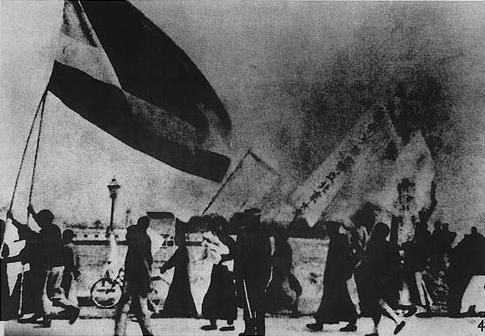
Protestors at the May Fourth Movement, dissatisfied with Article 156 of the Treaty of Versailles for China. Image Credit: Wikimedia Commons
The widening gap between the rich and the poor is another obstacle to overcome. China’s Gini coefficient – the index used to measure income distribution – stood at 0.47 last year (0.00 being perfect equality and 1.00 perfect inequality). This shows that there is still a huge gulf between the earnings of those at the very top of Chinese society and those, mainly in rural areas, who are left a lot worse off. Furthermore, around 12% of the population continues to live on less than £0.83 per day.
One of the biggest gripes of China’s burgeoning urban middle class, though, is the environmental situation. Anyone who watched the Beijing Olympics in 2008 would have seen the problem: smog. Air quality in the country’s capital Beijing, in particular, is frequently lambasted by the World Health Organisation (WHO). The latest concern is for the increasing ubiquity of particles known as PM2.5, which are able to penetrate deep into the lungs and can enter the bloodstream. Beijing currently takes readings of 1,000 micrograms of the matter per cubic metre of air, which is deemed by the WHO to be dangerous if it exceeds just 25. Unsurprisingly, the polluted air has been linked to tens of thousands of deaths in recent years as well as a rise in the number suffering from lung cancer. Yet this is not the least of the public’s concern: last month 16,000 dead pigs were found bobbing around in a Shanghai river that provides locals with tap water. There are also problems with substandard food – recently, batches of milk powder were discovered to be toxic and there were allegations that painted white stones were being sold as rice. But this is not new: in 1998 there was the cover-up of the blood-buying scheme in Henan province which infected tens of thousands with HIV, and in 2003 the government unsuccessfully attempted to sandpaper over an outbreak of the SARS virus. The environment, it seems, is not high on the government’s agenda.
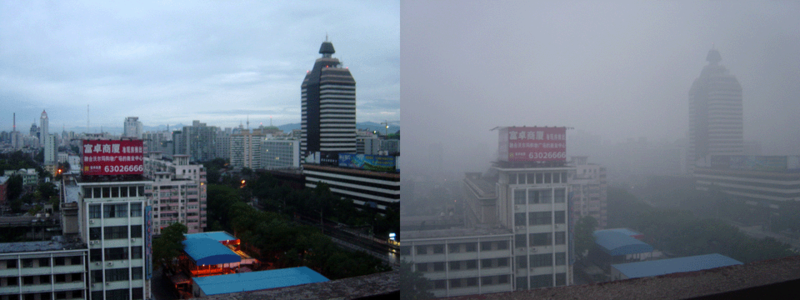
Now you see me, now you don’t. Smog in Bejing. Image: Bobak/Wikimedia Commons
Finally, there is the internet. It is a sad but likely fact that few in China will read this article, as it will probably either be blocked or censored by Communist Party officials. Since the construction of the “Great Firewall” in the 1990s Chinese people have been denied full access to the web. Websites deemed politically provocative are blocked whilst more moderate sites are surveyed, filtered and censored by the Party’s cyber arm, Golden Shield. Google is constantly attacked by Chinese malware, as are overseas IT firms, aerospace agencies and satellite and telecoms systems. The government is complicit in these acts, yet seemingly allows hackers a free rein. As Bill Clinton once sardonically remarked, attempting to control the internet in China is like “trying to nail Jell-O to the wall”. More worrying is the prospect of the government shutting down the internet altogether, as it did temporarily with the province of Xinjiang in 2009. Needless to say, there is a long struggle ahead for greater internet freedom.
This all paints a dull picture for the future of reform in China; but it shouldn’t do. The internet is, despite government controls, growing at an astronomical rate: 564 million people now use it. The e-commerce market is worth over $200 million in China and the online gaming market has recorded sales of up to 60 billion Yuan. More people are gaining access to the internet, and more readily. Surely it is only a matter of time before the government succumbs to increasing pressure for online reform. Li Keqiang, China’s new premier, has also made noises for significant governmental change and has vowed to curb the country’s spiraling corruption problem. The environment is also being looked at.
But will the government put its money where its mouth is? It is difficult to say. On the one hand Xi Jinping seems the reforming-type: on the other the government may settle for a compromise solution, in which the public are drip-fed reforms gradually over a number of years and are ‘kept happy’. This is probably the most likely scenario. Despite this, the Chinese government must stick to its promises. Actions are louder than words. History has shown us that, when humiliated, subjugated or suppressed the Chinese people will rise up and revolt – and in numbers. The Communist Party has to be careful where it treads, and it slows the pace of reform at its peril. The twenty first-century could be a dawning of a new era for China. It is time now for Mr Jinping to step up to the plate.
About the Author






[…] http://archive.the-ipf.com/chinas-revolutionary-road/ […]
[…] http://archive.the-ipf.com/chinas-revolutionary-road/ […]