
Since news broke about the death of Britain’s former Prime Minister Margaret Thatcher, celebrations have en widespread on Facebook, Twitter, blogs and in real life. Similar scenes were played out in 2011 when Osama Bin Laden was killed by the US military. Although the two are not at all similar figures – one a politician and one a terrorist – the extreme sense of mass joy at their deaths are very much the same. Entire nations are rejoicing that they are gone.
I am not British. My family was not affected by the horrors of Thatcher’s politics. Nor am I American. It was not my loved ones who died with the terror that struck New York. For this reason, I am not claiming to understand what it must feel like. I am not defending any of the terrible things they have put so many people through. I am simply arguing, as a believer in human rights as universal values, that we cannot pick and choose who we extend them to. If I have the right to life, then so do Margaret Thatcher and Osama Bin Laden, regardless of what they have done. That is why I will not celebrate their deaths, or the death of any human being.
I imagine arguments about the symbolic meaning of these deaths will come up. But if this is all symbolic, then we have to realise that the death of a person is not the actual cause for celebration and makes little difference to the current situation. Margaret Thatcher died of old age and illness. Her political deed was over long ago, which is why her death changes so little for those of us who do not know her personally. The symbolic death of her actions took place the day she stepped down from power. It takes place every day when people express anger and hatred over her politics. It has nothing to do with her actual death.
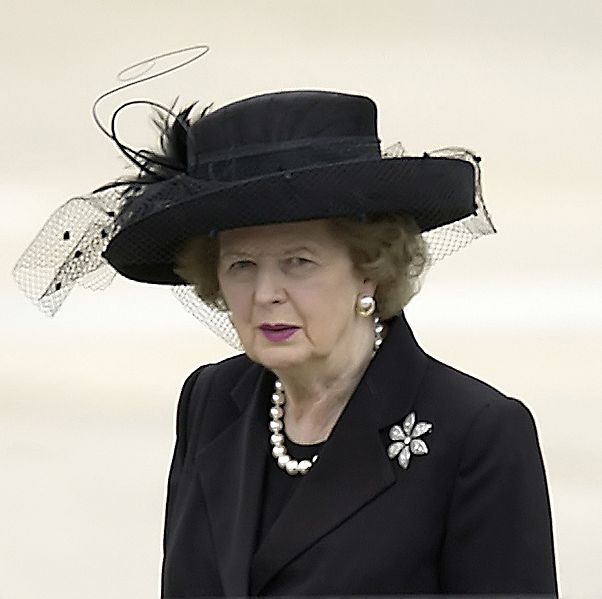
Margaret Thatcher at Ronald Reagan’s funeral. Image Credit: US Navy.
I imagine arguments about justice will come up. But the fact that the criminal is dead does not change what they have done. In the case of Osama Bin Laden, it was an organised killing of a wanted man who was eventually found. While there are at least various opinions about Margaret Thatcher, nobody can claim that this man did not deserve what he got, having over a thousand lives on his conscience. But is this kind of an-eye-for-an-eye-society really the world we want to live in? Criminal justice is one thing: accusing somebody of a crime and then putting them to a fair trial. Killing them in a war of revenge is quite another. And there are other ways to cope.
In South Africa, after the end of apartheid, the Truth and Reconciliation Commission reviewed case after case of murders that took place during the regime. In many cases, amnesty was granted for those responsible, if it was deemed that they acted as a consequence of the circumstances they were in. When amnesty had been granted, the killer was invited to express their regret to the family of the victim, and the family was in turn invited to talk to them, and see if they could eventually forgive. Of course, forgiveness of this kind will not always be possible. But I would rather live in a society that praises it as an ideal than one that celebrates revenge and punishment. Look at people like Nelson Mandela, who does not feel anger towards the ones who put him in prison for 27 years and caused his people so much suffering. All we have to do is realise that they are human beings too.
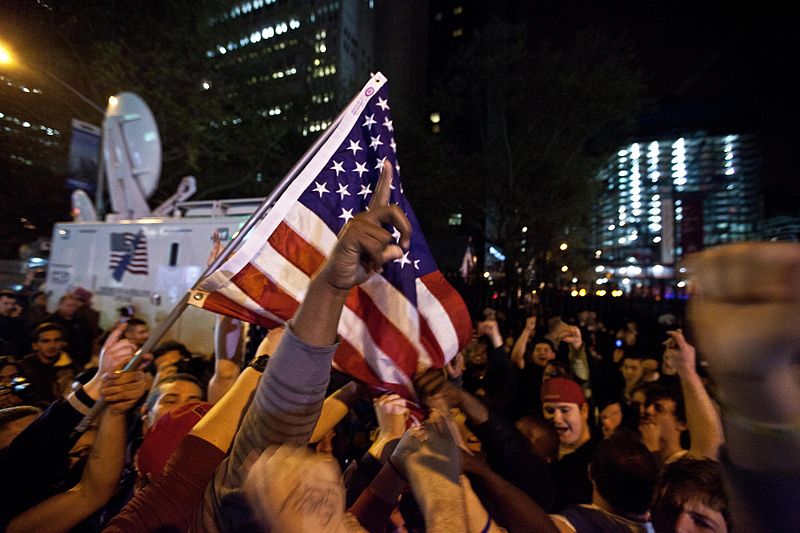
Americans celebrating the death of Osama Bin Laden. Image Credit: Sgt. Randall Clinton/U.S. Marine Corps
A more recent case is that of Anders Behring Breivik, who killed 77 people in Norway in 2011. Most of the victims were teenagers, enjoying a summer camp with the socialist party on the island Utøya. Afterwards, the entire country was in shock and mourning. The rest of the world imagined a Norway that would never recover, that it could never remain an open and trusting society after an event like this. But this is where the story becomes remarkable: Prime Minister Jens Stoltenberg declared that the Norwegians would do the exact opposite. “Our response,” he said in a speech in Oslo Cathedral, “is more democracy, more openness, and more humanity.” One year on, in July 2012, The Telegraph met Stoltenberg again. And he was right: Norway is still not suspicious, there is still no security outside government buildings and no CCTV cameras in the streets. The Prime Minister hails this fact as Breivik’s failure.
“He managed to cause a lot of sorrow and damage, and many people will live with the wounds, but he failed in his main project, which was to change Norway, to make Norway less open, less tolerant”
If human rights are values we want in our societies, this is how we must meet cruelty and injustice: with humanity and justice. If people do us wrong, we must still treat them fairly. If we do not, we will only contribute to creating an environment and a society that is unfair and unjust. De-humanising is a core factor in conflict; when we forget that our enemies are humans just like us, we will start treating them without the most basic human respect, and bring disaster on ourselves. By all means, people should be allowed to express their hatred over Thatcher’s and Bin Laden’s actions. But I want a fair society based on universal human rights values, and celebrating the death of a fellow human being does not fit in there.
Read also: I Disagree With Much of What Margaret Thatcher Did – But I Won’t Celebrate Her Death
About the Author






Having people accord you a level of respect you don’t deserve/ other people celebrating your death does not equate to a violation of a human right.
No, it doesn’t equate to a direct violation. But I do think the implicit message is that the person in question has less of a right to live than the rest of us, since their death is portrayed as a good thing through celebration. From my point of view, even implying that the right to life does not apply in some situations or to some people is dangerous if we want a society where such rights are respected. But I am aware that this is a matter of opinion.
Spot on, and almost exactly what I have been inferring when I engage in this debate. If Thatcher’s legacy still lives, then “symbolically” celebrating her death is futile, and yes, it is rather grim to celebrate someone’s death, and personally I couldn’t bring myself to do that.
The Thatcher death may be the topical event that ‘enables’ your article but it’s so different from the bin Laden death (on which you focus) that it doesn’t fit with your article. Your rather weak response to Simon (“directly”, “implicit”) clearly has no bearing on the Thatcher case, since she died naturally rather than being the subject of an extrajudicial killing by representatives of a foreign government with past acts of terrorism the justification. To celebrate someone’s death is not necessarily to see it as an act of perfect justice, especially when that person dies naturally. Likewise, and in relation to bin Laden too, to welcome an end is not necessarily to be morally unconcerned about the means by which it was brought about, and is certainly not to suggest that other means were not preferable. It’s facile to suggest otherwise, and moral facility seems to characterise much of the anti-anti-Thatcher sentiment.
As Simon says, it is not a ‘human right’ that other people see one’s death in any particular light. You might make the argument that if people are happy to see the back of someone, they should at least keep it to themselves. But then we begin to run into the problem of how the ‘human right’ of a gravely-mourned death measures up against rights of public expression for the still-living. You haven’t dealt with that.
There was a good piece by Adam Kotsko on the theology blog ‘an und fur sich’ at the time of bin Laden’s murder: http://itself.wordpress.com/2011/05/02/the-bare-life-of-osama-bin-laden/ It’s written from a Christian pov, and towards Christians, but the second sentence of paragraph four has applicability to all the cases you mention, I think.
I disagree. First of all, I know that Thatcher and Bin Laden are very different cases, but I maintain that the celebrations of their deaths are very similar. I did not intend to pass any judgement on the CAUSE of either of these deaths, I am simply discussing the reactions to them, which are similar and comparable. Secondly, my response to Simon states that celebrating someone’s death is the same as portraying the end of that person’s life as something positive, and in my opinion this applies to Thatcher and Bin Laden alike, again, regardless of the causes of their deaths. Thirdly, I have never claimed that death celebration is the same as seeing that death as “an act of perfect justice,” what I was saying is that criminal justice COULD be used as an argument in favour of celebrating these deaths, not that it is by necessity. Fourthly, I have already agreed with Simon in that an opinion is not a human rights violation, but I have also explained why I think these celebrations are problematic and I stand by that. I haven’t made and wouldn’t make the argument that people should keep such opinions to themselves, I am just saying that these celebrations are likely to actually be about the anti-Thatcherism or 9/11 closure rather than the end of someone’s life in which case those should be kept in focus. Which brings me to the final point: I am defending exactly the type of life celebrating that Adam Kotsko is criticising. I don’t see it as an “evacuation of moral judgement” because we are all free to judge people by their actions. But celebrating a death is not about that kind of judgement, it is about disrespect for that person’s right to life. Having said that, it doesn’t mean that I think this moral judgement is the only one out there. For example, lots of people are of the opinion that you can forfeit the right to life by committing a murder. I am just saying that this is my opinion, and I personally would like to see a society where this type of respect prevails.