
As Formula One thankfully revs up its engines in preparation for a return to the less controversial shores of Western Europe, the Western media’s hue and cry over the Bahrain grand prix has been reduced to a low roar. Discussion about the rectitude of holding a race in the tiny, politically divided Gulf state has contained much noise, as well as a good deal of signal. With ethical questions over the actual holding of the race laid aside for another year, we might wonder if the Bahrain GP and its attendant public discourse contain wider lessons regarding the nature and function of sporting events.
In such a process of wondering, it’s perhaps best to begin by dealing with the nuts and bolts (wheel nuts and wheel bolts!) issues of public responsibility. Is it right that the race went ahead? Huddled beneath his ubiquitous flat cap, Scottish former F1 champion Jackie Stewart was no doubt correct in suggesting, with reference to the April 14th race in China, that boycotting Bahrain would set ‘a dangerous precedent’. In case you don’t follow politics very closely (but are somehow still reading this website), China has a less-than-sparkling reputation with respect to human rights and press freedom. The 2013 ‘Freedom in the World’ report by American human rights NGO Freedom House judges both Bahrain and China to be ‘not-free’ societies (a bucket into which the United Arab Emirates, which will host an F1 race in November, is also thrown), whilst Reporters Without Borders’ 2013 Press Freedom Index suggests, unsurprisingly, that in China state control of the media is even tighter than in Bahrain. In order to be ‘consistent’, Formula One, and other bodies in charge of administering sporting events, would theoretically have to boycott or lock out all nations that, with reference to some objective standards, are ‘un-free’. Apart from the vicious deployment of collective punishment this would constitute, the morally whitened, vastly contracted, ‘free sporting world’ thus generated would presumably be maintained through the uncomfortable process of Western sporting bodies presiding in judgement over the moral acceptability of non-Western governments. If ethical considerations should have any role in determining who gets to join in with ‘our’ games, it’s unclear that these evaluations should be made by individuals who began their professional careers trading in used motor cycle parts (as F1 magnate Bernie Ecclestone did).
But if Ecclestone and his colleagues at the head of motor racing do not have an obligation to make consistent ethical judgements, they surely have certain other responsibilities. They could at least admit that there are political and, indeed, moral issues present regarding the race. That is to say, they could admit that sport is social. Ecclestone has been ambivalent in this regard. At times, he has presented himself as a sensitive insider hungry for dialogue. He met with Ala’a Shehabi of the Bahraini human rights organisation Bahrain Watch ahead of the 2011 race, which was eventually cancelled. In the run up to the 2012 race, which also witnessed controversy, he granted an audience to Bahrain’s largest opposition party, the Islamist Al Wefaq. Al Wefaq has, for the last two years anyway, supported the holding of the race due primarily to its economic benefits. This year, Ecclestone declared himself ‘happy to talk to anybody’ about the holding of the race. Despite this generally conciliatory approach, Ecclestone hasn’t always been able to resist a good bit of trolling. Asked in a BBC interview if F1 would be willing to stage a race in Syria, Ecclestone deadpanned that ‘they probably don’t have a circuit’. ‘But what if they did?’ asked the correspondent. ‘We’d have to look and see’ was Ecclestone’s mirth-soaked reply. Although those comments were surely in some sense jokes, the actual ethical complacency of many figures high-up in the world of motorsport ensures that the remarks lie at the very bottom of the uncanny valley: they might be jokes, but they’re not only jokes.
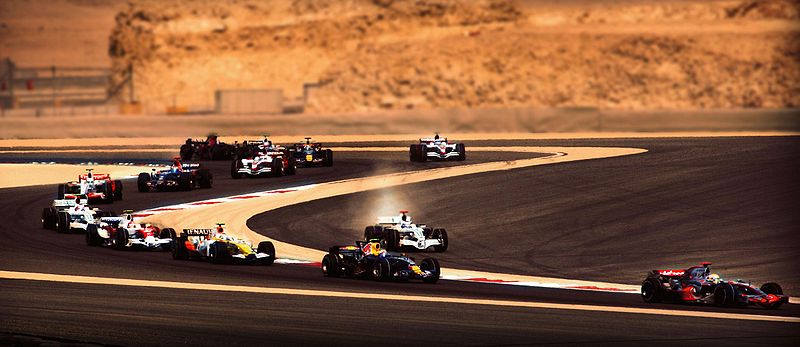
Image Credit: Emily Faulk
Moreover, F1’s attitude to the issue of safety, with respect to both its own personnel and spectators, has been unimpressive. The protests that were bound to occur, and did occur, around the venue mean that analogies to China are faulty. The presence of local objection in Bahrain does not indicate that Bahrain’s regime is ‘more objectionable’ than that of China (where no protests met the race), but does raise serious issues of public safety. Safety concerns probably did more to motivate the cancellation of Bahrain’s GP in 2011 than did the unseemly proximity (spatial and temporal) of violent repression. There were whispers, too, in 2012 that at least some F1 teams and drivers were unhappy with the level of security that could be guaranteed in Bahrain. Ecclestone, meanwhile, denied that any such concerns were brought to his own attention, and disavowed any anxiety over security himself. Such casual attitudes were apparently left unexploded by the petrol bomb that narrowly missed a Force India car during practice runs last April. Nor was the death of a protestor on the eve of the race seen as reason to doubt that the Bahraini government and its police were reliable guarantors of a safe and incident-free day at the track. This year, the dominant attitude was even breezier. Force India’s deputy principal Bob Fernley confidently averred that ‘lightning doesn’t strike twice in the same place’. Presumably he’d be delighted to add a race in Baghdad to next year’s calendar – given the recent level of violence in that city, it should be considered one of the safest places on earth. The passing of responsibility up through, and beyond, the chain of motorsport command was a common theme this April: FOTA (the Formula One Teams’ Association) thought the situation was fine because Ecclestone thought it was fine; he thought it was fine because the British Foreign Office and the Bahraini government thought it was fine. Ecclestone’s own private judgement, made after the race, that Bahrain was ‘stupid’ to go ahead with the event due to the protests it inspired is the logical apotheosis of his self-presentation as constrained tycoon – I only own the company; what do you want me to do about it?
Ecclestone’s pleas of impotence, as well as ignorance, reflect a broader perspective in which to hold the race is a ‘natural’ or value-free decision (or, better, non-decision). This perspective is valid in the trivial sense that contracts were signed, tickets sold, sponsors acquired, personnel hired, and so on, well in advance of the race. Nobody has more riding on its success than Bahrain’s crown prince and his government, which forks out £40mm annually for a place on the F1 calendar as part of a general strategy of economic diversification that targets the tourism dollars of Middle Eastern neighbours’ middle classes. But if exclusion from the convivial networks of international sport can help to establish a nation as a leper, then inclusion within those networks provides a thin veneer of legitimacy. Perhaps the best current example of this is another recent addition to the F1 calendar (in 2009), the UAE. Since the mid-1990s, the Emirates, specifically Dubai, has slowly added to its stable of big-draw sporting events – it can now boast the world’s richest horse race; one of tennis’ most lucrative non-Masters meetings; the F1 race; the majority of Pakistan’s ‘home’ cricket games; a leg of the Rugby World Sevens; and a place on the PGA ‘European’ golf tour. Sport is now a significant element of Dubai’s tourism industry, and the Emirates’ regime, despite presiding over a ‘not free’ society and countenancing the appalling conditions endured by the migrant workers that prop up its economy, is culturally legitimised to the extent that it participates in sport’s global networks without resistance. Bahrain’s sporting infrastructure, though puny in comparison to that of its big brother across the Gulf, serves a similar function.
Supporters of the Bahraini government and beneficiaries of the kingdom’s sports tourism industry claim that the F1 race, and events like it, have the potential to heal the very wounds these events anger. The crown prince has himself offered this analysis. The pro-government organisation Citizens for Bahrain has claimed that ‘the race unites people despite political differences’. Indeed, some placards bearing the message ‘UniF1ed’ could be seen before the 2012 race. Unsurprisingly, F1’s institutions have been eager to present themselves as agencies capable of extending social cohesion – FIA and the management of F1 have made this claim, as have the race’s organisers. Even in the run-up to the (eventually cancelled) 2011 race, in the wake of scores of deaths during Bahrain’s Arab Spring, Jackie Stewart suggested that ‘sport is a very good equaliser in the case of unrest, because sport somehow unifies people. An F1 race going there hopefully might help to do that.’ The qualifiers do little to lessen the weight of this claim. Yet even as it ascribes enormous power to sporting events, this familiar sketch, in which sport acts as society’s savant, places sport outside of society, capable only of riding (racing) in to (‘somehow’) enact a glib, apolitical, supra-rational moment of fragile ‘unity’, soon to be dissolved. It is precisely because sport is never separated from society that its ability to create ‘moments of’ anything is almost totally constrained by the wider social context in which sport plays out. Sporting events are also, of course, often great microcosms of certain forms of social exclusion: tickets for the Bahrain GP last year cost about one-fifth of a Bahraini public sector worker’s annual salary. Whatever was signified by the zone of exclusion around this year’s race, the protests that sought to prevent it, the police raids that sought to obviate the protests, and the violent repression that cleared protests away to form a path for the Ferraris and Mercedes, it is assuredly not unity.
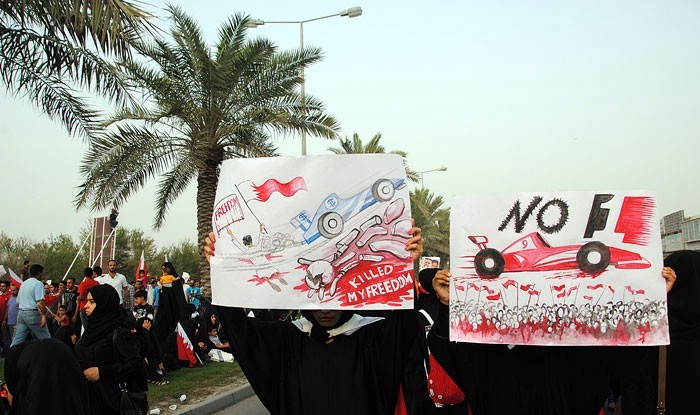
Two female protesters holding Anti-F1 sign during a march on Budaiya highway. Image Credit: Hamel Alrayeh/Wikimedia Commons
It is possible to accept all of this – Formula One’s complacency about its status as a social institution and even about the safety of its own personnel and fans; the legitimacy that sport can bring to regimes; and the powerlessness, even malevolence, of sport in the face of social division – and still feel that it was right for the race to go ahead. Many observers have suggested that the race benefited anti-government and human rights organisations by shining a spotlight on the situation in Bahrain. That the race encourages protest in this sense is surely true. In an article written hours after the chequered flag went up, Mariam al Khawaja, acting president of the Bahrain Centre for Human Rights (BCHR), said that the international spotlight thrown on Bahrain by the race ‘is not only appreciated, but also crucial to improving the situation on the ground…’ In the run up to the race, Al Wefaq was unabashed in allowing that ‘we are trying to benefit from the increased media presence’. Last year, it called for a week-long series of protests. Use of the race as an event around which to build protest has been criticised from pro-government quarters. Citizens for Bahrain carped last Tuesday about the ‘end of the protesting season’, and reflected that protestors ‘can at least feel satisfied that they generated enough smoke and dismay for the international media to write about how “unsettled” and “unstable” Bahrain is’. Extending his self-portrayal as a public servant, Ecclestone also suggested that ‘[n]obody had’ heard of Bahrain before the controversy over the race, but, thanks to his organisation, ‘the protesters have a platform to work from’. Attention, however, is never neutral, and reactions to the race have been ambiguous even in the major bastions of centre-left right-thinking. Whilst the news pages of the Guardian have displayed the sympathy with protests and concern with human rights that one would expect, the sport section’s review of the race referred to it as ‘a victory’ for the organisers and an ‘absurd circus’ in which a diverse cast of characters, from thawb-wearing Arab royalty to protesting villagers, ‘all anxious to bring their own fervent spin’ to proceedings, injected the event with a multichromatic blast of local colour. Whatever the Western media’s attitudes, what is the value of bare attention? Whilst the notion amongst media contributors that they’re doing good work in publicising under-reported current events amongst people like themselves (only less informed) might not be without merit, the tangible effects of increased knowledge are deeply uncertain. Any gains made in this area must surely be weighed against the human and political cost of the race.
And this human cost appears to be rising now that the media’s notoriously fickle attention is shifting away from Bahrain. Al Khawaja’s article made the important point that what really matters is ‘what happens after the cameras are gone’, since ‘[w]hen the cameras are gone, the crackdown intensifies as revenge, and the world is no longer paying attention’. Those who protested against the race appear to be at great risk. Two women who demonstrated at the circuit were arrested last week on charges relating to ‘terrorism’, and it is feared that they may have been compelled to name other activists. The UN’s Special Raporteur on Torture’s visit to Bahrain has recently been pushed back once more – the visit has been pending since 2011. Ecclestone suggested last week that Bahrain’s place on the F1 calendar will soon be contractually extended through to 2021, his work in the areas of unity-promotion and public relations for anti-government organisations evidently not yet complete. Tomorrow, Shaikh Salman bin Ibrahim, head of the Bahrain Football Association, will stand for election to the presidency of the Asian Football Confederation. BCHR accuses him of a long-term and violent campaign to rid Bahraini football of any persons connected to anti-government protests, fining and otherwise penalising any clubs that fail to support this endeavour. It’s unclear in what sense sport has the capacity to promote ‘unity’ here, though Bahraini protestors hope that one small further act of legitimisation-through-sport is prevented.
Percolation of governmental repression, by violence where necessary, into such mundane structures as lower-league football in a nation that FIFA ranks as the world’s 117th best evinces a point made above. Though neglected by certain currents of educated opinion for its (in each case ‘supposed’) anti-intellectualism, apoliticism, and promotion of fast bodies over quick minds, sport is as much a form of cultural and social practice as literature, art, and music. But this comparison is not intended to ‘rehabilitate’ sport; merely to underline its importance. If sport gives up its pretences to be external to society, commentators upon it must renounce their belief in sport’s ability to perform acts of social magic by using its apolitical lens to render, out of nothing, glossy, frameable snapshots of ‘unity’. If sport is to work for social goods, it must do so from inside society, containing within itself all of the hatreds, prejudices, hopes, divisions, constraints, obligations and obstacles that implies.
About the Author





