
The March 2013 general elections in Kenya left me with one burning question. Where are the women?
In response to my question you might point out the 47 women representatives in each county, a result of the special post created to represent women’s issues in the National Assembly. Political representation of Kenyan women now stands at 15 percent versus Rwanda’s 56 percent, South Africa’s 42 percent, Tanzania’s 36 percent and Uganda’s 35 percent. This is an improvement from the previous 9.8 percent representation in the 10th Parliament and the numbers have been greatly boosted by the 47 women representatives.
Although this is the highest number of female representatives Kenya has ever had in the area of political leadership, it is still a rather poor showing in this day and age, where women’s political participation has generally improved around the world. Some have argued that it is unfair for women to have dedicated electoral posts, but despite these affirmative action measures, the guaranteed 47 seats are still far below the 117 needed to satisfy the one third gender rule.
This dismal performance in the electoral process is notwithstanding the massive amounts of funding that have gone into capacity building, gender mainstreaming, gender activism, mobilizing and other NGO related buzzwords that imply a lot of work is being done at the grassroots level to get women participating in politics in a meaningful way.
As the years go by it seems women have been ignored in the top ranks of leadership, to the point that their contributions to the advancement of this nation remain forgotten. A myriad of excuses have been presented to explain the lack of participation from lack of resources, to the social construct skewed to the advantage of men, poor literacy levels, tribal/geographical and ethnic issues, and retrogressive cultural practices. Though these excuses are in fact valid, the point remains that previously women managed to break through and participate in the political arena.
Women seem to be valuable politically only as voters often depicted as Wanjiku, a poor village woman bearing a basket while dressed in a patched skirt with a scarf tied around her head and her hand stretched out, hoping that the big man will pay attention to her needs and not just wait for every election cycle to court her attention.
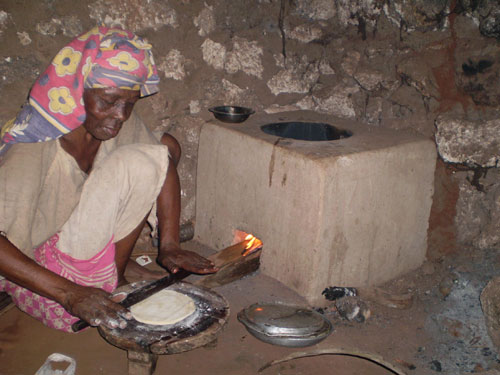
Women in Kenya are often portrayed as waiting for men to solve their problems. Image Credit: WambuiMwangi/Wikimedia Commons
When we look back at our history as a country there are examples of strong women leaders, whose participation in the political arena went beyond the oft repeated tales of feeding of freedom fighters and acting as communication channels during the Mau Mau rebellion years.
Women like Mekatilili wa Menza, a Giriama woman who played a key role in inciting and leading the resistance against the British in the period 1912-1914, urging the Giriama not to co-operate with attempts to recruit their men into wage labour. A key part of her successful campaign was that she marshaled other women to work together with her.
Wangu wa Makeri, a Kikuyu woman who was appointed the ‘headman’ of Weithaga Location in Central Province, the first and only female “headman” of the entire colonial period. Wangu wa Makeri was a capable and remarkable leader who contrary to lies peddled in our primary school books did not sit on the backs of men and subjugate them at will.
These women, like Phoebe Asiyo, Grace Ogot, Wambui Otieno, Professor Wangari Maathai, Martha Karua, and others like them sought to represent the interests of their people. They provided sound leadership during key stages of Kenya’s political journey from the crucial post-independence era to the agitation for multi-party democracy and beyond.
They managed to do this despite the prevailing patriarchal nature of politics in Kenya, which is characterized by marginalization, exclusion of women and constricted involvement often defined by gender roles. There is an expectation that the next generation of women leaders were bound for greater things, but the recent elections have exposed the serious and continuing gap of female representation in the political classes.
Something needs to change. Women cannot be shattering ceilings in the cut throat corporate world and then shying away in politics. The quality of female leadership in the country also needs to improve, and move from political patronage, a worrying tradition which rewards women with electoral posts, in some instances to keep it in the family, following the death of their political husbands, as was the case with Nyiva Mwendwa, Jane Kihara and Christine Mango.
The 10th parliament was generally lacklustre in performance, especially among female politicians, unlike the previous government, where female legislators like Njoki Ndungu championed the Sexual Offences Act. Women from this parliament with the exception of Martha Karua were known more for their outlandish and ridiculous remarks within and outside parliament and less for legislative wins.
There is a great need for real mentorship, not powered by NGOs, but by the pioneers of female political leadership in Kenya. They must find a way to share their experiences, lessons and deliberate together with future leaders on the way forward for our country.
The key for the future of any country, and indeed any institution, is the capability to develop, retain and attract the best talent. Women make up one half of the world’s human capital. Empowering and educating girls and women and leveraging their talent and leadership fully in the global economy, politics and society are thus fundamental elements of succeeding and prospering in an ever more competitive world. We need to be alive to the fact that women in leadership bring a different skill set that is characterized by collaboration, conviction, inclusiveness, creativity where there is limited access to resources, and mentorship.
As women we must take the next five years to reflect, strategize and implement measures that will ensure meaningful and impactful political participation now and in future electoral processes to safeguard the gains of the women who came before us. Only then will Wanjiku progress to the next stage of her evolution from the symbol of the oppressed to the icon for progressive change from the elector to the elected.
About the Author





Elizabeth,this is well done.We really need to join hands as women who care for women’s voices in this country,empower our fellow females and mentor the young ones
Ruth,Nakuru