
Racked by ethnic violence in recent months, Myanmar is fast re-entering the mainstream news sphere for all the wrong reasons. While the country has been under military rule since the 1960s, since 2010 the country has re-opened its door to tourists. Arriving into Yangon, the city reminded me of many others in south-east Asia. The vistas are not gripping but the undeniably there is a sense of awakening among the population. The locals are charming and curious about foreigners. ”Where are you from?” the question follows you everywhere you go. Traveling with a Spaniard, a Peruvian and a Finn, having to explain our origins often was an interesting exercise in geography.
Yangon, formerly Rangoon and formerly the capital of the country, lies on the banks of two rivers. The city is a combination of old world colonial buildings and newer government-funded office buildings. 2011 saw an end to official military rule and with that also came an injection of investments in infrastructure improvements. By opening the economy to trade, further supported by the world’s most influential economy, the United States, Myanmar’s economic potential is of interest to all its immediate neighbours and several economies beyond its immediate borders. These improvements are readily witnessed by travellers and backpackers as they travel domestically. Our travels to Yangon included a two night stay so we could see the glorious Shwedagon Pagoda at sunset. The guidebooks recommend visiting the temple at either sunrise or sunset to see the gold encased pagoda. On a clear night the view is amazing, as the fading light changes the colour of the pagoda. At twilight it appears to sparkle unfazed by the floodlights now lighting it.
Our journey continued north as my fellow backpackers and I traveled to Bagan. Overnight coaches run by private charter companies are the best way to travel. The trains are less comfortable and due to lack of maintenance can succumb travellers to lengthy delays. The trip takes approximately 10 hours, and all coaches arrive between 3am and 4am. Local horse carts transport weary travellers to hotels. Travelers are advised to pre-book hotel rooms because the sparsely populated town has only one or two tea shops one can spend in until daybreak. Located in arid conditions, Bagan is home to over 2300 Buddhist temples all built between the 11th and 13th centuries. The best way to see the main attractions is to rent cruiser bikes in the town or at the hotel.
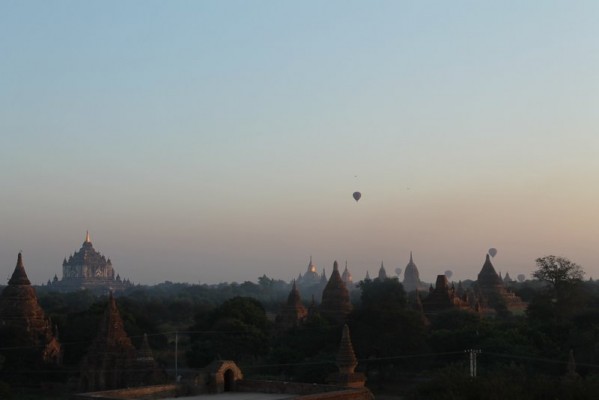
The plains of Bagan at dawn
In stark contrast, the region around Inle Lake reminds me of the hills of the Pacific Northwest in North America. The skies are clear and the air is crisp. The region attracts hikers and adventure tourists in the season, but the most peaceful way to explore the region is hiring a longboat. The town is quaint and is already a favourite among tourists. This was our last stop before heading back to Yangon to board a flight for Singapore. The serenity of Inle Lake and the myriad of images it presents from the fisherman to the long neck tribes gave us several moments to reflect on what had no doubt been a hectic and must-see-all itinerary around the country.
Of couse, it’s impossible to see it all. But what stands out the most is that Myanmar defies expectations. The locals are warm and friendly, and the sights breathtaking. After being hidden away for so many decades, witnessing the country’s transformation is the image that remains as we leave the golden land in the east.
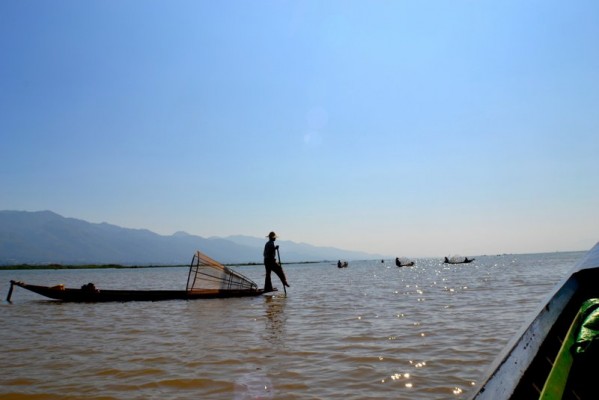
Fisherman at Inle Lake
Myanmar Cheat sheet
Guidebook: Most guidebooks on Myanmar are outdated. Having recently opened its doors to tourists, things are rapidly changing in the country, so travellers have to be prepared for things to cost more than guidebooks suggest.
Currency: US dollars are the predominant currency available for exchange into local currency. ATMs are emerging but they are not as widespread in Myanmar. We carried sufficient cash to sustain us on our entire trip.
Souvenir-stop: The Bogyoke Aung San market in Yangon is one of the best places to buy souvenirs. Lacquerware, characteristic of Myanmar is made in Bagan and one can sometimes find better deals on travels.
Staying connected: Consider getting a local SIM card for phone connectivity while traveling. This is fairly easy to do and helpful in booking hotels and hostels on the road.
Accommodation: Budget travellers have restricted options for accommodation. We didn’t stray far from the Lonely Planet recommendations, but found it a challenge to book accommodation more than a day in advance.
This article was written by Chaitra Desbhtla and originally appeared on the Urban Times.
About the Author





