
Occupy Central with Love and Peace, or Occupy Central in short, does not refer to the Hong Kong version of the anti-capitalist Occupy Wall Street movement in 2011. Nor is it a romantic title of a melodrama. Instead, it is a proposed civil disobedience movement which would take place in Central (the CBD), Hong Kong in July 2014. The concept of Occupy Central was proposed by Benny Tai Yiu-ting, an associate professor of law at the University of Hong Kong, in January 2013. In his article titled Civil disobedience’s mass destruction weapon in his Hong Kong Economic Journal column, where he proposes a 10,000 people blockade of a main street in Central if universal suffrage in the 2017 Chief Executive (the head of the Hong Kong government) and 2020 legislative elections cannot be guaranteed by the Hong Kong Government and/or the Beijing Central Government.
Occupy Central is not a mere protest. Instead, it is a comprehensive campaign that involves four steps: signing covenant, deliberation day, citizen authorization and finally the Occupy Central itself. In the manifesto, it states that the campaign will also draft a proposal on the elections mentioned above after “it is decided in the Deliberation Day and authorised by the citizens”. Occupy Central or other acts of civil disobedience will be carried out if either 1) the authorities ignore the people’s democratic wants, or 2) the authorities proposed an election method that is not in line with international standards.
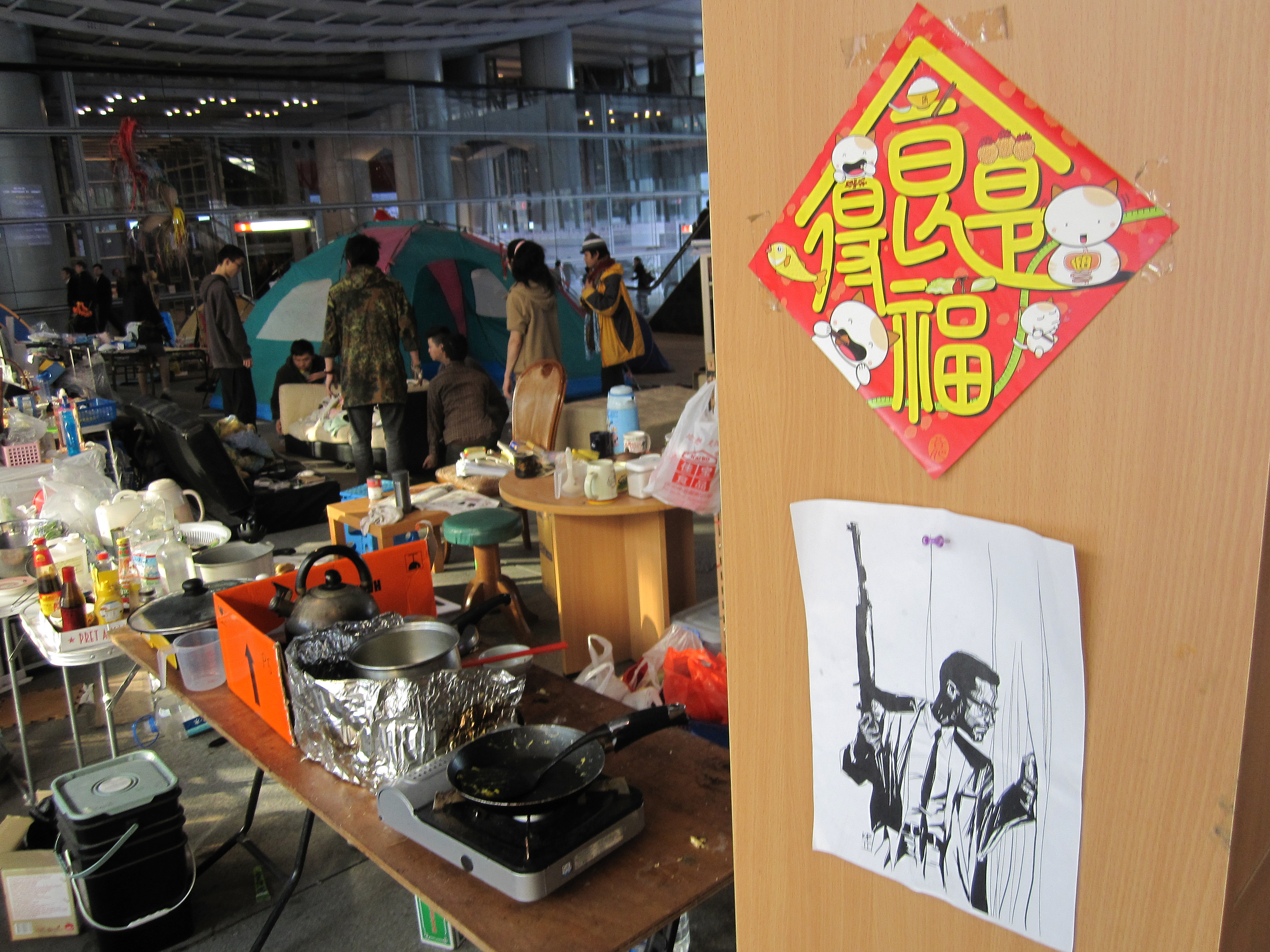
Malcolm X keeps watch over Occupy Hong Kong, aka Occupy Central, under the HSBC building in Central, Hong Kong. Image credit: istolethetv from Hong Kong, China
Related: Protest vote? Hong Kong Election Analysis
By international standards, the founders of Occupy Central mainly referred to the International Covenant on Civil and Political Rights of the United Nations. Specifically, Article 25 (b) states that,
The founders of Occupy Central and the pro-democracy camp argue that the current electoral system is not up to the international standard because the current Chief Executive was elected by a 12,000 member Election Committee, which consists of individuals and bodies selected or elected within 28 functional constituencies. Although the Occupy Central campaign has not officially produced a proposal at this stage, there are two main proposed changes to the electoral system being put forward within the pan-democratic camp. One of them is to scrap the Election Committee once-and-for-all. The other, often cited as “the compromised plan”, is to enable universal suffrage in selecting the members of the Election Committee.

Founders of Occupy Central with Love and Peace
From left: Benny Tai Yiu-ting, Rev. Chu Yiu-ming, Chan Kin-man
It should not be mistaken that Occupy Central is a sudden awakening of the Hong Kong citizens or a young process in striving for democracy. From the 1980s, Hong Kong activists have been fighting for full universal suffrage in both elections for the Chief Executive and the Legislative Councils. The fight continued during the process of drafting the Basic Law, the constitutional document of Hong Kong, in light of the 1997 handover from Britain to China. In fact, in Article 45 of the Basic Law, universal suffrage was put down as the “ultimate aim”:
Related: Hong Kong and China’s influence: Much ado about nothing?
In response to Article 45, the Hong Kong government put forward the Green Paper on Constitutional Development in 2007. Subsequently, the Standing Committee of the National People’s Congress in Beijing resolved that there would be universal suffrage in the Chief Executive election. This is often seen as a “promise” of the Central Government to allow full democracy in Hong Kong. And if this “promise” is broken, Occupy Central will be carried out.
The first of July was the date when Hong Kong was handed over to China. It has also become the day on which Hong Kong citizens take to the street every year to voice their discontent. The organisers of the annual march, The Civil Human Rights Front, led this years demonstrations, protesting for universal suffrage right now as well as the resignation of CY Leung, the current Chief Executive. They have also changed the usual end point of the march, from the Central Government Offices to Charter Road in Central. They explained that the change of the end point is to further inform the march-goers about the proposed Occupy Central Campaign, but the march should not be seen as a “rehearsal”of the proposed act of civil disobedience.
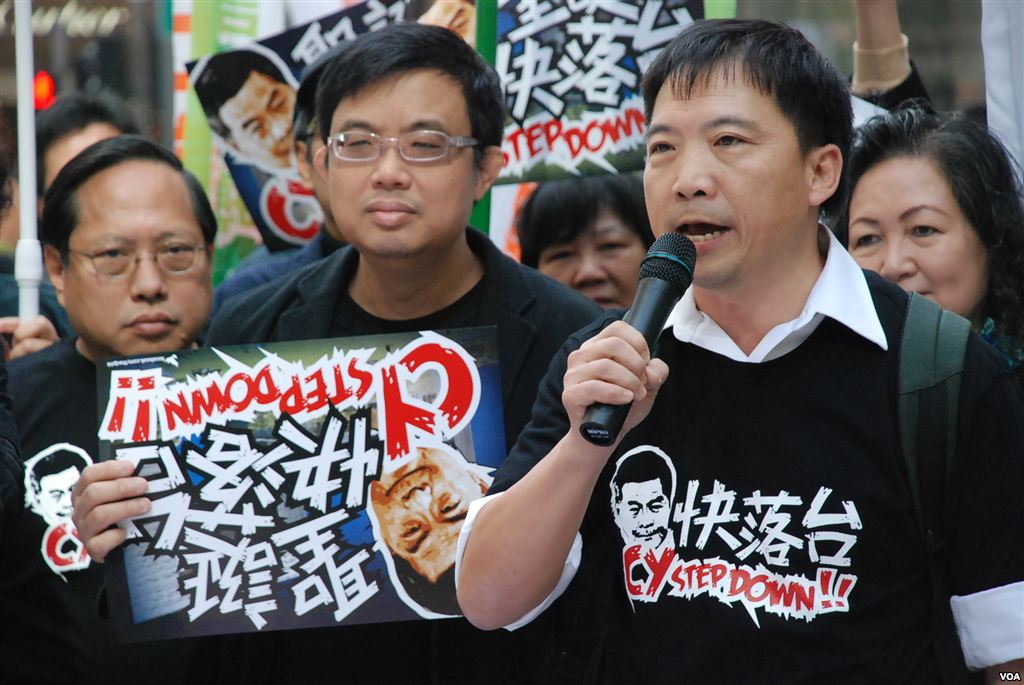
Democratic Party in the CY step down protest. Image credit: VOA
On the ninth of June, the first Deliberation Day (known as DDay 1) of the Occupy Central campaign was held. It consisted of discussions among campaign supporters as well as randomly selected members of the public.
The IPF will also continue its coverage over the course of Occupy Central with Love and Peace as well as other news concerned with the road to full democracy of Hong Kong. Stay tuned.
You can visit the official website of the Occupy Central with Love and Peace Campaign (in Chinese):
About the Author






Well done, Bryan! Good analysis – I’ll keep an eye on this.
Matthew
Thank you Matthew! Stay tuned for my coverage of the Occupy Central development.
And feel free to voice your opinions!
[…] Twitter […]
[…] the campaign page of “Occupy Central with Love and Peace”, one can see that Martin Luther King’s dream continues to serve as an inspiration for the […]
[…] published on International Political Forum, Aug 8, […]
[…] At the moment, the Hong Kong government is dreading what could end up as large-scale protests, organized by the Occupy Central, scheduled for this July. The group promises to shut down the heart of the city’s business […]
[…] At the moment, the Hong Kong government is dreading what could end up as large-scale protests, organized by the Occupy Central, scheduled for this July. The group promises to shut down the heart of the city’s business […]
well done Bryan, only a minor error. Mr. Tai is the one in the middle in the 2nd photo from the top
[…] Continue reading… […]