
Imagine a country. Imagine a ruling party that represents freedom of expression and religion to the rest of the world and many of your countrymen. Imagine progressive reforms and economic development. Imagine democracy. Then imagine authoritarian rule, restrictions on human rights and political freedom. Imagine protests curbed by police violence. Imagine this imposed on you by the very same democratic leadership, from the very same democratically elected party. Imagine Turkey, Recep Tayyip Erdoğan, and the urge to protest against him.
This description hardly applies to all Turkish people today. Although many comparisons have been made between Taksim and Tahrir, the Turkish protests of the past two weeks are far from the reality of the 2011 Arab Spring. It is not a populist movement against a dictator, it is a very selective movement made up of those who experience oppression from the current government. In other words, it is not the case that Erdoğan is a dictator clinging onto power. But it is a fact that he is shooting at his opposition. It is a fact that he is using ruling methods usually reserved for dictatorship. And this has been going on for several years. But the difference is that this time the rest of the world is watching.
In the early days of his political career, Erdoğan was at the receiving end of political and religious oppression. As the mayor of Istanbul he delivered a speech in south-eastern town Siirt in 1997, which nearly two years later had him removed from his post and sentenced to prison for “inciting hatred based on religious differences.” During the speech he had recited a poem by Mehmet Ziya Gökalp that reads: “Our minarets are our bayonets, Our domes are our helmets, Our mosques are our barracks. We will put a final end to ethnic segregation. No one can ever intimidate us.” Despite his sentence including a life-long ban from politics and public life, Erdoğan founded the Justice and Development Party (AKP) in 2001. Only a year later the party won a two thirds majority in the parliamentary elections and, following a legal change to get around the ban on political leadership, the sitting Prime Minister (and current President) Abdullah Gül resigned in 2003 to give way for Erdoğan.
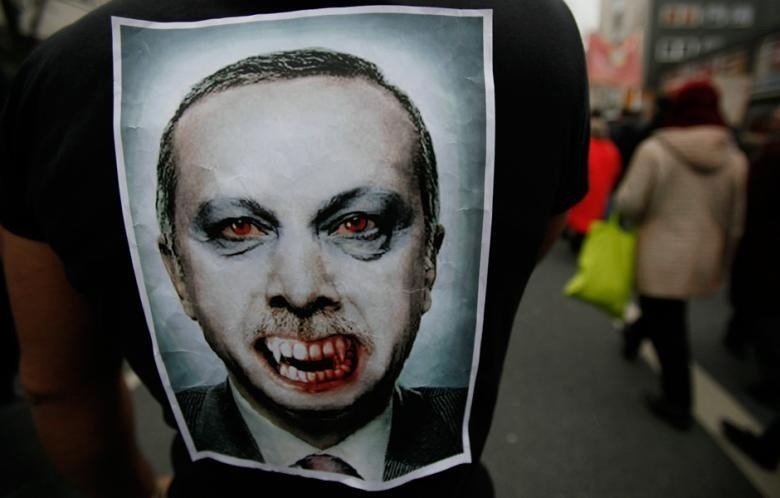
Image Credit: OccupyGeziPics/Tumblr
One might think that such experiences with legal oppression would render some understanding of what it is like to be persecuted for expressing your views, but in Erdoğan’s case it seems to have backfired completely. Today, he is in power, and he claims to be distancing himself from dictatorship. Yet he has said that “dissent is legal only when expressed at the ballot box.” He sees it as the state’s right to impose their own moral values on the population while they are using public roads and public transport. He tries to impose his own beliefs on society, for example by restricting alcohol consumption and stating that every woman should have at least three children. He refers to social media, particularly Twitter, as “the biggest trouble for society right now.” His regime has been called “the world’s biggest prison for journalists” in Reporters Without Borders’ 2013 Press Freedom Index for jailing more journalists than any dictatorship (or democracy) in the world.
But as much as he is behaving like one, Erdoğan is not a dictator in the technical sense of the word. With parliamentary majority since 2002, the latest election in 2011 gave AKP as much as 50 percent of the votes. And, especially after the regions’ widespread protests against dictatorship during the Arab Spring, Turkey has been upheld as the democratic state whose example which should be followed. Erdoğan and AKP represent reforms in Turkey, particularly for the religious and the conservative who were previously discriminated against by the military. The protesters, on the other hand, identify with the secular state founded by Mustafa Kemal Atatürk, and as the father of the modern Turkish state he has become a symbol for the Gezi Park movement.
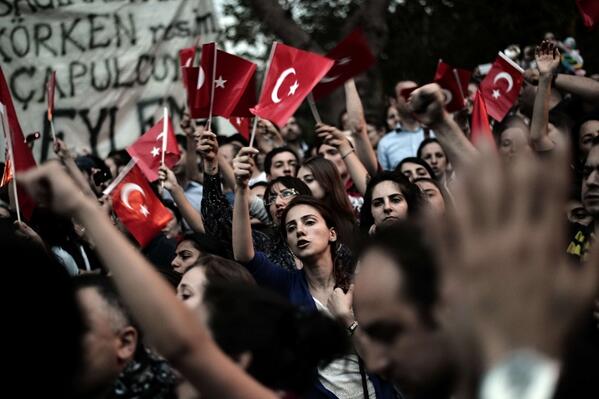
Image Credit: OccupyGeziPics/Tumblr
This deep division within Turkish society, between progressive and conservative, religious and secular, seems to be growing by the day. Unfortunately, the current leadership shows no signs of wanting to reconcile society. On his return to Istanbul on June 7th after a trip to North Africa, Erdoğan is believed to be preparing for confrontation with the protesting part of his population. When addressing his supporters, he underlined that he is Prime Minister of the whole population rather than just 50 percent of it, and once again deemed the protests as “lawless.” And so, while Taksim Square heard chants of “Tayyip Resign” the opposing AKP supporters were chanting at the airport that “those who raise their hands against the police should have their hands broken.” The two groups keep getting more and more alienated, while Erdoğan refuses to acknowledge the protests as anything but marginal terrorists.
“They think they can start a revolution with their drunken heads,” an AKP parliamentarian proclaimed earlier this week. But, as columnist Burak Bedil points out, these “drunken heads” and their revolution are all over the world media. And they are not going anywhere.
About the Author






Thank you for the article. I liked the way you present the situation in general, although I would like to add a few comments, if I could.
I personally find “selective” comparing Arab Spring with the movement in Turkey with only the number of protesters involved and with their respective political views, instead of pointing to common characteristic of both opposition movements as a protest against authoritarian way of ruling in a so called “democracy”. Turkey is already a parliamentarian democracy, and with that alone, its case should be separated from the other “springs”. Turkey has done what Arabs are trying today 70 years ago. No one wants to change the democratic regime based on “demos kratos” or the type of ruling as “republic” in political terms. Therefore, it is quite normal that there is no attempt for toppling regime. Instead, we demand “decentralization”, “pluralisation” and “respect for basic human rights”, which are essential to any working pluralist democracy.
I support Gezi Park Resistance, and regard it as legitimate as long as they limit their demands to protection of the park as it is.
Toppling of the regime via either military intervention or via civil means (revolution) would result in chaos and would polarize this society further more. I also think that Erdogan’s AKP has made a remarkable progress with regards to solving Kurdish Issue to the extent that no other party could ever imagine. I am a voter of the Republican Party (CHP) when it comes to the ballot box. But I do not believe CHP could make this progress in the Kurdish Issue, were they in power. I do not want to see that progress be curbed because of these events, and the economic development trend that Turkey has caught for the last decade. I also believe that today’s democratic movements are in place thanks to the political environment promoted by the ruling party, AKP ( as well as the urbanization project imposed by the same party). We need to see both sides of the coin before accusing a person as “dictator”.
Finally, I suggest Gezi Protesters (whom I see myself among as I also contributed to civil peaceful protests in the Capital City where I live) to limit their resistance to the boundaries of the park and as such they will remain legitimate with their demands. Today, there was news in that direction, that protesters decreased their demands to three: 1) Gezi Park remains as Gezi Park without any construction on it (Totally legitimate), 2) Those who are responsible to be deposed, 3) Releasing those who were taken into custody during the demonstrations.
I believe all three demands are fair. However, Gezi protesters should not vouch for everyone who were involved in protests, some of whom via violent means. I am sure those in custody will be released soon. But in any case, protester’s demand should be limited to an assurance that these individual cases will be attended within the respective laws and regulations and with respect to human rights at all times. As for the second demand, there is already an investigation going on, which I believe would not be finalized before at least a month. Therefore, the demands should be reduced to one and only one, which would be met by an official announcement by the government of suspension of all projects regarding the park.
We are all equal citizens of this country, regardless of our political opinion. I believe this movement, among other things, has contributed to our culture of launching peaceful protests as a legitimate mean for democratic demands and not wait for the ballot box to show discontent. We had our part of the so called “springs”, to the frustration of some journalists, without a regime change and without further bloodshed as some would expect. The movement will have its political fruits in the upcoming days, which I hope would bring “normalization” of life for all those involved.
Thank you for reading! I can only agree with what you’re saying about democracy, and I am not denying that Erdogan and AKP have done good things for Turkey. I also agree that forcing the current government to resign altogether would likely lead to chaos. But I do think the protesters are demanding a lot more than keeping the trees in Gezi Park at this point, and I also think they are right in doing so. Ever since the police first attacked them, the following protests have been about the fact that the government denied them the right to peaceful demonstration, which is only one example of basic rights denied by the current government. And with Erdaogan’s recent vow to end the protests within 24 hours, it doesn’t sound like that is about to change. I never claimed that he is a dictator, I claimed that he is behaving like one. And in my opinion he will have to give the protesters more than trees to make up for that.
Thanks for covering up this issue. But I must completely deny the things that supposed to be done by Erdogan and his government. He is the worst thing Turkey has encountered since ten years.
And thanks for answering as these protests are not only of a park issue, but resistance to the dictatorship and fascism of Erdogan’s government.
No matter what, I’d like to keep my hopes for this wide, civil awakening will eventually resolve as resignation of Erdogan and establishment of a new ,democratic, secular, respectful government.
Thank you for reading and commenting! I can only echo your hope for a democratic and peaceful solution to this issue.