
Chocolate, wine, sleep, sex: How would you react if these comforting pleasures were to be sapped from your life? If we truly value the good things in life, then why are we sacrificing the warming blaze of the sun, the life affirming sound of birds, and the refreshing smell of blossom for shadowy reflections of the street, the monotonous hum of air conditioning, and the monstrous growl of engines? I’m talking about the demolition of free, open, green spaces to make room for office blocks, shopping malls, railway lines and highways.
There are many who share my bemusement. The planned £34.5 bn HS2 rail route that will slice its way through 45 miles of Staffordshire countryside in order to slash the journey times of commuters between London, Manchester, Birmingham, and Leeds, has met strong opposition from those who fear the destruction of valued space and the disruption to homes (human and wildlife), and those who doubt the economic motives behind the project. Robert Fyson writes in the Staffordshire Sentinel that ‘if this unnecessary folly goes ahead, it will spoil the environment of Whitmore, Madeley and Betley, in the former Newcastle Rural District, and now part of the borough council’s area’, adding that ‘the property of individual farmers and others will be blighted.’
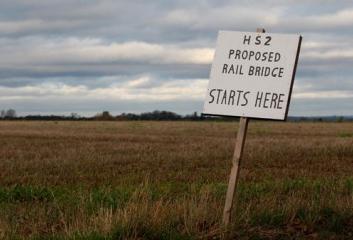
Additionally, The Wildlife Trusts informs us that the planned route will endanger four Wildlife Trust reserves, 10 Sites of Special Scientific Interest (SSSIs), more than 50 ancient woodlands, and several local wildlife sites. All this for a matter of minutes saved on your journey time? Rail is widely regarded as one of the most comfortable ways to travel, providing businessmen with the opportunity to work as they travel, while others read, contemplate, and enjoy their window views. Why is it deemed necessary to reduce these periods of pleasurable efficiency?
The HS2 website ensures us that space will be freed up on existing rail networks, providing more space for freight trains, subsequently reducing lorry traffic and improving air quality.With great optimism, we can hope that this may occur, but by depleting woodland, wildlife, and greenery, there becomes less opportunity to enjoy this air. That the proposed route of HS2 will cleave through 12 miles of what has been officially designated an Area of Outstanding Natural Beauty – the Chilterns – puts into question the amount of consideration behind the project. And while it’s arguable that increased efficient rail opportunities (for those able to afford them) will eliminate some air travel, contradictions start to emerge surrounding other government proposals. (I’ll refrain from a detailed discussion of ‘Boris Island’ and Heathrow Airport expansions in this instance.)
Whether effective or not, it’s at least encouraging that the UK government engages a wider audience in debates over planning projects. In Turkey, no such outside contribution is being granted. In fact, ‘proposal’ is not the right word to use in the case of prime minister Erdogan’s recent plans of action. Intentions to transform Istanbul’s Taksim square and Gezi Park into a shopping mall have enraged swaths of citizens who have taken to protesting in the streets. Istanbul’s residents are indignant at the lack of involvement they’ve been granted in the plans. Recorded by the New York Times, one protester laments how ‘the government wants to sanitize this place without consulting the people.’ Another asserts that ‘the prime minister is treating the place as his private property’ (New York Times). This is yet another case of the public becoming the private, where a communal space that fosters the quality of life for a significant population may become transformed into a money generating scheme.
Both HS2 and the redevelopment plans for Taksim square and Gezi Park reflect a growing global trend whereby local values are being trampled over by corporate interests. This is damaging not only to people’s well being and trust in their governments, but also to the beauty of our surroundings and the existence of our wildlife. The statistician Nic Marks of the New Economics Foundation refers to our planet as ‘the ultimate scarce resource’ that must be shared and cherished rather than gobbled up in pursuit of economic gain. Given the ratios between national ecological footprint and well being across the world, we learn that Costa Rica, ‘the happiest nation on the planet’ uses ¼ of the resources used typically in the Western world. Campaigns such as the Telegraph’s ‘Hands off our land’ are proof of the value we place on our surroundings. But in the pursuit of financial growth, competitive development, and foreign investment, we risk losing touch with our sense of place and those people that occupy these spaces. We need to protect our pleasures and maintain the character of our surroundings.
About the Author





