
Tim de Chant, founder of Per Square Mile, made an infographic illustrating the densities of some of the world’s major cities. It shows the amount of land those cities would occupy if they had to accommodate the world’s population. The results are interesting: Parisians are so huddled together that if the world’s 7 billion people lived in their home city, it would only occupy 127,930 square miles, or 3.4% of the area of the United States. Houston, on the other hand, would cover 1,769,085 square miles, or 46.7% of the United States, if it had to fit the same number of people at its present density. This raises questions about quality of life and urban sprawl, and can be viewed below.
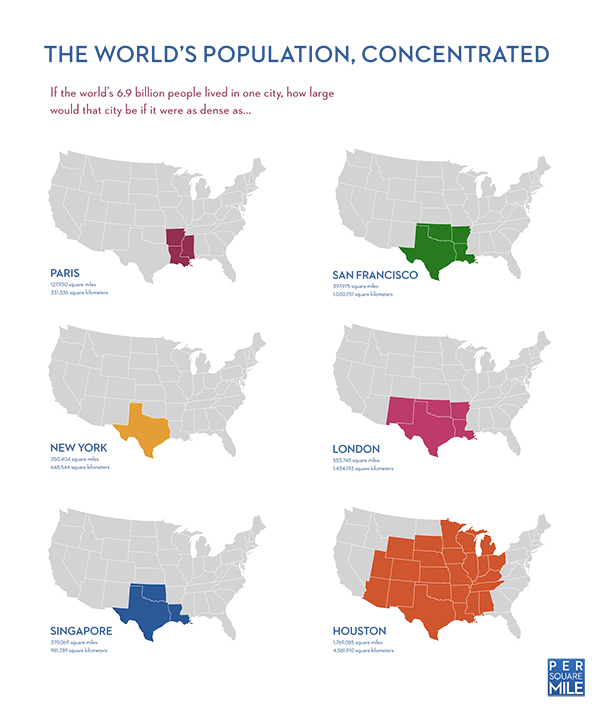
However, Mr de Chant was troubled to find that some visitors to his site were using his findings to argue that concerns about sustainable living and population growth are overblown. (It should be clear why this doesn’t follow since the infographic only illustrated the city’s physical size, not its ecological footprint.) Mr de Chant made a follow-up infographic, showing how much land would be required to meet food, water, infrastructural and other needs if the world’s 7 billion people lived like the populations of various countries.
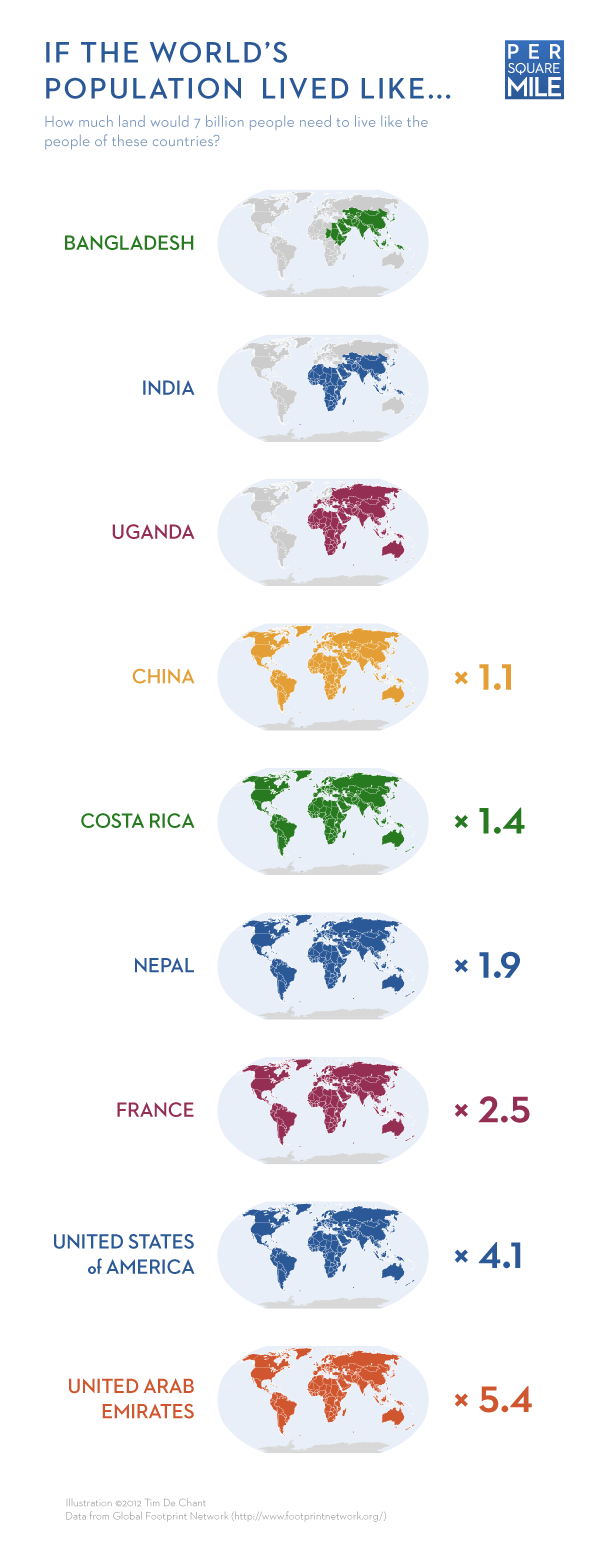 Predictably, the developing world is placing the least strain on the planet’s resources: if we all lived like Bangladeshis, we’d only need between a quarter and a third of the Earth’s landmass to meet these needs. As lifestyles develop, however, the results rapidly become troubling: if everyone lived like the Chinese, we’d need about 10% more land than the Earth has. If we all lived like the French or the Americans, our lifestyles would require 250% or 410% of the planet’s land respectively, and if the world’s 7 billion people all lived like the citizens of the United Arab Emirates, we’d need a shocking 5.4 Earths’ worth of land to sustain our appetites. Perhaps our cities are so densely-packed because they can’t afford to spread out.
Mr de Chant’s work suggests that questions of environmentally sustainable development are as relevant as we keep hearing. It is reliably sourced from the Global Footprint Network, as he explains in his accompanying article. That article, along with both infographics, can be viewed here.
About the Author





