
For over a decade China has been involved in maritime boundary disputes with the Philippines, Vietnam, Malaysia and Brunei. With the recent pivot to Asia by the US, the South China Sea has become the new battleground for US-China interests.
China, Vietnam and the Philippines have been disputing over the Spratly and Parcel Islands and the waters around it which reportedly hold potential oil and gas reserves and fishing resources. The Parcel islands are currently under Chinese control including 8 of the Spratly islands. The majority of the islands are held by Vietnam, with 5 by Malaysia, 8 by the Philippines, 2 by Brunei and 1 under Taiwan.
China’s u-shape claim of the region breaches the Exclusive Economic Zones (EEZ) of the ASEAN (Association of South East Asian Nations) states and violates the law of the sea. The EEZ refers to an area of sea or ocean adjacent to the state who has special rights over fishing, under sea mining and minerals exploration. The zone stretches 200 nautical miles from the coastline.
Early this year, the Philippines deployed troops to the Spratly islands to “boost its military presence” in the area. Beijing has demanded the immediate withdrawal of all military personnel. The Chinese foreign ministry released a statement claiming “China has always strongly opposed to the Philippines’ illegal occupation and now solemnly requests again that the Philippines pull out all of its staff and facilities from these Chinese islands.”
In January of this year, with support from the US, the Philippines filed a complaint against China with the International Tribunal for the Law of the Sea, an independent judicial body established to settle maritime disputes.
According to the Filipino President Benigno Aquino and Prime Minister Albert del Rosario, “Everybody is interested in having a peaceful resolution …and that the international arbitration over disputes in the South China Sea would continue with or without China’s blessing.”
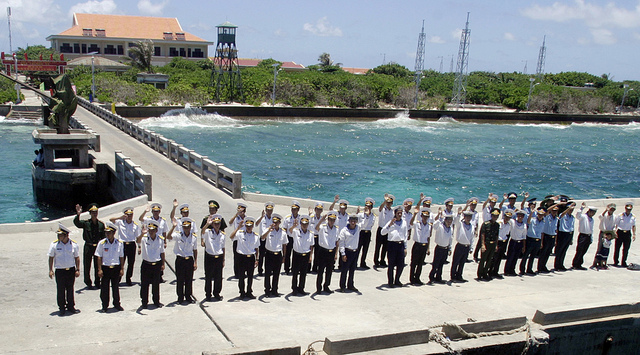
Filippino troops on Spratly island. Image credit: Robtof
In response, the Chinese foreign ministry released a statement, “The Philippine side is trying to use this to negate China’s territorial sovereignty and attach a veneer of ‘legality’ to its illegal occupation of Chinese islands and reefs.” The Chinese government strongly believes that the Tribunal has no jurisdiction and its involvement would put its sovereignty into question
The legal process has already begun with an arbitration panel being appointed and convened. China has refused to participate despite ratifying the United Nations Convention on the Law of the Sea in 1996. However, arbitration will most likely be a long drawn out process which may or may not settle the dispute. Whatever the outcome, all parties have to comply with the results.
History vs. International Law
China first made its claim over the islands after World War II which went uncontested until the 1970s. China is in dispute over maritime boundaries with four ASEAN members – Vietnam, Malaysia, Brunei and the Philippines. Rising tensions between Beijing and Manila has resulted in both sides accusing the other of violating prior agreements and maritime boundaries.
China’s claim to the Spratly islands is based on the historical evidence. In the eyes of the Chinese authorities, their version of history trumps international law.
Forging new battlegrounds
The recent pivot to the region by the US is seen as a step in balancing China’s naval expansion. The US has said that it will remain neutral in the matter and has urged ASEAN to act as mediator and settle the dispute through peaceful negotiations. To many, the US appears to be reluctant to take sides for fear of incurring China’s wrath. It would seem that the pivot was to not settle the dispute and calm China but to protect its own interests and influence in Asia.
Well on the path to becoming a superpower with a permanent seat at the UN Security council, China is abusing its powers by pushing its unwilling neighbours into negotiating on its own terms.
The Philippines and Vietnam are worried that when push comes to shove, the US will hesitate to militarily defend them against China. The Chinese and American economy are too closely intertwined and the US has too much to lose from its beneficial relationship with China, much more than with any of its other allies in the region.
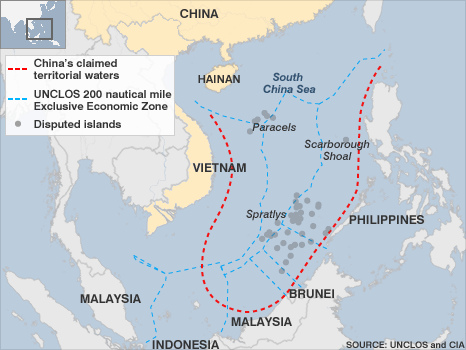
Map of south china sea. Image credit: tieunu.miulyu
ASEAN, mediator?
ASEAN along with senior officials and experts met in Thailand on 14-15th August of this year to work collectively on a legally binding code of conduct. At the meeting, ASEAN vowed to speak as “one voice”.
ASEAN foreign ministers agreed to a code of conduct (COC) to tackle conflicts in the South China Sea. This was in preparation for the foreign ministerial meeting in Beijing this Thursday as part of the 10th anniversary of ASEAN-China strategic partnership forum. Chinese Foreign Minister Wang Yi has agreed to work together with ASEAN to discuss the implementation Code of Conduct. This meeting will help lay the foundations for the ASEAN summit in Brunei in October.
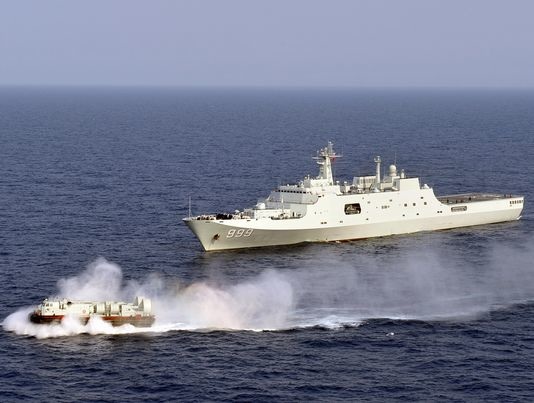
The Chinese navy conducts drills in the South China Sea. Image credit: Times Asi
However, there seems to be confusion over the underlying purpose of the code. In a recent interview, Su Xiaohui, the deputy director of the department of strategy at the China institute of International Studies stated –
Return of the Emperor
The international community has accused China of behaving like an emperor with its aggressive and intimidating stance in the dispute by insisting on bilateral negotiations and refusing to participate in tribunal proceedings.
The outcome of this dispute could also have adverse effects on the tribunal. If it fails to end the dispute or is seen to have no jurisdiction in the case, that could endanger its ‘authoritative’ power.
The ideal outcome would be for the tribunal to rule that the resources in the disputed area are to be shared with the Philippines and others regardless of China’s historic claims.
Should the tribunal not favour China many suspect that the Chinese will simply not abide with its final decision and suffer the consequences of a diplomatic fallout with its neighbours. By refusing to listen to its allies and neighbours and not complying with international law, the outcome of this dispute could potentially be devastating for all.
This article was originally published on World Outline.
About the Author






I think those are Vietnamese soldiers on the Spratly Island, not Filipinos.
this whole thing is getting really stupid. first of all why in the world would anyone claim an island(s) just because of some weird old HISTORICAL thing…just because China has this ‘i-have-long-history-dynasty-…’ or whatever crap is NOT a good reason to claim something. First of all there are laws for this case, CHINA should follow the rules and laws that was made in the first place that is the purpose of the law. The law made is something that all states agreed upon legalising it and Vietnam, Malaysia, Brunei and Philippines deserve to have some share of the islands because they are eligible (upon the law) to state a claim on those islands. China is being so damn greedy. like seriously just because you’re way advance in the military stuff and economically on par or maybe even better than US why would you act like some childish scared brat. Do they have any idea how many chinese lives in vietnam? malaysia? philippines? brunei? WHAT DO YOU THINK WOULD HAPPEN IF ALL THOSE SMALL COUNTRIES THAT YOU’VE TRAMPLE UPON COMBINE their RESOURCES JUST TO GO AGAINST YOU. I think it would be so much better to have every country go against china….and see how stupid china is…territorial disputes? geez can’t you just be glad that your country is doing a lot more better compare to the philippines, vietnam, brunei, malaysia…? OH wait i have a better idea why not just sunk all those islands so there’s no more dispute?
You are right
China always want to become a super power country in the word they think they can do any things they want
May be some day china will claim sanfrancisco and Chicago parts of china too
According to past historical records, China did not invade other country and make it as a colony. Japan had invaded other countries and brutally killed many people. All the countries such as Malaysia, Singapore, Philippines,,China , Korea….would never forget this terrible history.There are many good religious people in USA. But there are also many cunning and greedy politicians and weapons manufacturers who wants wars which would provide them business.
Japan and Philippines presidents just thinking of their own personal
power and benefit. They never bother that they make US and China at war will cause all the neighboring countries suffered seriously. This also satisfy the US ambition that Asia will not be prosperous again.
All these Asian countries will be control by the Western supper powers again.