
In the past year a number of prisoners were ‘electronically tagged’ by private companies, G4S and Serco. The funny thing about these particular ‘prisoners’ is that they were dead. Justice Secretary Chris Grayling revealed that G4S and Serco had been overcharging the government in the sum of tens of millions of pounds – they had been billing the government for tagging non-existent people. If only it stopped there. Last week a Ministry of Justice (MOJ) audit of Serco found that the company had been inflating its figures regarding the delivery of prisoners to court, falsely claiming that they had escorted prisoners when in fact they had not.
Private companies have increased their control over the criminal justice system over the years, and the UK currently has the highest proportion of private prisons anywhere else in the world. The problems with this are there to be seen: in addition to the fraud noted above, private companies have failed to compete with their public sector rivals on quality. The privatisation of the prison system, though an interesting experiment, should now be stopped.

HMP Altcourse was the first designed, constructed, managed and financed private prison in the UK. The prison opened its doors to prisoners on 1st December 1997. Image credit: Sue Adair
England was the first country in Europe to use private prisons. In 1992 HMP Wolds was opened, and there are currently 14 prisons privately managed across England and Wales. In July this year, it was announced that one state-run prison, HMP Northumberland, will be handed over to the private sector. Although Justice Secretary Chris Grayling has announced that four privately run prisons will in time be handed back to the state, he has also signalled his intention to introduce privately run services within all prisons, including the resettlement of prisoners.
The primary argument made by advocates for increased privatisation is that private companies conduct more efficient operations, whilst maintaining or improving the quality of the services they provide. They cut costs in order to generate greater profits for themselves. They maintain quality either because they are financially incentivised to do so, or because they want to win future government contracts – providing good-quality services will improve their chances of doing so. However, in practice this has not happened. No study so far conclusively demonstrates that costs have in fact been cut, and in fact there is evidence to the contrary. During the bidding process for prison contracts, public sector teams were forced to inflate the cost of their bids by up to 21% supposedly in order to ‘allow the private sector to compete’.
With regards to quality, the case is clearer. Firstly, there is the widespread corruption – the now infamous Serco and G4S run almost all the country’s private prisons. Furthermore, the 2012/13 Prison Annual Performance Ratings, issued by the Ministry of Justice (MOJ), rates each prison in England and Wales between 1 and 4, depending on their success at five categories including the prison’s ability to reduce reoffending rates, and its ability provide a decent standard of living to inmates. A rating of 2 indicates a concerning performance, a ranking of 1 indicates a serious concern. 30% of private prisons attained the lowest two ratings (compared with only 9% of state-run prisons). In addition to this, nearly twice as many prisoner complaints are upheld in private prisons as they are in state-run institutions, in part because of lower staff-to-prisoner ratios implemented by private contractors as a way of cutting costs and boosting profits. Treating prisoners well is an important step towards reform and reducing reoffending rates – the renowned Balstoy prison in Norway is a perfect example of this. If the case wasn’t compelling enough, public opinion is stacked against private prions: 50% say they are uncomfortable with them, and this figure jumps to 75% when they are presented with the reality of G4S running private prisons.
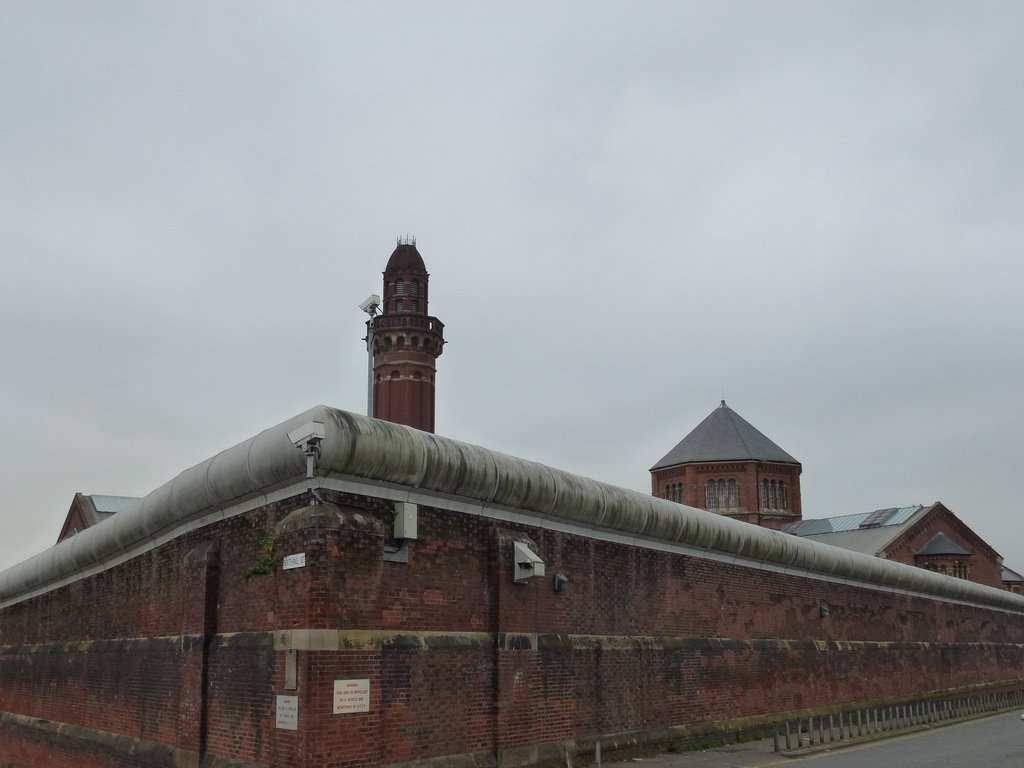
HMP Manchester. Still better known as Strangeways Prison. Image credit: Gene Hunt
It is important to consider the opposition’s argument. The right-wing think-tank Reform, which is funded by private companies such as G4S and Serco, recently published research claiming that in fact private prisons have been better than their public sector rivals at reducing reoffending rates. However, their statistics fail to take into account the full picture. Probation trusts play a crucial role in the rehabilitation of criminals. They provide post-release support, such as finding accommodation for ex-prisoners. Thus when considering reoffending rates, it is important to compare prisons operating within the same Probation Trust area. When this is done, a very different picture emerges. For example, the privately run HMP Forest Bank has a lower reoffending rate than the national average amongst short-term prisoners (60.48%), but it is considerably higher than that the nearby state-run HMP Manchester, which has a comparable prison population and operates within the same probation area. Or to take another example: HMP Altcourse has a lower reoffending rate than the national average, but it is higher than that of HMP Liverpool, a local prison with a similar prison population. In fact over 70% of the private prisons that were noted by Reform as having lower reoffending rates than the national average operate in probation areas that have a lower reoffending rate than the national average.
It is time the government realised that its idealogical stance towards prison privatisation is built upon weak assumptions and ignores the evidence. A well functioning prison system is crucial to any decent society, and though private companies can adequately provide certain services such as cleaning and catering to prisons, they should steer clear from any of the core functions of the justice system.
About the Author






A well written article that shows that private prisons are not cost effective but political. HMP Altcourse costs over 60k a year per prisoner place, the most expensive in the country. Privatisation has also dragged down the quality on what public prison deliver leaving those staffing in public prisons disillusioned. The government will have us belive that private prison increase competition and better services. Well why dont the Government just introduce better services and costs. What is it that private prison introduce that cut costs, likely to be only to be work force wages. It goes without saying that the first ever private prison is now back in public hands, why??. The question maybe that it had a very long contract and the private company increased its cots over the years to maximize profits costing the tax payers more in the long run. One day someone will look very deeply into this and see that it was never cheaper or better and that companies were allowed to cream off tax payer monies.
Hi Steve, thanks for your comment and I’m glad you found the article good-reading. I wasn’t aware that HMP Altcourse had the highest costs-per-prisoner in the country. It is really amazing given the BBC article yesterday, which revealed it is one of the most overcrowded prisons. You’d at least expect the costs to be low if prisoners are cramped up inside! http://www.bbc.co.uk/news/uk-23923321