
In God We Trust, the inescapable proclamation which notoriously takes pride of place on one of the most iconic and recognisable commodities on the planet; the American dollar bill. A 2012 Gallup Poll indicated that around 82% of American citizens self-identify as religious in some way, shape or form, and 77% of these identify with a Christian denomination. 2.2% declined to answer, leaving 15.6% citing no explicit religious affiliation. Despite this representing around 50 million people (agnostic, irreligious and atheist) in the United States, it is a group struggling for any kind of political representation in a country where religion and politics are inescapably intertwined. Some argue that it is understandable given these statistics that no US president has ever explicitly declared himself to be agnostic, irreligious or, God forbid, atheist. However, as Bill Maher points out in his poignant documentary Religulous, when considered alongside the numbers of blacks (13%), Jews (2%) or powerful lobby groups such as NRA members (1.5%), 15.6% of Americans begins to look more impressive. Despite this (growing) number, America remains one of the most religious of the industrialised nations especially when compared to its Western European counterparts.
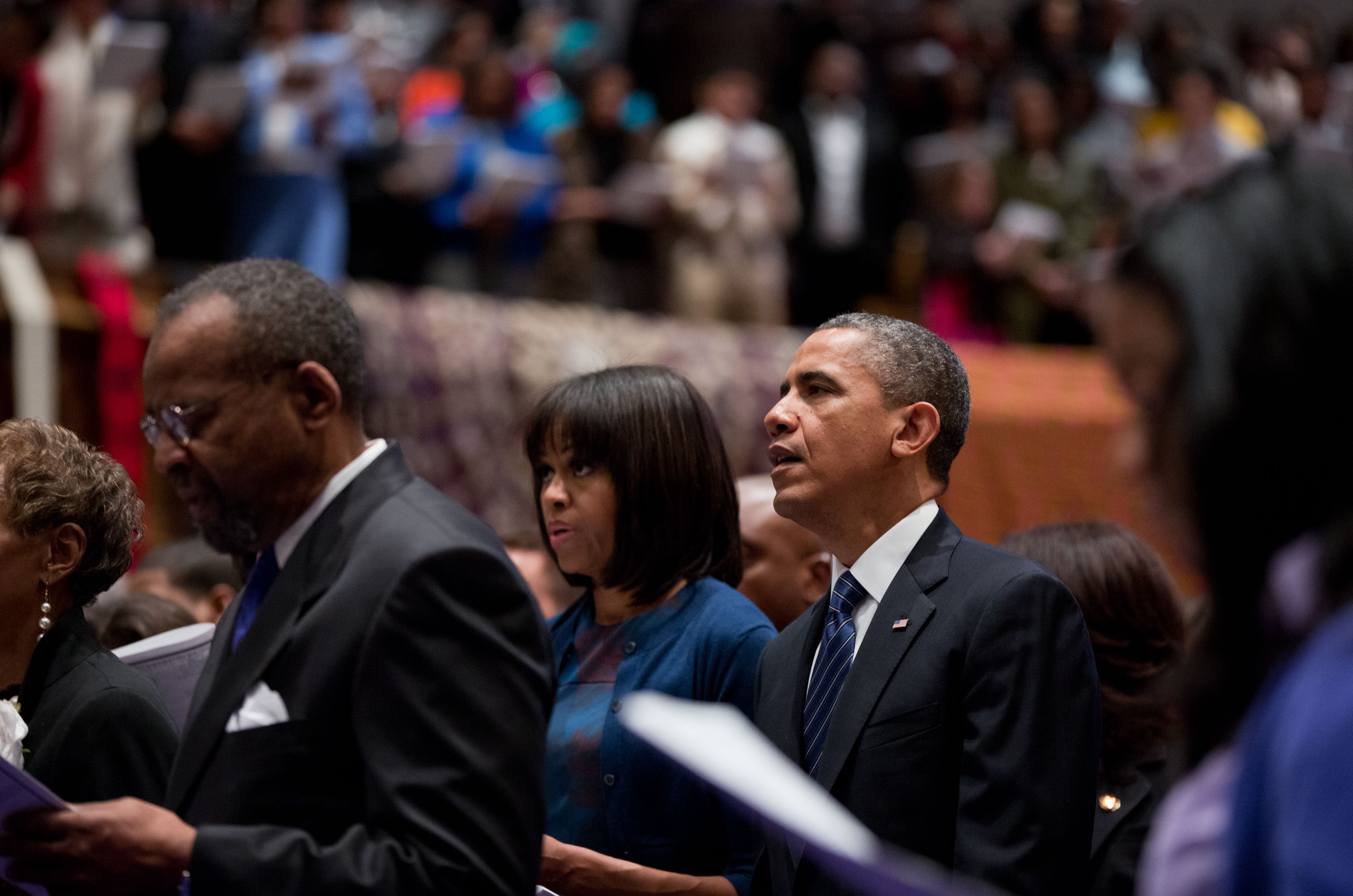
President Barack Obama, First Lady Michelle Obama and daughters Sasha and Malia, attend a church service at Metropolitan African Methodist Episcopal Church in in Washington, D.C., on Inauguration Day, Sunday, Jan. 20, 2013. Image credit: Official White House Photo by Pete Souza
Democrat or Republican, senator or lobbyist, the atheist community is vastly underrepresented in the US political arena. Indeed Fred Edwards of the American Humanist Association claims that, “Americans still feel it’s acceptable to discriminate against atheists in ways considered beyond the pale for other groups”. While some may dismiss this view as sensationalist, to this day the Constitutions of 7 US States retain archaic laws officially prohibiting non-believers from running for public office. It doesn’t take much to imagine the response if these (admittedly defunct in practice) laws referred to an ethnic minority or perhaps another specific religious group. It would seem that there is simply less concern regarding representation or even discrimination afforded to those who lack belief than for those who do.
While the global trend is proportionally shifting toward a more atheist population, the office of the US presidency remains resolutely in its direct and explicit association with religion, with no tangible evidence suggesting change any time soon. Many will ask at this point why this fact is potentially problematic, or even why it is noteworthy. These people might do well to recall George W. Bush’s now infamous proclamation, “I believe that God wants everybody to be free. That’s what I believe, and that’s part of my foreign policy,” symbolic of the position the office of President holds in the hearts and minds of the religious American public, and how religion is directly influencing policy. Britain is often cited as America’s closest ally and peer on the international stage, however on the subject of religion in politics the two nations are on polar opposites of the spectrum. Both the current Deputy Prime Minister Nick Clegg, and the leader of the opposition Ed Miliband are self-proclaimed atheists, ex-Prime Minister Tony Blair only truly revealed the extent of his religious affiliation after leaving office. Meanwhile on the other side of the Atlantic, it is unthinkable that any US President today could even end a speech without the (ironically deeply un-Christian) God Bless America, let alone reach the White House as anything other than a Christian follower.
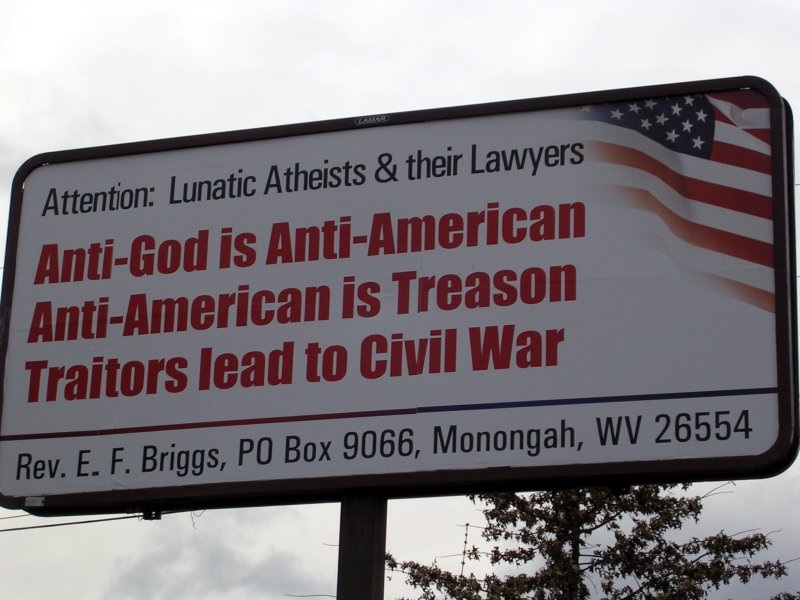
Attention Lunatic Atheists. Image credit: Dave Riggs
Given the state of affairs in America today you could be forgiven for assuming (as many do) that the USA was founded as a constitutionally Christian or religious nation, far from it. Many of the founding fathers are commonly paraphrased in their writings citing their none too flattering views on religion in their country; “Christianity is the most perverted system that ever shone on man”(Jefferson) or “Lighthouses are more useful than churches” (Franklin), to name but a few. And yet despite this America finds itself today at the stage of moral and social development where the very idea of a non-believer obtaining the top job, or even getting anywhere close to it is laughable.
We have seen the first African-American in the White House and could potentially be seeing the first female in the near future. In this respect at least, American political society has been undergoing recent cataclysmic shifts in a largely positive direction, above and beyond even many of its European contemporaries. Despite this, the reality would appear to be that religion is so deeply ingrained in American life that there is no foreseeable room for an outsider to enter the most coveted political sphere. The late, great Christopher Hitchens mused that, “It’s a curious thing in American life that the most abject nonsense will be excused if the utterer can claim the sanction of religion.” Is this not a classic case in point? The most advanced, richest and greatest power on earth cannot seem to get past a social barrier that so much of the world has hurdled, often with far fewer resources at their disposal. Perhaps this will be the next step on the way to social equality in America; representation for a seemingly silent group drowned out all too often by the religious fervour that adorns the American political way of life. At the very least it is time for the growing “great untapped minority” (Maher) to stand up and be counted, and to show their nation and the wider world that attitudes can and should change.
About the Author






Thanks for this man, it’s a good post, interesting and kept my attention the whole way through. Not many things do that nowadays.
Thanks for the comments, glad you liked the article.