
Yesterday, (September 8th 2013) UK Foreign Secretary William Hague appeared on the leading BBC political and current affairs program – The Andrew Marr Show. Not unsurprisingly, there was only one real topic up for discussion in a week which has been as much dominated by a single issue as any other this year – Syria.
On August 29th of this year, the UK House of Commons voted against a government proposal hoping to set out the preliminary stages for military action in response to alleged chemical weapons attacks by the Syrian government, a landmark event and one that has sent shock waves across the world.
What can the public and governments around the world really infer from some of Hague’s most important and interesting statements:
“I have been meeting the Syrian opposition – the ones who are neither the regime, nor the extremists, there are some good people there in Syria”
As Foreign Secretary it is of course natural that Hague has been in contact with the Syrian opposition that so much of the Western world is ‘supporting’ to various degrees. What is interesting to note here is what this statement confirms about the nature of this opposition. Hague openly admits that extremist elements exist within the opposition faction, thus this opposition is far from a coherent or united entity. Instead what this confirms is the divided, and unstable nature of a group to whom we may be offering support, including those who are not ‘good people’ to make use of Hague’s own words.
“I do believe very strongly the world must stand up to the use of chemical weapons… it is very important and the risks of not doing so in my view are greater than the risks of doing so”
There are very few, if any, who believe the world should do anything less than ‘stand up’ against chemical weapons, which are after all prohibited by numerous treaties and conventions (not, however, signed by Syria). However, Mr Hague’s risk calculation here is highly ambiguous and thus worthy of attention. When he claims that the risks of action are less than those of non-actions, to what risks, and to whom is he referring? There are three main possibilities here. First, by risk he means risk to the United Kingdom, thus claiming that these weapons pose a direct threat to our national security. Second, it may be the risk to the Syrian people of repeated attacks if nothing is done. Third, it could refer to the risk of the precedent set by not taking direct action in response to the attack. Each of these cases is highly specific with very different ethical and political questions surrounding them; clarifications of these ‘risks’ are therefore necessary.
“The opposition behaved, I have to say, in a rather opportunistic and partisan way and… on issues … major issues of international peace and security, opposition should be able to rise above that”
This statement refers to the voting behaviour of the opposition Labour party in the commons vote of August 29th, which Hague apparently believes was, at least in part, motivated by a desire to discredit the government rather than to come to a democratic consensus. Despite the cavalier attitude with which the Secretary of State made this accusation, it implies something very serious. Claiming that some MPs did anything other than vote for what they believed to be the right course of action both personally and on behalf of their constituents is undoubtedly somewhat insulting at the very least; it would not be surprising to see a reaction from the opposition regarding this statement in the near future.

Special Relationship: President Barack Obama and British Prime Minister David Cameron, left, trade bottles of beer to settle a bet on the US-UK. Image credit: Pete Souza
“I say (to the public) be reassured that we have learnt lessons of Iraq”
Perhaps one of the most memorable and stand out sound bites from the interview and one which will undoubtedly appear in headlines around the world. The intent behind this statement was to attempt to quell public fear and distrust, which (understandably) forms a large part of the opposition to the government on the issue, over the memories of the last time Britain, the US and others got involved in the Middle East.
However, was this a slip of the tongue or a change in the government line? In his speech to Parliament on the day of the vote, UK Prime Minister David Cameron told the house and the watching public, “Syria is not like Iraq”, US President Barak Obama too has been keen to emphasise this point, only yesterday telling the nation, “Syria is not another Iraq of Afghanistan”. Thus when William Hague says that the UK has “learnt the lessons of Iraq”, he is taking a dramatic step away from previous attempts to distance the two conflicts in the minds of the opposition and the public. It now sounds like Mr Hague is claiming that thanks to what we (the government) learned from Iraq, we are better prepared to deal with a similar conflict, a message the government has been trying desperately to avoid.
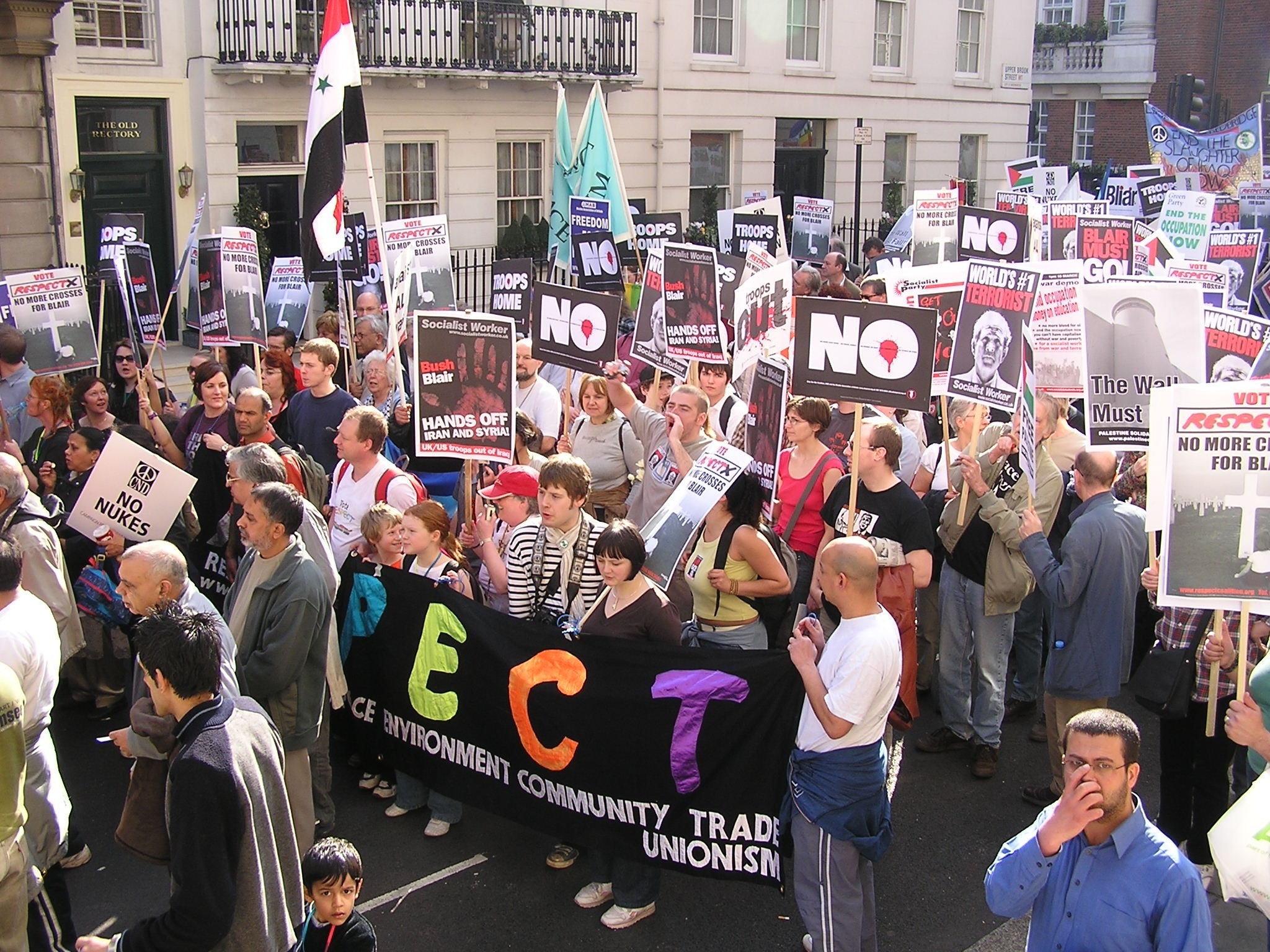
Anti-war demo London March 20th 2005. Image credit: JK the Unwise
“This issue is about chemical weapons, which is a bigger issue than Syria”
Here, perhaps inadvertently, Hague is entering into highly complex and potentially politically troublesome ethical and moral questions. According to US Secretary of State John Kerry, the recent chemical weapons attack in Damascus killed 1429 people, according to United Nations estimates over 100,000 people have been killed and over 2,000,000 Syrians have fled the country as refugees since the start of the civil war. Clearly, Hague is attempting to focus the political and public mood towards the specific response to chemical attacks rather than the notion of becoming further involved in the conflict. However, by making this statement he is stating, more or less unequivocally, that the issue of this single instance of chemical weapons is of greater international concern than the conflict as a whole, which even ignoring this recent attack has brought a country and it’s people to it’s knees with death and suffering on an unprecedented scale in recent years. Should not the focus be on how to bring this horrendous conflict to an end rather than a single event, after all the UN High Commissioner for Human Rights Navi Pillay has said that both sides appear to have committed war crimes on numerous occasions before now.
“your question of what next (after a military strike) – people also have to ask themselves if the world does not confront the use of chemical weapons, then what next?”
Once again, William Hague like many in the UK and other governments is unable to answer the all important question of ‘end game’. Perhaps the main reason for opposition globally to military action in Syria is the inability of leaders to give even a clue as to a coherent plan of action after the initial attacks, were they to take place. Supporters have dismissed this argument, claiming that governments can’t give away detailed military plans, for obvious reasons. However no one is asking for, or expecting, a detailed blow-by-blow military blueprint, merely the assurance and evidence that a long term plan after ‘military airstrikes’ exist. What is more, the US government in particular is seemingly very keen to share it’s detailed plans for exactly how and when and using what weaponry they would use in their strike, but apparently what would come later is too secretive to even whisper about.
“I can’t see how Syria can be governed, can be held together in the future with President Assad there”
Fair enough, right? However earlier in this very interview Hague admitted to the presence of extremists in the opposition and to the divided nature of their group. Undoubtedly there are ‘good people’, perhaps a vast majority in fact, in Syria who would do an infinitely better job of running the country than Assad; but what are the chances that it is these people and not the extremists, or terrorist linked rebels who take control if the President were to fall? Perhaps Hague should do some more risk calculations here and let us know his results.
“our Parliament has spoken… It is now, therefore, up to other parliaments and they are about to speak.”
The UK people have spoken through their elected representatives in a display of the best democratic process in the world today in action. What is left to be answered on the matter, and thus the questions that now fall to other countries and governments is why the UK government was unable to win this vote.
Marr attempted to push the Secretary of State on a number of other issues, including whether this decision in the Commons had weakened Britain’s position on the world stage. The Secretary of State’s response was naturally one of downplaying these concerns and pointing out the good work being done elsewhere in the world by Britain in humanitarian endeavours. Instead however, perhaps Hague should be vehemently extolling Britain’s world leading role on this very issue. While much of the rest of the world deliberates and stalls, Britain has taken a lead in taking a strong and uncompromising stance. It may not be what the government initially wanted, but it is now what it must accept. Democracy has given it’s democratic verdict, of this at least, we should be proud of.
For the full transcript of the interview click here.
About the Author





