
Last week, in a speech to the left wing think tank the Resolution Foundation, Rachel Reeves the UK MP for Leeds West, and Labour’s Shadow Chief Secretary to the Treasury; set out her parties ‘One Nation Labour’ approach for dealing with diminishing living standards.
The speech entitled ‘The labour Agenda for Tackling Low Pay’ was an informed advocacy of the ‘living wage’; a salary that is £1.26 above the national minimum wage nationally and £2.36 above the minimum wage in London. As the name suggests ‘the living wage’, is a salary that is considered by economists, charities and politicians to be enough to live upon, without experiencing economic hardship.
The Labour party’s intention is to encourage the adoption of this wage by companies up and down the country in exchange for the government sharing some of the tax credit savings which would result from such a move.
Unfortunately for Mrs Reeves she delivered her speech on the same day that the GMB trade union announced it would cut over a million pounds worth of the affiliation funds it gives the Labour Party. This combined with Syrian crisis and the G20 summit has unfortunately pushed this green shoot of party policy out of the minds of most contributors (even I’m writing on this a little bit late), but I do believe it is significant.
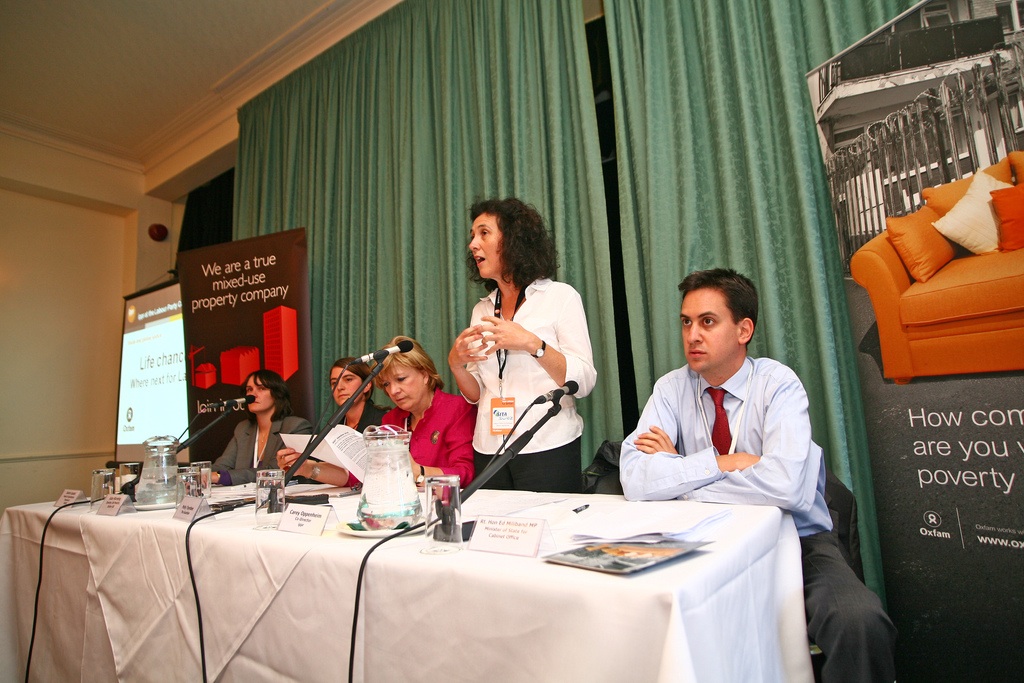
Labour Party conference panel discussing poverty in the UK. Image credit: net_efekt
The last UK general election was fought and won on the subject of the budget deficit. An economic catastrophe had savaged the nation and the labour party lost the argument over how to solve it. However the wake of the recession is now behind Britain, the UK economy is slowly growing and in light of this it is my belief that Labour will attempt to turn the debate surrounding the next general election to the subject of living standards.
In short they will ask the country ‘are you better off now than you were four years ago?’ Like a teacher before an enthusiastic class Labour will ask a question to which they already know the answer, in order to get their pupils talking. And if Ed Milliband can guide discussion towards his figures:
“There are 700,000 people in the UK working more than one job”
“Wages are down an average £1,500 since David Cameron became Prime Minister”
Then he might be able to generate consensus about the need for change. But the party must be more vocal for this message to truly come across.
Since Labour’s defeat to the conservatives in the 2010 General election there has been a great deal of soul searching going on within the party. While many within Labour no doubt enjoyed an era of success, during which the party won three consecutive general election victories (1997, 2001, 2005) the eventual defeat of New Labour to David Cameron’s Conservatives was a blow that was hard to shrug off. To some, Labour had become too ‘New’ and not enough ‘labour’. There was an argument within the party that the politics they had practiced had become more centre than left and was out of touch with the parties roots in the guarding of welfare and the representation of working people.
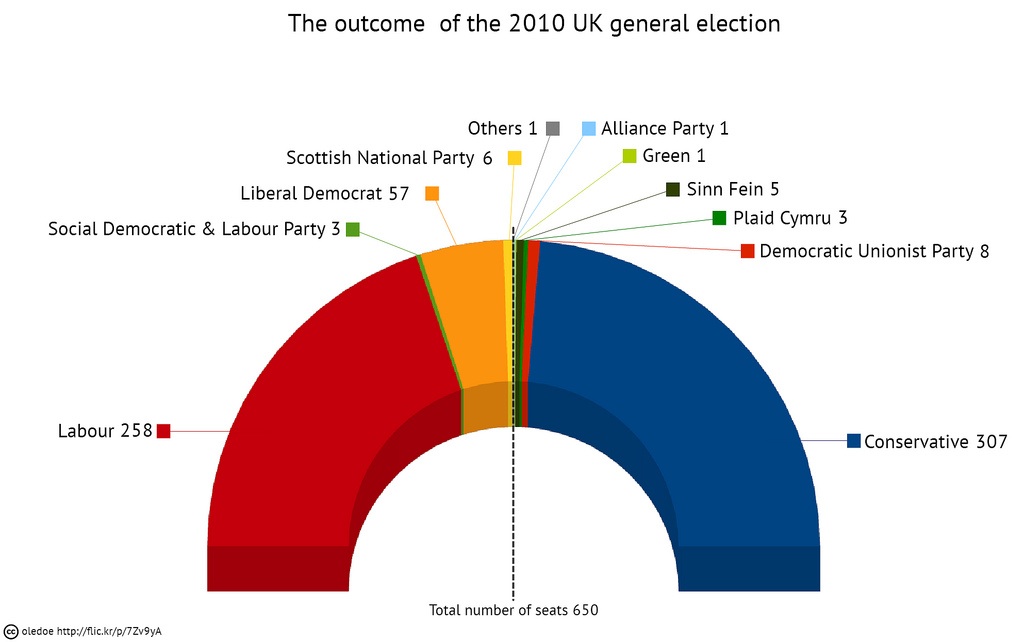
UK 2010 election results. Image credit: oledoe
Labour’s promotion of the living wage is a clear signal that the Party can once again stand up for the rights of working people to earn a decent living that is enough to support themselves and their families.
But I believe that this policy goes much further than that; A living wage will not just take thousands out of poverty, but it will give countless families and young people across this country a real stake in our society and its economy. Better pay for working people will reduce the need for the state to intervene with tax credits when a multinational reports profits on the backs of its impoverished employees. A living wage will be an engine for economic growth as those earnings circulate into local businesses, which will in turn generate more employment. A decent salary is a mechanism for increasing social mobility as workers that have disposable income have the opportunity to pursue an education, or to join the housing market, or to start a business, or buy shares. Finally it will narrow the gap between those that have and those that don’t, making our society a fairer place, a place which we can all be proud of.
All that at a cost of £1 and 26p? The 7th of May 2015 can’t come soon enough.
About the Author






I wouldn’t speak too soon on the benefits of a living wage. The maths shows there’s a good case to be made from reducing taxes instead http://tinyurl.com/pvh9gao