
A few weeks ago, in the scorching summer heat of New Delhi, my friends and I stood knee-deep in a garbage dump, diligently sorting through a big mound of waste. Stifling our gag reflexes and struggling to keep our lunches down, we were experiencing what millions of waste pickers around the globe go through every day.
“Wastepicker” is a term used commonly to refer to millions of individuals who salvage recyclable materials from waste streams and serve as a conduit for reducing the amount of waste sent to landfills. A routine day consists of collecting waste from a neighborhood and digging through all of it to separate paper, PET bottles, thick plastics, cardboard, metals etc. before selling each kind of material to a middleman who in turn sells these materials to recycling facilities. Many other wastepickers live near landfills and make a livelihood by scavenging in the landfill for valuable materials that other waste pickers in the city didn’t spot. They work in extremely hazardous conditions, handling waste with their bare hands and often paying with their lives for waste we carelessly throw away.
Related: From Littering to Spitting: Sanitary Problems in India’s Public Spaces
Earlier this year, my friends from the Global Education and Leadership Foundation and I started a project to change the way people think about waste. We wanted people to develop an appreciation for the contribution of millions of wastepickers to our environment and the economy, while understanding that waste is both an environmental issue and a social one. Above all, we hoped to make ordinary people a little more curious about the waste cycle in their city and enable them to contribute to it in small but powerful ways.
We decided to begin by working with school children who are still impressionable and more likely to change their behaviour. Our reasoning was simple, if people segregate their own waste, it would prevent valuable recyclables from getting contaminated by other wastes and will increase the amount of waste diverted from landfills. Moreover, wastepickers would not have to spend hours every day sorting through trash, thereby allowing them to collect more waste, more efficiently. Thus began our project, The Missing Link.
And so we found ourselves in a garbage dump – in order to determine how best to help wastepickers, we needed to understand them better. At the advice of our partners at Chintan, an environmental research and action group, we began by conducting a waste audit of the school’s garbage dump to understand what kind of waste is generated by the school on average. We found paper and plastics mixed with dal mixed with sanitary napkins, and it took five people more than 4 hours to separate a day’s worth of waste! While we wore gloves and closed shoes, most wastepickers do this with their bare hands for hours upon hours every day of their lives.
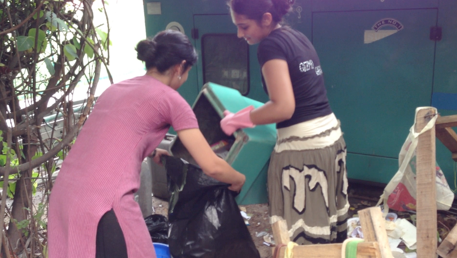
A waste audit in progress
When we repeated the waste audit with school students to sensitize them to the conditions of wastepickers, we were surprised by the results. The students saw waste in a whole new light, and conversations following the waste audit illustrated that the students had developed a deep understanding for why segregation was critical and more importantly, why wastepickers deserve credit, recognition and our help for their work. In the coming weeks, we will be reaching more students in the school by conducting workshops for each grade. Students will also have an opportunity to interact with a wastepickers and learn directly from their experiences. Moving forward, we hope to expand our work to schools across the city, country and the globe, collaborating with local wastepickers everywhere we go.
Related: Only Indians Can Clean India
Wondering what you can do to help? Please watch and share this video – every hit help us spread the word about the issue. You can also like our facebook page where we will be posting information for interested donors and potential collaborators.
In your own community, you can start by reaching out to your local waste collector and find out what you can do to help him/her. Get your friends together to conduct a waste audit on your waste, post your findings on our facebook page and share what you are doing in your home or community. Most importantly, segregate your waste and encourage others to do the same!
Ultimately it is our hope that people around the globe will learn to respect and work with wastepickers to save valuable resources, precious lives and our fragile environment.
Contact us at: themissinglink@tgelf.org
About the Author






I find your effort as much needed. As a documentary filmmaker i have made films about Delhi”s wastepickers. Watch my doc ” More Men In Black” at http://www.cultureunplugged.com/storyteller/Sudheer_Gupta and pass on the link. Would love to be part of your effort in some way.