
Last month the British Foreign Office lengthened its list of Arab states unsuitable for travel with the addition of Lebanon. Now Jordan appears more than ever to be a fragment of peace wedged between some of the most volatile states in the world. How has this constitutional monarchy remained peaceful as its neighbours clamour uncontrollably for democracy?
Firstly, it is important to recognise that Jordanians were not altogether docile when the infamous Arab Spring commenced in January 2011. Like much of the region, tales of economic woe were rife in the Kingdom as inflation climbed from 1.5 to 6.1% in December 2010, exceeding that of Somalia, and youth unemployment rose to 25%. These financial doldrums along with reports of corruption and eagerness for parliamentary reform led thousands to take to the streets in Amman 2 years ago.
However 2011 was not the end of Jordan’s Arab Spring; last November the hike in gas prices again pushed thousands around the country to protest.“Freedom, Freedom, Down with Abdullah!” was one of several slogans used by protesters in calls for King Abdullah II to abdicate; a somewhat unprecedented occurrence given the relative popularity of the Jordanian monarch. In late August demonstrations took place once again, this time over the proposed American involvement in Syria. Demonstrations have been frequent in downtown Amman ever since the Arab world’s revolutionary movement and they show no sign of stopping.

Scenes From Demonstrations Around the World Protesting Possible Strike on Syria. (AP)
Despite the repeated inconsequential outcries against the Government, one could not describe the climate in Jordan as a hotbed for tumultuous uprisings. There are reported to have been only two casualties in the two years of protests and numbers certainly do not constitute the mass resistance to authority we have witnessed in Egypt and Syria. Jordan’s biggest protest occurred in February 2011 and drew a crowd of 10,000. Compare this to the colossal 250,000 whorevolted in Cairo’s Tahrir Square the the last few months, then the Kingdom’s cause for concern seems negligible.
While support for King Abdullah II may not be unanimous, he is certainly viewed as a reasonably pragmatic leader by most. Hashem Abu Arqoub, a doctor from Amman tells me, ‘people respect the King because he acts swiftly and sensibly and he doesn’t use violence.’ This is undoubtedly a reference to the several ostensible efforts at constitutional reform he has made and the government’s reluctance to crack down combatatively on demonstrators.
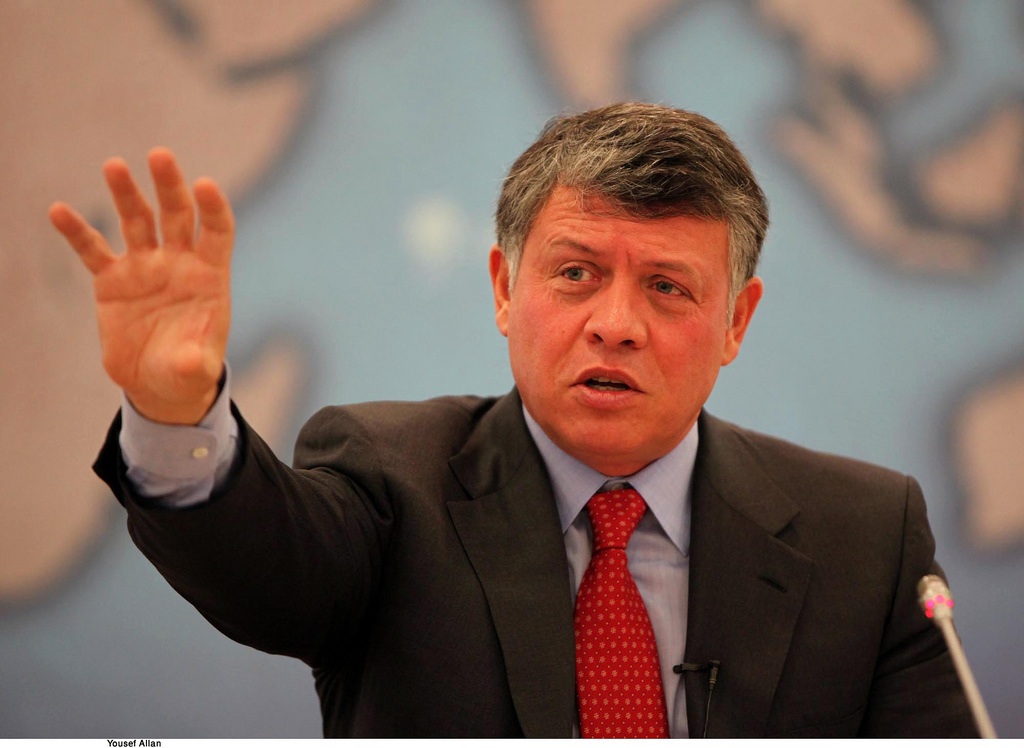
King Abdullah of Jordan. Image credit: Chatham House
In the past two years King Abdullah has sacked and re-appointed the country’s Prime Ministers three times in the wake of mass protests and demanded several cabinet reshuffles. More meaningful attempts at modernisation include the formation of an Independent Electoral Commission, a step expected to halt further corruption and the monarch’s promise last June that he would relinquish his right to choose Heads of Government. Along with King Abdullah’s recent, mainly superficial, reforms, people here are scared to suffer the cataclysmic bloodshed and brutality their neighbours are experiencing. The 550,000 Syrian refugees who have made the Hashemite Kingdom their home since civil war broke out are a constant reminder of the fate Jordanians do not want to endure.
When I ask if there’s other reasons the country has remained stable, Hashem replies succinctly ‘America and Israel’. Jordan became the second and only Arab country to normalise relations with Israel when it signed a Treaty of Peace with the state in 1994, removing any stipulation on US aid to The Hashemite Kingdom. This July the American Government pledged to increase its aid to Jordan to $1 billion, undoubtedly fearing more regional instability if Jordan’s economy continues to falter. Although the Jordanian public view the USA’s involvement in Iraq and proposed intervention in Syria in an overwhelmingly negative light, they know that their alliance with such a belligerent superpower has proved beneficial, if not essential, for the country.

President Barack Obama is seen having tea with King Abdullah of Jordan in a one-on-one meeting Tuesday, April 21, 2009, at the Oval Office Private Dining Room in the West Wing of the White House. Image credit: Pete Souza
Nonetheless peace in Jordan is not guaranteed. Refugee camps are prone to breeding tension as the water-poor and economically overwrought nation struggles to provide enough food and basic human resources for the copious amounts of displaced Syrians. Last winter heavy rain caused throngs of tents to collapse and flood in the Zaatari camp, now technically Jordan’s fourth largest city. Recent influxes will likely place even more strain on the country.
In addition any US military intervention in Syria and Jordan’s quiet acceptance of such an offensive may further inflame the King’s opposition. Islamic Action Front, Jordan’s branch of The Muslim Brotherhood has already spoken out against proposed Western interference in Syria and fears that a collapsed Syrian state, under command by rebel opposition could fuel jihadists across the border are not to be easily dismissed.
As the region descends further into dispute and disorder, Jordan teeters carefully on its wall of stability. Maintaining its friendship with the US, whilst attempting to distance itself from Syrian affairs is a fine balance to remonstrate. The economic squeeze, further strains on resources due to increasing refugee numbers and a potentially violent spill over from across the border may exacerbate the existing resentment felt over the monarchy. However, whilst Jordanians continue to witness the horrors endured by their neighbours, they are too wary to enact their very own revolution.
About the Author






A good piece of factual analysis
King Abdullah is a tyrant, Jordan is ripe for a revolution!
Lets hope we can get rid of this leech without too much bloodshed