
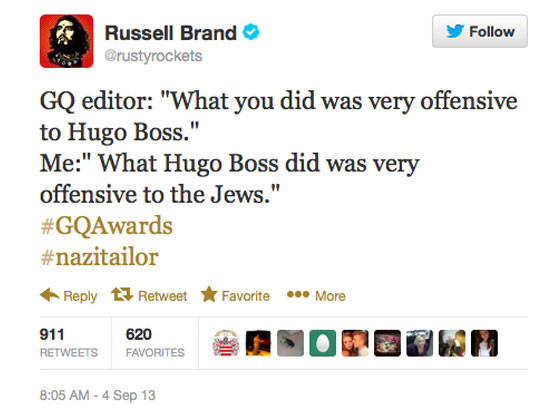
At the GQ magazine’s Men of the Year awards, Russell Brand made some comments about event sponsor, Hugo Boss, which resulted with him being thrown out of the after-show. The comments were to do with Hugo Boss’s past dealings in Nazi Germany. When the GQ Magazine editor Dylan Jones grilled him on what he had done, saying “What you did was very offensive to Hugo Boss” he replied “What Hugo Boss did was very offensive to the Jews”.
A little history on this: Hugo Boss set up a clothing company in 1924 in a small town in south Germany. After forced bankruptcy due to the diminishing German economy at the time, Boss retains only a very modest company and opened again, at the same time becoming a member of the National Socialist Party (or the Nazi party). Due to the rapid increase in the Nazi Party’s membership, Boss’s company starts to grow and from 1932 to 1941 his sales increase from 38,000 Riechsmark to 3,000,000 Riechmark. However, as has been implied by the media and other individuals, Hugo Boss did not design the clothing (specifically the shirt) for the Nazi party, but did manufacture and supply them. They also used prisoners of war and slave laborers from occupied countries in the later years of the war to help cope with the increase in transactions. Hugo Boss was tried and received judgment in 1946 accused of being an active supporter of the Nazi party, which stripped him of his capability to run a business, but after he died in 1948 his business endured.
They weren’t the only company to do business with the Nazis. IBM, Coco-Cola, Siemens, Staton Chase Bank, as well as many others, had dealings and worked with the Nazi party, some more intimately and directly than others. At the time the US were newly awakening as an open and capitalist country, and in terms of capitalist rule goes, companies can deal with anyone. But it does push onto very uncertain ethical problem, and not many of these firms will openly apologise or admit these trades, and comprehensibly so: it would be very bad for their business and integrity to be related to one of the single most hideous regimes of modern history.
But that’s the problem. As corporations they have to make decisions on whether to be ethical or whether to make the most amount of profit with “a sale is a sale” type attitude, and as much as America likes to think “corporations are people”, they aren’t: they are just money making organisations. And can we really judge them. Especially in the west, and specifically in the US, where capitalism is valued over most other things, isn’t open and free trading the most sacred concept of all? We would like to think it isn’t, but this has been the philosophy of our economies for decades.
Ironically, Russell Brand had made this speech after receiving the “Oracle” award, and I can only ask GQ Magazine’s judges. What did you really expect? You just awarded the guy on his truth speaking abilities. Russell Brand is a comedian you either love or you hate, in my case being the latter of the two. But whatever your personal opinions on him, he does bring light a common issue with several major corporations, albeit in a slightly brassy manner.
About the Author





