
The “Riots”
It has been more than three months since the Turkish protests that started as an environmental campaign to stop the Taksim Gezi Park in Istanbul from changing into anything other than a protected green area. It soon spun out of control with clashes between the public and the police erupting around Turkey.
There were many reasons for the protest, the main one being that Prime Minister Recep Tayyip Erdoğan had grown too authoritarian and the protesters were dubbed as anti-government, or anti-Erdoğan. They said he was an authoritarian, they called him a Muslim dictator and they accused him of getting in the way of progress. The police, in their usual heavy-handedness, passed out a strict treatment for vandals and protestors alike.
There is no denying that the police force needs reforming. Turkey used to be a police state, with the military devoted the biggest part of the government budget for years before Erdoğan’s rule, regardless of the fact that Turkey hasn’t been in any military conflict for decades. This has changed dramatically since 1998 but more still needs to be done. The police need to become better educated, especially in psychological, conflict resolution and social training in order to deal with different conflicts, social groups and areas appropriately. But it wasn’t the police that was being protesting against.

Protests at Gezi Park on 3rd June 2013. Image credit: VikiPicture
I am a Turk, but I am not a Muslim, I am actually secular. I speak Turkish; in fact it is my first language. I live in the UK and I go to Turkey every year, for months at a time. But get this too; I am a progressive in most aspects. I always try to follow Turkish news, and support most of the the Justice and Development Party’s (AKP) initiative’s and Prime Minister Erdoğan’s actions over the past decade. My position on the riots is very much one sided: yes, the police used excessive force at first on the peaceful protestor, and there should have been a more appropriate reaction from the government, both by the opposition and those in power, but after the first week of protests the aim of the protesters was opportunistic and vandalistic. In reality they obstructed other people’s daily democracy, vandalising private cars and properties, and violating the right to walk to work/home/school in full safety. I remember a disturbing report on ATV Turkish news of a lone, obviously pregnant women in a car having a panic attack as protestor tried to topple or get into her car.
They likened themselves to the protesters in Tahrir Square who were protesting against an abhorrent real dictatorship that lasted 30 years, compared Erdoğan to Hitler, and dubbed the protests as OccupyGezi, comparing them to OccupyWallSreet, the two with no distinguishable similarities whatsoever. They tried to convince the media and the world that they were calmly minding their business, picking up litter and reading to the police when brutally attacked. The western media were quick to brush the Turks with the same brush as the other Muslims states calling the protests “Arab Springs in Turkey” calling Erdoğan an “Islamist ruler” implying he is fundamentalist and oppressive. But tear gas and water cannons are surely not the same as bullets and bombs. They argued about the Freedom of Press in Turkey and 40 or so journalist jailed for alleged terrorist threat, but in the US and the UK a threat of terrorism is punishable by up to 5 years and by up to life in prison respectively. Isn’t this the same thing?
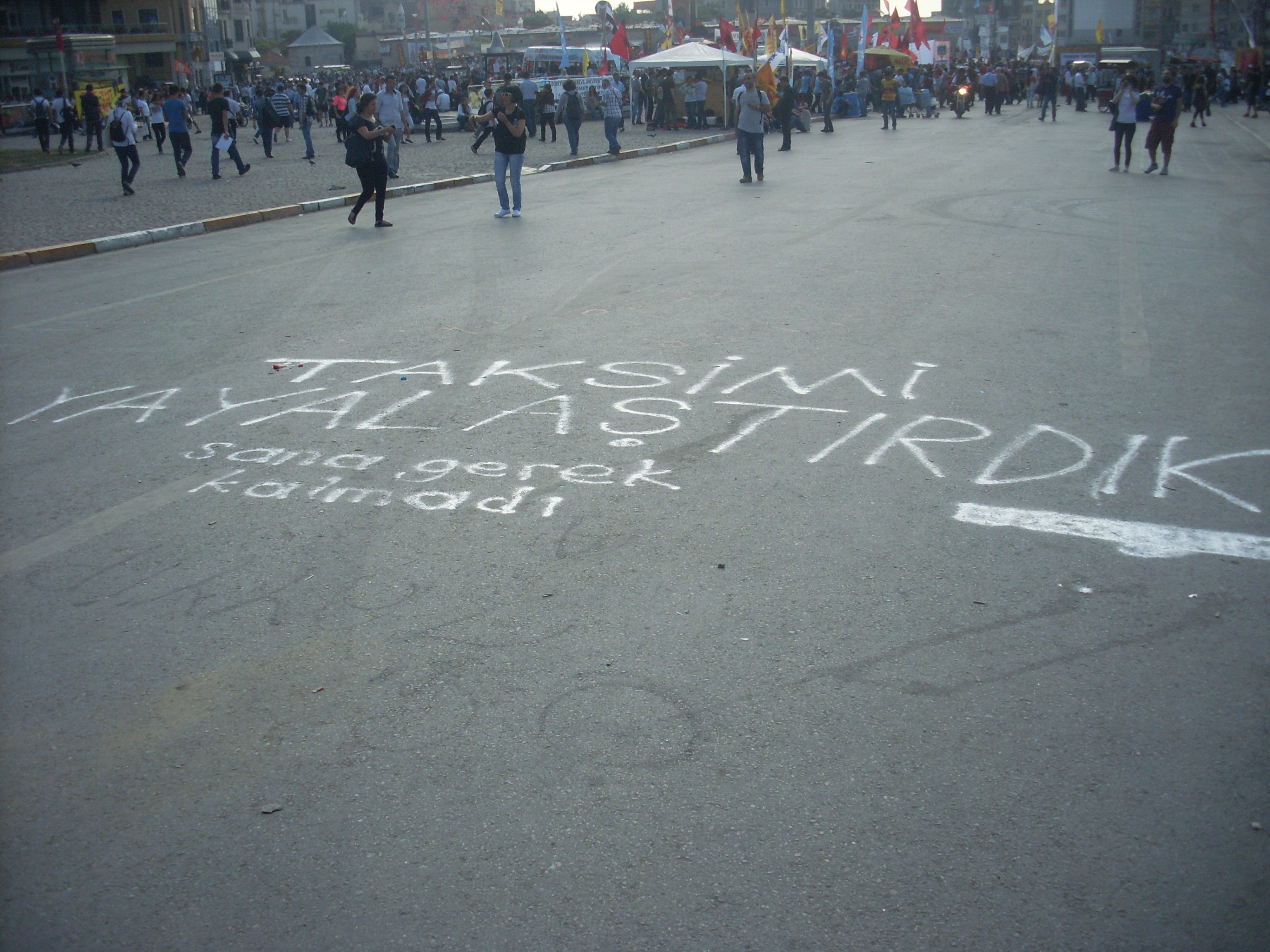
2013 Taksim Gezi Park protests, a slogan on Taksim Square, reading “Already pedestrianised”. Image credit: VikiPicture
The prime aim of the protests: The concept of overthrowing a democratically elected Prime Minister, or further threatening the Grand National Assembly to let protester in with Molotov cocktails, as it’s the protesters’ rights to be allowed to walk into the Grand National Assembly and suspend a democratically elected parliamentary chamber, all in the name of democracy is insane and absurd. Most importantly, the first protest was illegal.
I could go on about why I disagreed with the riots, but there is a deeper issue I wanted to address.
The nation of dissatisfaction
It’s popular to be against the government in power. Being supportive of the government is so unpopular that even if one does support them and voted and continues to vote for them one doesn’t admit this openly and instead denounces the very government they support. I would be heckled and called an Erdoğan-er if I voiced my views. That doesn’t mean that I don’t argue back, much like Socrates I ask question as to why they feel so strongly about a subject they know little about. In most cases there is silence to my enquiries, and in very few there is a legitimate argument.
Everything is relative, I say, and at the time, every bordering country was in a much worse a state than Turkey. The economy in neighboring Greece is still in insolvency, with public and private debt rising exponentially every year, with neighboring Syria a certified warzone with over 2 million civilians declared refugees, and neighboring Iraq still left in the ruins of a war that started over two decades ago.
During my visit to Turkey a few weeks ago my family and I were visiting a gardener’s family in the village we stay in near the town of Bodrum on the west coast of turkey, and out of nowhere the eldest boy of the family (about 13 or 14 years old) Apo (short for Abdullah) said, “I hate Erdoğan”. Expectedly the sudden confession of the young boy was met with laughter but I wanted to know why, “what did he ever do to you?” To that he clarified that he hadn’t received his IPad yet. Let me explain: at the beginning of this year an initiative was taken by the Turkish government with apple to supply 15 million schoolchildren with IPad tablets for their studies. The logistic side of it is predictably very difficult, and has been organised in a province-by-province format.
This kind of sentiment is common in Turkish children, it’s common in adults who have no knowledge of Turkey’s modern history or in politics, and it’s common in the workplace that have no business in politics. But it’s all very unnecessary and a hindrance to some significant improvements and initiatives, such as the IPad initiative. Social welfare has improved immensely under this government, with education and health receiving the most funded departments. Education has transformed completely with compulsory education rising to 12 years (compared to the 15 years of compulsory education in the UK by 2015) as opposed to the previous 8 years. Their new system is dubbed “4+4+4”, relating to the 4 year of primary that starts after the 6th birthday, then 4 years of middle, and finally 4 years of secondary school. Again on my trip to turkey I was in deep conversation with a teacher about this system she called a travesty, debating that compulsory education started too early and lasted too long for students to learn, but silenced as I mentioned the 2+6+5+2 education system that starts at the age of 3/4 in the UK. To my amusement I was later informed that she was an English language and culture teacher. Again someone voiced this sentiment of contempt for the government with no valid reason.
The most upsetting demonstration of this disdain was expressed in the most vulgar form by a chauvinist journalist who insulted the Turkish President and Prime Minister’s wives to get his incomprehensible point across. He called the two women who were shaking hands with guests at a reception on the 30th of August as “ağzı açık” (translated “open mouthed”) which is a term used for people who look dim-witted, described their burkas as “horse-blinders” and rounded it off by saying “Emine Erdoğan literally hobbles as she walks due of her obesity”. For a well-known established journalist of a popular newspaper to write such offensive and libelous statements is, well, just wrong on a fundamental level. He has insulted their choice of religion and freedom of expression, but I doubt he will be accused of being anti-democracy or anti-freedom-of-expression.
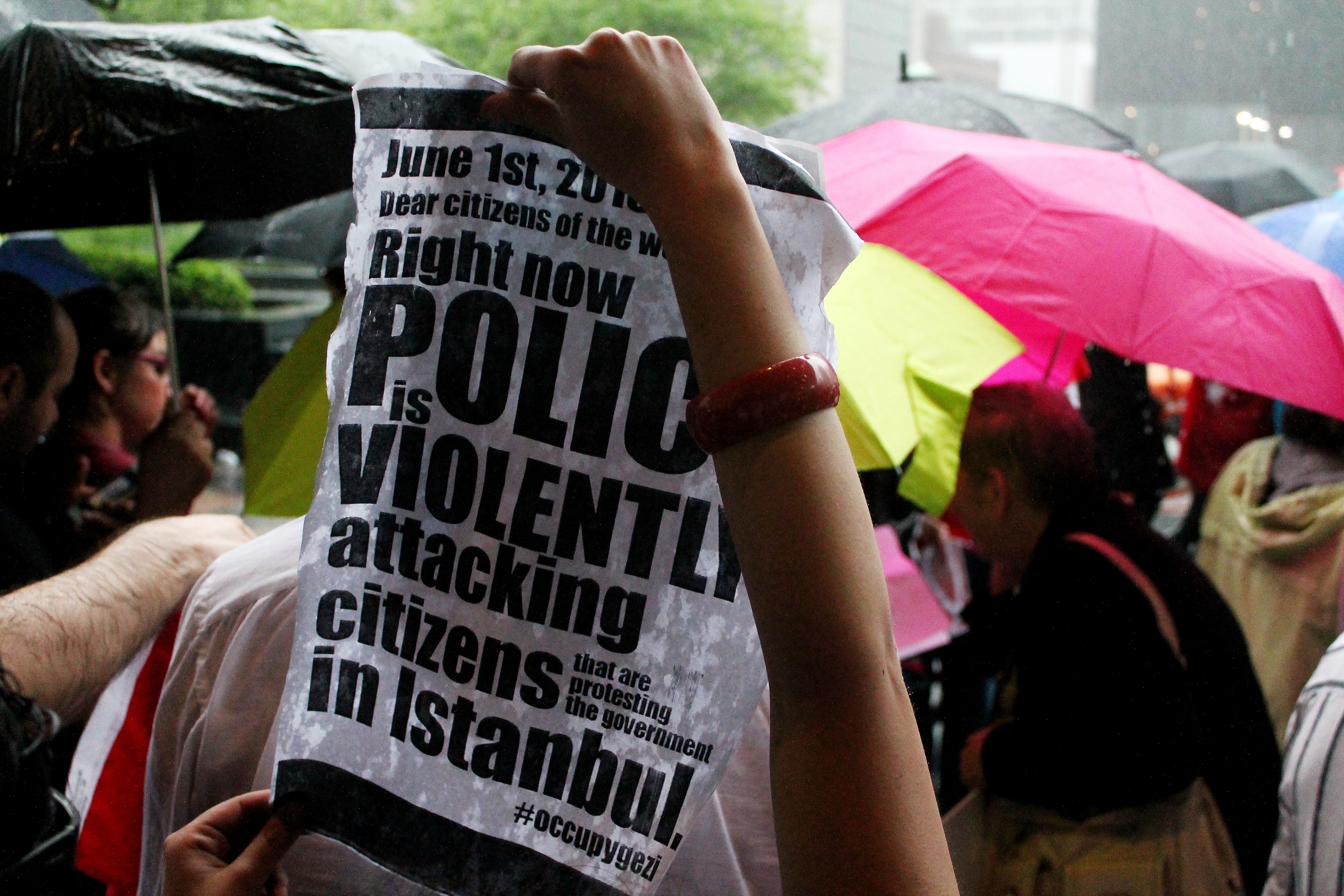
Taksim Gezi Park protests in Chicago, IL. Image credit: Mental Balance
My parent’s generation had much more to be resentful about, and the situation has improved dramatically under the current government. My mother often speaks of her university days when she had to roll up her jeans and take off her coat and her covered up friends had to were a wig to get into university as being overly conservative in dress-sense was banned, where girls in burkas were taken aside and interrogated about why they wore a burka, and “who made you wear it? Your family?”
But still this opposition toward the government remains strong, and it seems, to me at least, that no-matter what the government do the Turkish people will find fault in it. They complain about the 3-baby policy, with no understanding of the thought behind it. They argue about the lack of freedom, without noting the progress it has made under the AKP government. They criticize about the Imam Hatip (Muslim) schools, not comparing them to other religious school in the world, much like the Catholic schools in the UK. It was this government who fully introduced the welfare state, of having free and comprehensive healthcare and education. It was this government who completed all the IMF loan payments. It was this government who pulled Turkey out the sinkhole of inflation (34.9% to 6.1%, the lowest in 39 years). It was this government who started Turkey’s first high-speed train line, and hugely improved infrastructure. And it was this government who made the world recognise that a state could be both Muslim and moderate. Of course they have problems, as I stated before, the police force is in dire need of reforming, the big issue with youth unemployment (which was probably the main cause of the pent up frustrations seen during the protests), as well some key social liberties, namely LGBT and women rights, but this certainly does not mean we should oust Erdoğan.
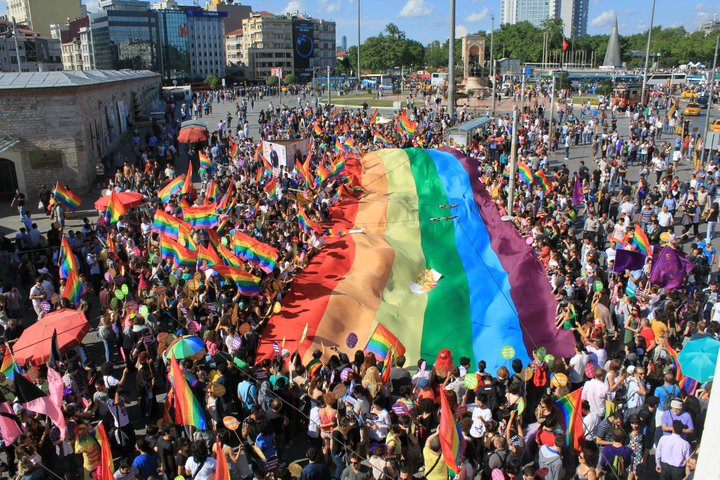
stanbul pride at Taksim square. Image credit: Jordy91
For the public of a country to be so involved with politics is quite strange to me, growing up in the UK, a country known for its ambivalence towards conventional politics, a disillusioned society. Stranger still is the one-sidedness of the discussion, and how blind to history the conversations are.
It’s almost a popular culture in Turkey to be against the government, it’s cool to disagree to most, if not all, of what the government does. But in the end, it will only obstruct Turkey’s miraculous development if the people do not embrace these changes, or at least use legitimate ways to lobby and pressure government through pressure group politics, interest groups, or think tanks much like in other democracies.
I doubt many politicians could have the constant dedication, determination and charisma Reccep Tayyip Erdoğan conducts himself with. None could balance a country between the secular west and Muslim east as well as he can.
About the Author





